
How I Quit My Day Job and Went Completely Freelance and Why this Decision has Changed My Life
by
W. Paul Alexander

What Is Freelancing?
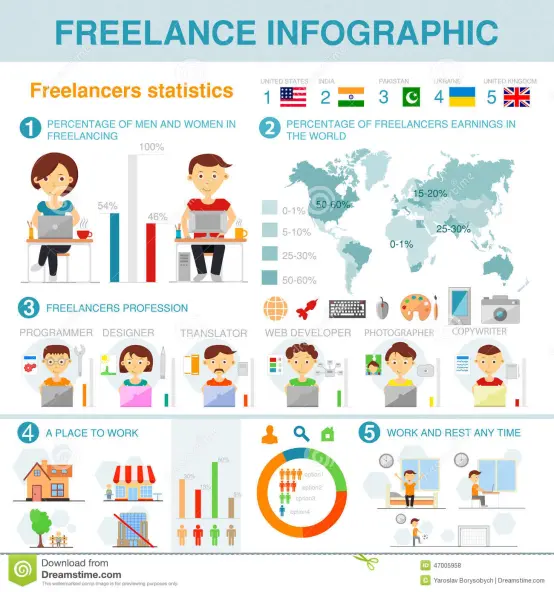
Freelancing is a method of working that has tons of benefits but also shoulders a large amount of risk.
Companies find themselves looking for individuals that they do not want to hire, as they only need assistance with a small number of very specialized tasks. To accomplish this, they hire one-time temporary workers either outright or through a freelancing platform like Upwork (which is what I use most often)
Freelancing from home is distinct from other work-from-home schemes, such as telecommuting, in which companies actually hire the "work-at-home" individuals for long-term employment. With telecommuting, the worker is an employee, whereas freelancers are independent contractors -- at least according to US laws.
Since the advent of platforms like Upwork, freelancing has become responsible for over 70% of the global workforce. This statistic is utterly amazing, and it demonstrates that freelancing will likely crush traditional employee-employer relationships within the next decade or so.
I have been freelancing since 2009. I started freelancing as a way to supplement my income. By 2013, I was able to quit my day job to focus on building my freelancing business, which has completely exploded both in real life and via online clients.
By training and trade, I am a paralegal -- a highly experienced and specialized paralegal -- as well as a professional ghostwriter and freelance journalist. My wife, who is my legal partner, is a notary public and is in school to obtain her criminal justice bachelor's degree so that we can open a private investigation firm where we will offer our services to insurance companies, attorneys, bail bonds agencies, and much more.
We are developing our Better Call Paul brand and will soon be creating a network of interested writers and researchers that we can introduce to the freelancing lifestyle.
It is important to note that these achievements were made parallel to the profits I have made since entering the Cryptoverse. Aside from my day-to-day freelancing, I also took on the position of US Marketing Adviser for the RUPEE Blockchain Project. During the ICO boom of 2017, our asset increased in value from less than .001 USD to .75 USD each. I had 1.1 million RUPEE at that time, as one of the founders of the project, and I made a small fortune from this. I have also been a long-term crypto enthusiast, and I have expanded the reach of the words I publish.
It is important for me to say this because I have developed my freelance income separately from my freelancing ventures. Thus, I want to make it clear to all of me readers that my freelance success had nothing to do with my blockchain activites, except for the fact that being in a home office all day frees up a good amount of time that I have spent on-chain.
How Has Freelancing Changed My Life?
In the below paragraphs, you will read a bit more on this, but just to give a quick rundown of how my choice to freelancing has changed my life, I present the following:
My wife and I are able to spend all day, every day with each other. This can be a good thing and a bad thing, depending on the dynamic of a person's marriage. Some marriages and relationships require that time apart each day.
This is not the case with my wife and I. We are best friends, lovers, spouses, partners, and business associates. Since we have both joined the freelancing world, we are able to work together, play together, and confer with each other on issues that are complex.
We have multiple business entities, but there are several ventures that we have that cross over into each other's work.
In January 2020, we decided to take a trip to Pensacola, Florida to visit my wife's best friend and godchildren. Normally, in the 9 to 5 world, it would have been necessary to put in a request, make sure you had saved up "Paid Time Off" hours, and get approval from a supervisor or management.
This had been my life as I worked in corporate America, first as a Medicare Claims Examiner and eventually a Surgical Assistant. I was on someone else's dime making money for them, like a good ol' capitalist in the American system. Ha!
So, what this means is that, as a freelancer, I can simply disconnect my laptop and take it with me, ensuring that I can operate the online portion of my freelancing venture while a form email to my local clients explained my absence without issue. During the vacation, I was able to make close to $3000 over the course of a week and a half because I was able to work from the road and got hired on a gig that was very lucrative.
This Could NEVER Happen With a 9-5 Corporate Career!
I had a major, life-changing event in 2010, and by the end of the trials and tribulations I had to endure, I was introduced to freelancing as a viable alternative to use the skill set I had acquired over the years.
Eventually, through hard work over the course of about 8 months, I started making constant income that far exceeded what I made working in the medical field. It was during this time that I dusted off my paralegal credentials and began building a legal services operation to join the ghostwriting and consulting I was already doing for my clients from Upwork.
It was an all-out success. So many businesses, firms, and agencies need both the help of a writer as well as a paralegal.
However, this is not to say that you will automatically be a success the second you join the world of freelance work.
It’s important to note that there are also characteristics inherent to freelancing and telecommuting in general that can be difficult to overcome, and are the main reasons why people do not stick to it. This would not be a fair and balanced article if I did not at least skim through these topics, so without further ado…
-
It takes discipline. The main reason that people fail as freelancers or telecommuters (work-from-home) is because of the discipline required. It can be tempting to watch the TV, get a sandwich or drink from the fridge, or browse the internet while you are supposed to be getting work done; and many times, people look at this hurdle as simply too difficult to overcome and give up on the industry. There are 1500-plus-word articles dedicated solely to overcoming such obstacles with great tips for doing just that. I will not sugarcoat this – distraction can be a huge, huge problem. However, besides reading up on articles like the one linked above, my advice on the topic is simply to stick with it. Eventually, you will find your groove and learn to understand when you can afford to take a quick look at your personal sites and when you simply cannot. If you simply cannot make it without seeing your social media – buy a used laptop and set it up next to your main workstation. Use it to log in to all of your personal pages and set it off to the side at a right angle. Some people may think that this is bad advice, but the fact of the matter is that some people simply do not have the discipline to cut the likes and retweets out of their daily life, so pragmatic solutions like this can be just the thing to keep you going during those first aggravating months. Eventually, you will find that you focus less and less on the laptop and more and more on your professional workstation.
-
Freelancing simply is not for everyone. The plain and simple fact remains that freelancing is not for everyone. There are those of us who simply cannot work a productive job without having constant supervision. This is not a character flaw, it just means that these people work differently. Some people may be able to train themselves to work without supervision, but there will always remain those who cannot. There are also people who simply cannot work from behind a screen and prefer manual labor or jobs that require travel and face-to-face interaction. These people have some choices within the freelance market, such as freelance journalism that requires investigative techniques to write their work. There is definitely room within the freelance economy for these people, but they may find that working for a traditional employer better meets their desire for a career choice. Before you decide to freelance because your neighbor is making beaucoup bucks writing for Men’s Health as a freelance contributor, consider your desires when it comes to your career goals and determine whether or not your goals line up with freelancing. If you think that you may be a fit but you have some reservations, fear not, there is a solution for you (and for all freelancers just starting out, actually). Before you commit to freelancing full-time, get an account with a freelancing platform and find a couple of small gigs that are open to everyone. Work these single-serve gigs over the course of a single week during your time off from your current job. If you find that you like it, slowly build your income foundation with small hourly or fixed-price gigs that want a little bit of work from you per week on a long-term basis. As you continue to pick up gigs, you will eventually get to the point where you have to decide whether to freelance to supplement your regular job or if it is time to replace the 9-5 with the freelance society. This process may reveal to you that you may be a good fit but not full-time, and in the process, you may have found yourself some nice supplemental income. Either way, you will soon get a feel for whether or not freelancing is for you.
-
Taxes, insurance, and records are your responsibility. This is one of the biggest concerns for newcomers to freelancing, but in all honesty, I have found it to be liberating instead of a burden. Being that I have prepared taxes back-and-forth over the course of my career as a paralegal, I find that dealing with your own taxes is not as daunting as many make it out to be. As an independent contractor, you are supposed to pay your taxes quarterly. However, in my case, I usually see a pretty large refund every year, so I simply wait until the end of the year and have my self-employment taxes deducted from my yearly refund. For instance, I did this last year – had a refund due to me of close to $6500 but owed around $1600 in self-employment taxes, so I simply allowed this to reduce my refund to $4900. This should not be construed as tax advice, because I do not know your personal tax situation, but if you usually have a tax liability (meaning you owe every year), filing quarterly is probably better for you, so that you will not be hit with the extra $1500-3000 in self-employment taxes on top of what you normally would owe.
The lack of having access to health insurance is one of the main reasons people give for not wanting to freelance. This has been a valid concern in times past, but today's robust healthcare market combined with the changes that were enacted through Trump means that this is no longer the case. Health insurance for you and your entire family can be purchased through the US Government's Health Insurance Marketplace (Click Here) or through a freelance-friendly health plan. As a matter of fact, the Freelancers’ Union can help direct you to health insurance companies with special rates for freelancers as well as dental insurers who do the same. The founder of Freelancer's Union saw an opportunity here and opened up her own health insurance entity to serve freelancers. As freelancing overtakes traditional employment in the labor force, more and more options will become available.
This issue of record-keeping can also be a problem. As a freelancer, you are responsible for keeping track of your income and expenses in order to file an accurate tax return. In the United States, you can pay your freelancing taxes either quarterly or annually with your 1040 at the beginning of each year. As a freelancer, you are your own business. You need to save receipts from paper, ink, pens, notebooks, tech, PC upgrades, equipment, etc. You also have to keep track of all of your income.
Now, this can be easily solved by utilizing an app that keeps records for you. For time-keeping, I use Clockify as a Chrome Extension. It is fabulous and can be found on the Chrome Web Store by searching "Clockify." I do this for all of my clients.
Upwork and other freelancing platforms give you the ability to run reports based on specific criteria. They also provide you with a statement of earnings so you can understand what you are making and provide a record of your earnings for any purpose you may need it for. The ability to run these reports means that the records you are required to personally keep are, for the most part, no longer needed and antiquated.
Conclusion/Final Thoughts

The decision to jump into freelancing is not something that should be made overnight. Six years ago, as I started to write my first $2.00 article, I thought that there was no way I would be able to completely replace my W-2 income with a freelance career. Now, as a Top Rated freelancer with a vast sea of networked professionals, there is nothing I would rather do. I can work while I travel, when I cannot sleep at night, while on a vacation to Hawaii, or while doing anything that life throws my way. I can write an article while waiting for a doctor’s appointment or bill a client from the grocery store. The flexibility and the ability to work across multiple fields to make full use of the wide variety of tools in my skill set make freelancing my preferred method of getting work done, and I cannot see that changing at any time in the foreseeable future. However, those considering a career in freelancing should be aware that success is not an overnight accomplishment and that there is hard work that must be put in to become a highly sought-after freelance agent. Discipline is a must and the dedication to succeed without supervision and a direct set of instructions will either make you or break you. However, the rewards that can be reaped are just now starting to come into focus for those who get in at the forefront. Taking all of this into consideration, I suggest that anyone looking to change their career path into something where you can set your own hours and basically write your own paychecks consider taking a look at what freelancing has to offer.
Source Material:
1. The Conversation. (August 15, 2017). Is Freelancing the Future of Employment? Retrieved from https://theconversation.com/is-freelancing-the-future-of-employment-80253
2. Smooth Business Growth. (July 31, 2017). Overcoming Distractions for the Work-at-Home Professional. Retrieved from https://www.smoothbusinessgrowth.com/overcoming-distractions/
3. The Health Insurance Marketplace. Government Agency. Provider link: https://www.healthcare.gov.
4. Upwork.com. Professional Platform. Product link: https://www.upwork.com.
5. Christian, A. (April 8, 2014). Don’t Get Mad, Get Paid. The Freelancers’ Union Blog. Retrieved from https://blog.freelancersunion.org/2014/04/08/dont-get-mad-get-paid-6-invoice-apps-freelancers/






