
In today's edition, we will address the concept of “contrary investor”, elaborated in the book The Most Important Thing, by Howard Marks.

To be a contrarian investor is, essentially, to be independent and to use superior thinking to make good decisions that differ from most people. The logic that underlies this ability to be contrary is described as follows:
“The market oscillates between highs and lows, and the movements are a result of the actions established by the herd. The bull market, for example, occurs due to greater pressure from buyers against sellers, until it reaches the extreme. ”
The edge in a bull market is characterized by the moment when there is only one buyer left. When this zeroes, the market will no longer be able to continue upward, as all buyers have already joined the crowd at the peak of appreciation. In this way, the inflection point emerges, in which there is a turn in the trend, starting the bear market. That is, at the extreme points of the cycle - formed by the opinion in which the consensus believes -, most are wrong.
Therefore, the secret to successful investment is to go against the herd. Those who recognize the mistakes made by common sense can generate great profits by being contrarians. (Remember my last article?)
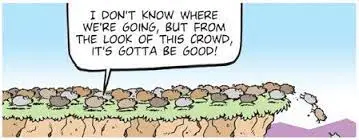
In other words, the contrarian is always aware of the cycles and their ends. While bull markets are driven by greed and are very dangerous at best, bear markets are dishes full of bargains to be exploited by opposing investors.
As Warren Buffett says:
"Be fearful when everyone is greedy and greedy when everyone is afraid".
This is a simple skill to understand, but complex in its application. Therefore, it is always worth remembering to internalize it in our minds. Thus, we will be better prepared psychologically to act in situations of panic.
To apply it more efficiently, we need to understand the causes of the difficulty of being a contrary investor.
After buying a share, even if the investor is certain that the acquisition was made at a discounted price, it does not mean that the share will appreciate the next day. In fact, it is possible that it will remain stationary (or even devalue even more) for years. (BTC in the past couple years!)

Thus, it can be quite painful to carry on such a position that most do not believe. After all, it is uncomfortable to monitor the decline in invested equity in circumstances in which the investor is lonely. In periods like this, it is important to remember Benjamin Graham's lesson about maintaining a sense of ownership, that is, not seeing investment as a simple financial application.
If you see the stock only as a role, the investor will be inclined to sell it in the fall. On the other hand, if he feels like a partner, he will be willing to pay every day for the discounted price available on the screen. Furthermore, it is not enough to be opposed by itself: rational and analytical research is necessary to understand why the consensus is wrong. It is not because no one is jumping off the cliff that you should jump!
Ultimately, being an opposing investor is one of the essential skills to become a value investor. The notion of intrinsic value, therefore, is of paramount importance for the investor to be able to stick to an uncomfortable position. When we acquire shares when everyone sells them at a price below the intrinsic value - and when the thesis proves to be correct in the long run - we are moving towards great returns at low risks.






