
Bitcoin, introduced in 2009 by the pseudo Satoshi Nakamoto, is the first decentralized cryptocurrency. It operates on a blockchain, a linear chain of blocks where each block contains a list of transactions. Bitcoin's design emphasizes security and decentralization, with a fixed supply cap of 21 million coins, making it a deflationary asset. However, its scalability is limited by a block interval of approximately 10 minutes, which can lead to slower transaction processing during periods of high demand.

Kaspa: Innovating with BlockDAG Technology
Kaspa, introduced in 2021, employs a novel approach by implementing a blockDAG (Directed Acyclic Graph) structure through the GHOSTDAG protocol. Unlike traditional blockchains, Kaspa allows multiple blocks to be created in parallel, which are then ordered in consensus, enabling high throughputt and rapid transaction confirmations. This design aims to address the scalability trilemma by offering high block rates, fast confirmations, and mining decentralization.
Key Differences
-
Consensus Mechanism: Both Bitcoin and Kaspa use PoW, but Kaspa's GHOSTDAG protocol allows for parallell block creation, enhancing scalability.
-
Transaction Speed: Kaspa's architecture enables faster transaction confirmations compared to Bitcoin's 10-minute block interval.
-
Scalability: Kaspa's blockDAG structure supports higher transaction throughput, whereas Bitcoin's scalability is constrained by its linear blockchain design.

Market Performance and Adoption
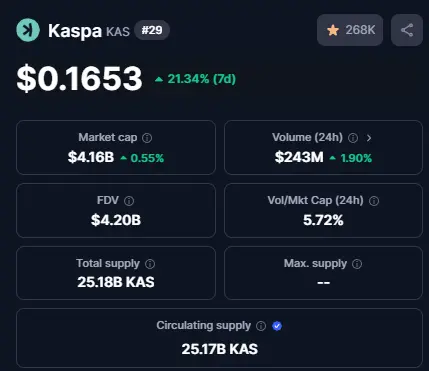
Bitcoin has established itself as a store of value, often referred to as "digital gold" and is widely recognized and adopted globally. Its market capitalization and liquidity are significantly higher than those of many other cryptocurrencies. Kaspa, being a newer entrant, is still gaining regulatory approval and market traction. However, its impressive technology has garnered enthusiasm among the cryptocurrency community. Many Bitcoins supporters are taking interest in Kaspa as an innovative option that may help drive mainstream crypto adoption.
Energy Efficiency
Both Bitcoin and Kaspa utilize PoW, which is often criticized for its high energy consumption. Kaspa's design aims to be more energy-efficient compared to Bitcoin's traditional PoW. The environmental impact of mining is a crucial consideration for eco-conscious investors.
Tokens on the Kaspa Network: Spotlight on Dagknight Dog
The Kaspa network has seen the emergence of various tokens, with Dagknight Dog (DOGK) being a notable example. Dagknight Dog is a meme token on the KRC20 protocol on Kaspa. Join our hero "DOGK" as he navigates his way through the BlockDAG world, protecting and guarding the Kaspa network.

Dagknight Dog will be at the forefront, helping onboard users to the revolutionary technology, and visionary founders of the world's first BlockDAG, Kaspa!
The tokenomics of Dagknight Dog include a total supply of 4,460,000,000 DOGK tokens. The token is listed on various exchanges, including AscendEX, where users can trade DOGK/USDT pairs.
Conclusion
While Bitcoin remains the most recognized cryptocurrency, Kaspa introduces innovative technology aimed at overcoming scalability challenges. I don't want to influence. I like new tech and I understand the legacy and i support it, but I think Kaspa is the future. But these are my own opinions. Always DYOR!
*These are my thoughts and opinions. It is not a investment advice*
Other very useful off-topic links where you can earn crypto via faucet or gambling:
Free Bitcoin from FreeBitco: https://freebitco.in/?r=41241890
Free bitcoin Cointiply: http://cointiply.com/r/ayxNO
Faucet crypto: https://faucetcrypto.com/ref/1977276
Free BCH and BCH games: https://bch.games/play/M3BJLz58
PI is a new digital currency developed by Stanford PhDs, To claim your Pi, follow this link https://minepi.com/azertyswe and use my username (azertyswe) as your invitation code
If you want to be a good samaritan then send to this BSC and ETH address: 0x849bCA745E9F8e0c7dd58d553d05d4c5AD280e46






