
Japan is taking a significant step toward embracing cryptocurrency and blockchain technology by easing its crypto regulations, aiming to fuel growth in blockchain-based industries, particularly gaming. The country’s Financial Services Agency (FSA) recently announced plans to revise its regulatory framework, focusing on making it easier for businesses to manage digital assets and in-game cryptocurrencies. This move could position Japan as a leading hub for blockchain gaming in Asia.
Historically, Japan has maintained a cautious stance on cryptocurrencies and digital assets, influenced by events such as the collapse of Tokyo-based Mt. Gox in 2014, one of the largest Bitcoin trading platforms at the time. Strict regulations were implemented to protect investors and prevent similar incidents. However, the landscape is shifting as blockchain gaming and Web3 technologies gain momentum globally.
Japan’s new approach, led by the Financial System Council, a key policy-making body, aims to reduce regulatory friction, enabling businesses to more easily manage digital currency assets. This reform targets a key pain point for many companies involved in blockchain gaming: the complex and restrictive legal framework surrounding the use and management of in-game cryptocurrencies.
The revised regulations are part of a broader initiative to foster innovation within Japan’s tech and gaming sectors. By streamlining processes and lowering regulatory hurdles, the FSA hopes to create a more crypto-friendly environment, attracting both startups and established companies to explore blockchain-integrated business models.
At the heart of this regulatory shift is the revision of Japan’s Payment Services Act, which governs the handling of digital currencies. The proposed changes focus on simplifying the management of in-game cryptocurrencies, making it easier for companies to handle transactions, issue digital tokens, and allow in-game purchases using crypto assets.
The reforms also explore broader asset management rules, aiming to provide companies with more flexibility when handling digital currencies. This could reduce financial barriers for businesses and consumers alike, fostering a more seamless integration of crypto assets into games. As a result, businesses in the gaming sector could find it easier to issue and manage in-game items, tokens, or currencies that players can trade or purchase.
Blockchain Gaming: A Growing Market
Japan’s interest in blockchain gaming comes as the sector continues to expand worldwide. Blockchain games, which allow players to earn, trade, and use digital assets across platforms, have emerged as a popular niche within the gaming industry. These games are built on decentralized networks, offering players greater ownership and control over their in-game items.
The regulatory shift aligns with the growing interest in Web3 technologies, which emphasize decentralized platforms and digital asset ownership. With the rise of non-fungible tokens (NFTs) and decentralized finance (DeFi), blockchain gaming has become an exciting frontier for developers, gamers, and investors. Japan’s move to ease crypto regulations could give the country an edge in this emerging market.
Several major Japanese companies are already exploring the potential of blockchain technology. Sony, a global leader in entertainment, recently unveiled its digital ledger platform, Soneium, which it envisions integrating with gaming, music, and film. The platform could enable new forms of digital asset management and trade, providing a glimpse into how entertainment and blockchain might intersect in the future.
Other Japanese firms, including Nippon Telegraph & Telephone (NTT), Toyota, and Mitsubishi UFJ Financial Group, are also exploring blockchain-related initiatives. Mitsubishi UFJ, Japan’s largest bank, is considering issuing stablecoins — cryptocurrencies tied to a stable asset like fiat currency — signaling a broader shift toward embracing digital finance.
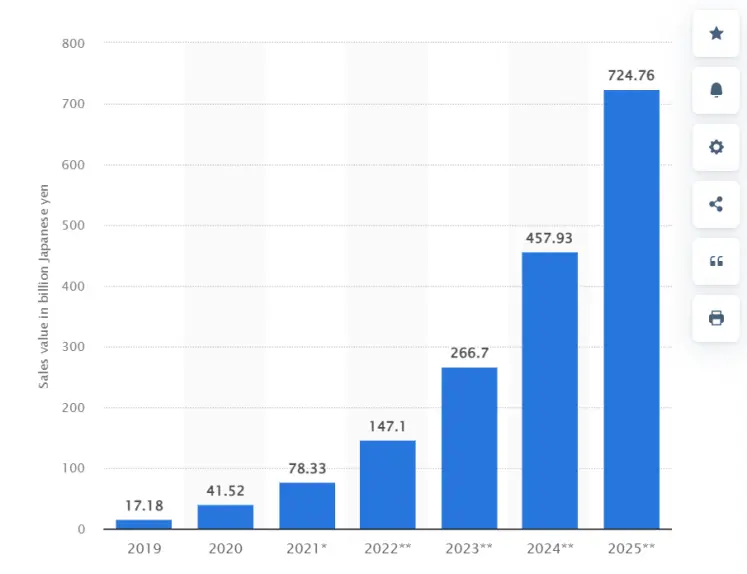
Sales value of blockchain-utilized services in Japan from fiscal year 2019 to 2021 with a forecast until 2025, according to Statista 2024.
Still High Country Tax on Crypto
While Japan’s regulatory landscape is becoming more favorable for crypto and blockchain innovation, challenges remain. The country’s tax policies, for example, still impose a significant burden on crypto investors, with gains from digital assets taxed at rates as high as 55%, compared to 20% for traditional investments. This discrepancy could hinder broader adoption unless addressed in future reforms.
The FSA is making it easier for businesses to handle digital currencies, the country’s focus on investor protection remains strong. Tight regulations designed to prevent fraud and hacking will continue to be enforced, as demonstrated by recent incidents like the $320 million breach at Japanese crypto exchange DMM Bitcoin.
Japan’s decision to ease crypto regulations signals a broader shift in how the country views blockchain and its potential for innovation. By creating a more accommodating environment for digital assets, Japan is positioning itself to become a key player in the global blockchain gaming and Web3 ecosystem.
With major corporations like Sony, Toyota, and Mitsubishi UFJ exploring blockchain initiatives, and startups poised to capitalize on new opportunities, the stage is set for significant growth. As the FSA continues to reform its regulatory framework, Japan may emerge as a leader in the next wave of digital innovation, attracting talent, investment, and new business models centered around cryptocurrencies and blockchain technology.






