
The Pinwheel Galaxy (Messier 101 & NGC 5457) is a spiral galaxy and it is about 24 to 27 million light years away from us. Seen from Earth, it is located in the constellation Ursa Major / Big Dipper / Big Bear and forms a triangle with the stars Alkaid and Mizar, which makes it easy to find it in the night sky.
The Pinwheel Galaxy has an estimated diameter of about 170,000 light years and contains about one trillion stars, which are more than twice as much stars as there are expected to be in our galaxy, the Milky Way.
The Pinwheel Galaxy at a focal length of 420mm.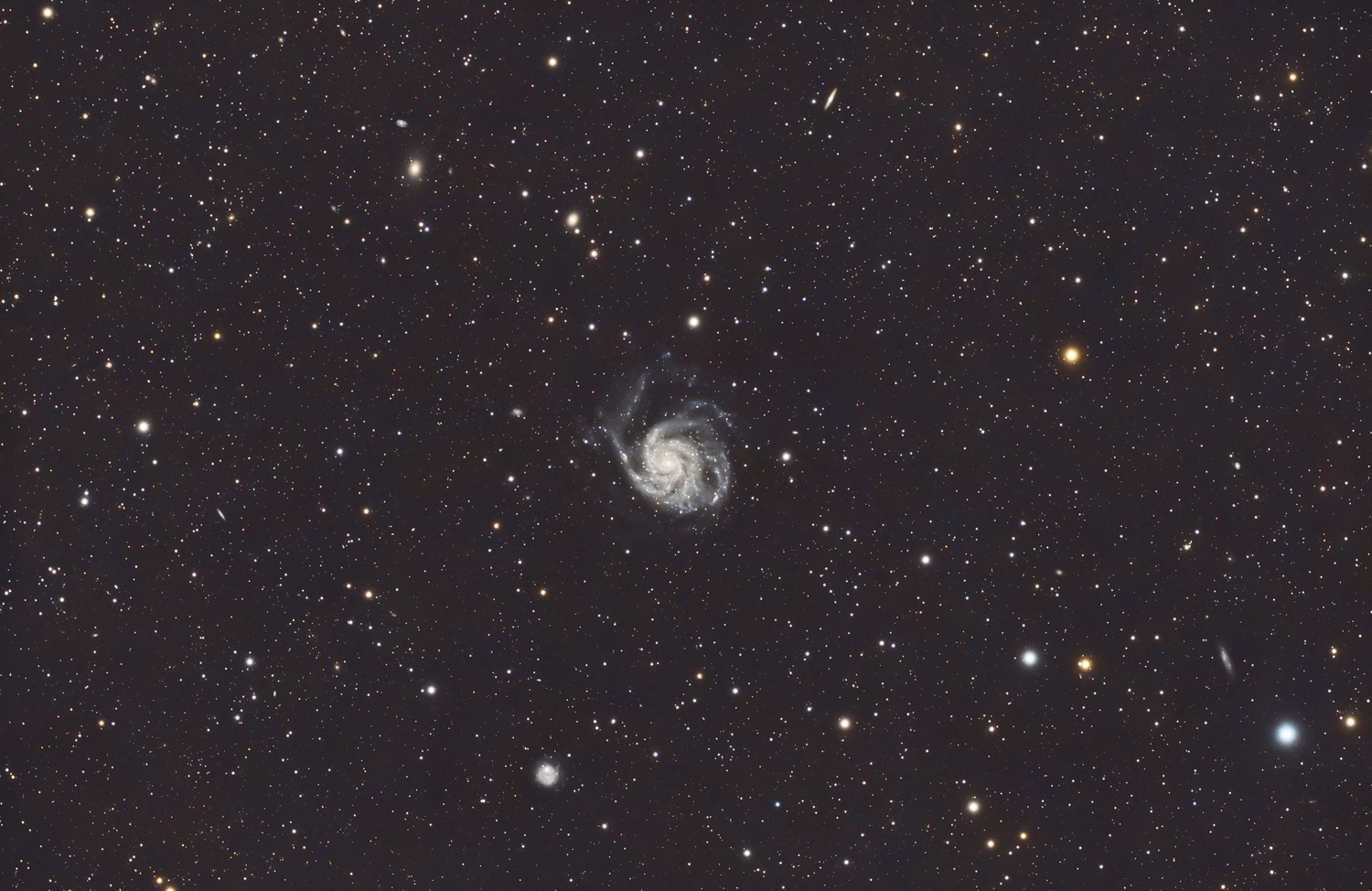
Click on the picture for a larger view ▲
In its spiral arms, there are many star-forming regions, to be seen at the brighter spots in the image. Unfortunately, I don’t have the focal length to make this more visible. On the picture taken by the Hubble Space Telescope, you can see them very well.
In these star formation regions are many very hot stars, like, for example, the Orion Nebula in our galaxy. The older stars in the star formation regions have already “blown away” the hydrogen and dust clouds from which they were formed with their solar winds, and have developed into star clusters over the time. Astronomers have identified over 3000 such Star Clusters in the Pinwheel Galaxy. Also in our galaxy, such processes are taking place, good to see at the Orion Nebula, the Pleiades, and the Star Clusters.
This image was taken by the Hubble Space Telescope. The star formation regions mentioned above are the brighter areas in this picture.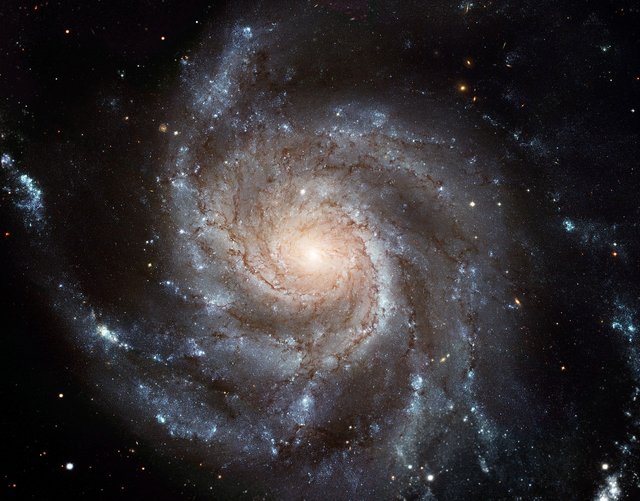
Copyright: European Space Agency & NASA, Attribution 3.0 Unported (CC BY 3.0)
Position in the night sky
Viewed from Earth, the Pinwheel Galaxy has an extension of 22 arc minutes, which corresponds to about 0.367 degrees. Its apparent size is, therefore, smaller than that of the moon which has an average of about 0.5 degrees. Due to its not very small size, it can also be photographed with regular telephoto lenses.
Position of the Pinwheel Galaxy in the night sky. Screenshot of SkySafari Plus app for iOS.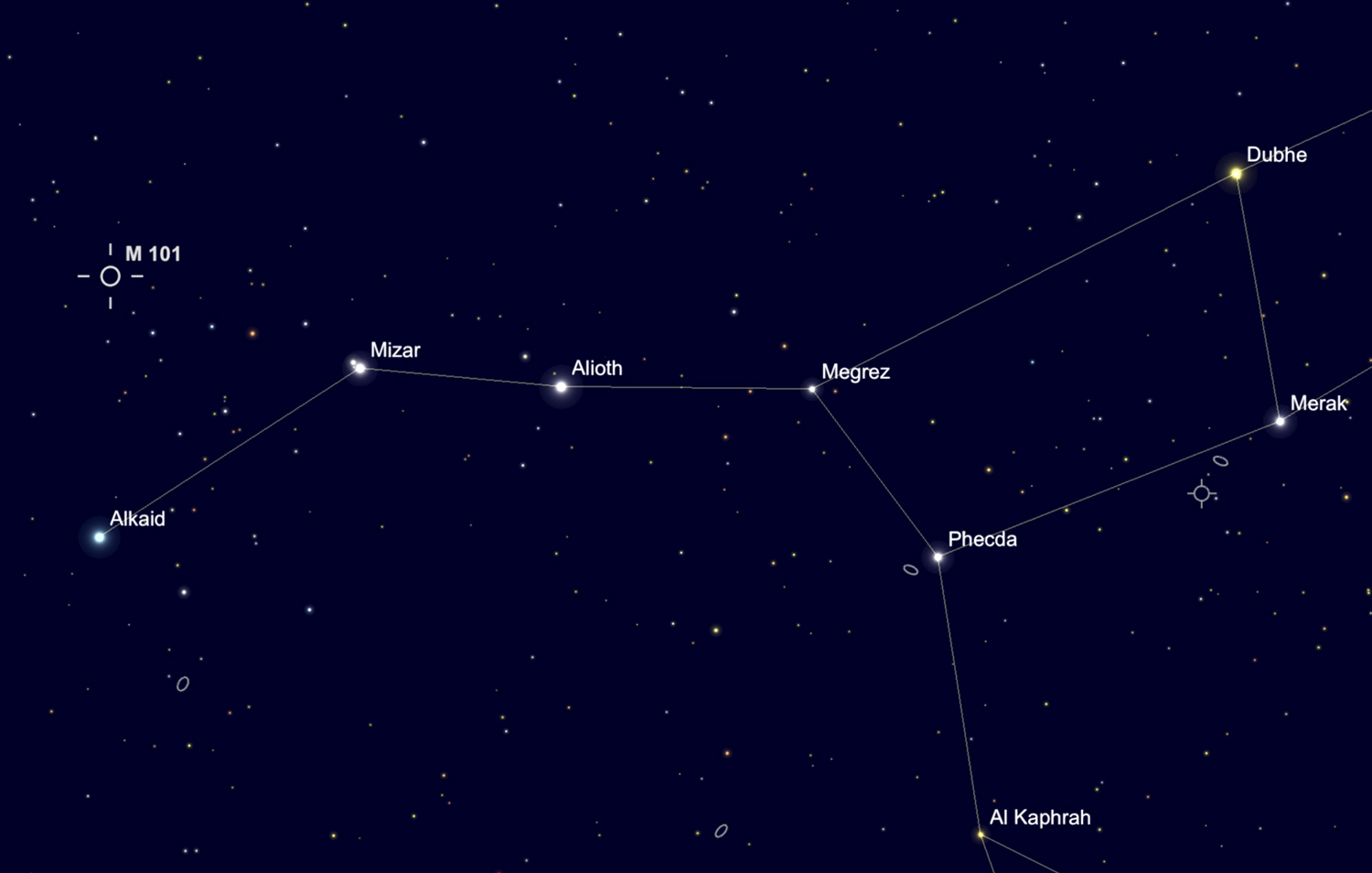
Click on the picture for a larger view ▲
Supernova in the Pinwheel Galaxy
On August 24, 2011, an Ia-type supernova was discovered in the Pinwheel Galaxy. This discovery was made by the Palomar Observatory / Palomar Transient Factory during an automatic analysis of images taken during the previous nights. The supernova was first named PTF 11kly before it was renamed to SN 2011fe. At its maximum brightness, it reached an apparent brightness of +9.9 mag, which is between the intensity of Neptune (+7.8 mag) and Pluto (+13.9 mag). In comparison, the apparent brightness of the Pinwheel Galaxy itself is +7.9 mag.
Amateur image of the Supernova SN 2011fe happened in the year 2011.
Copyright: Thunderf00t, Attribution 3.0 Unported (CC BY 3.0)
What is in the area around the Pinwheel Galaxy?
In the following two pictures, I have marked a few galaxies. If you keep in mind that each of them is home to billions of stars, the possibilities of infinite diversity never run out.
The picture with captions of the “larger” galaxies. Created by hand in Photoshop.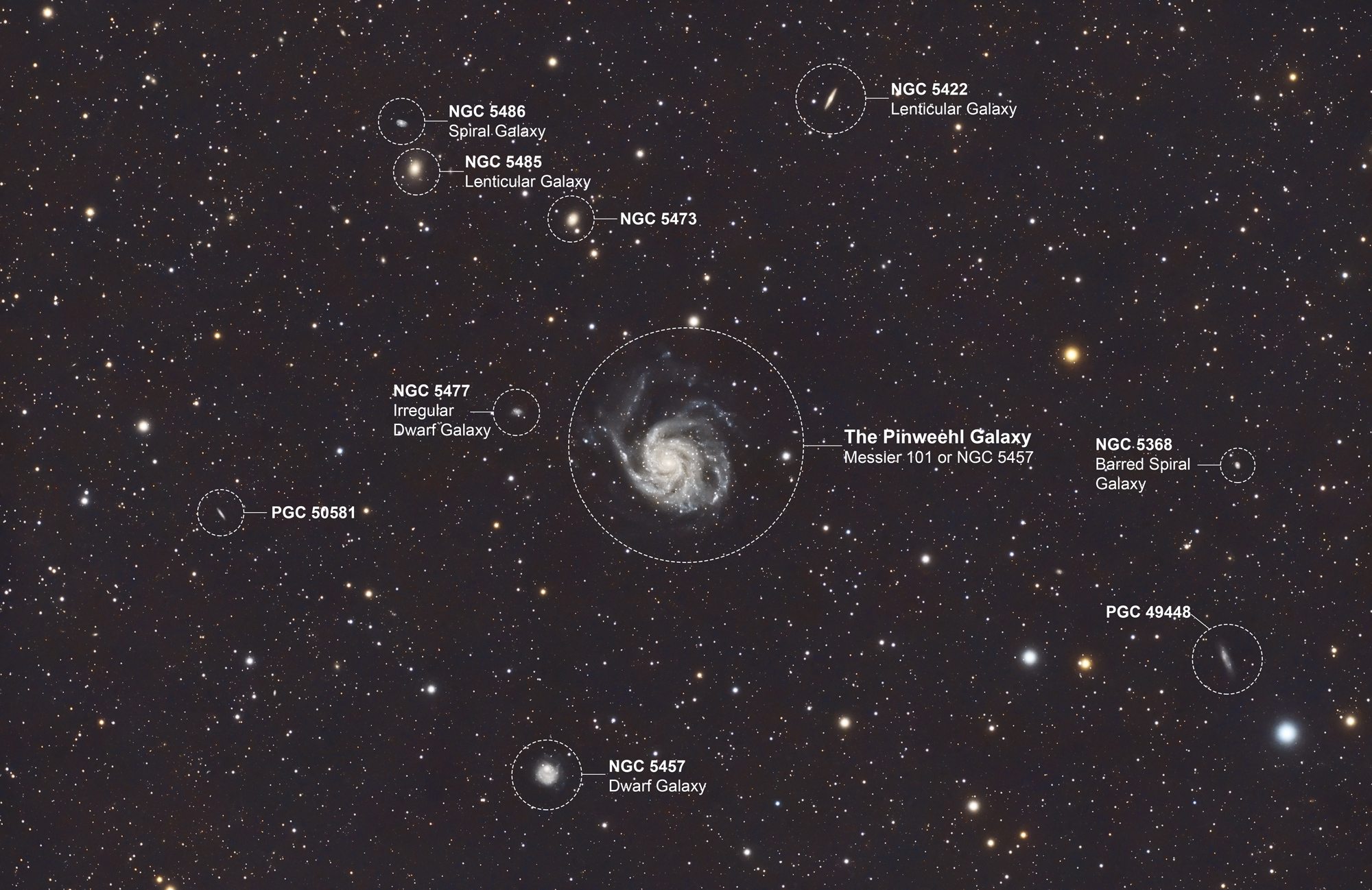
Click on the picture for a larger view ▲
As you can see in the images, there are many background galaxies in it. In a sky section of only 3.07 by 1.99 degrees, which is covered by this image, there are 252 galaxies.
Labeled with all galaxies that can be found in the PGC catalog and are visible on the image. Automatically created with PixInsight.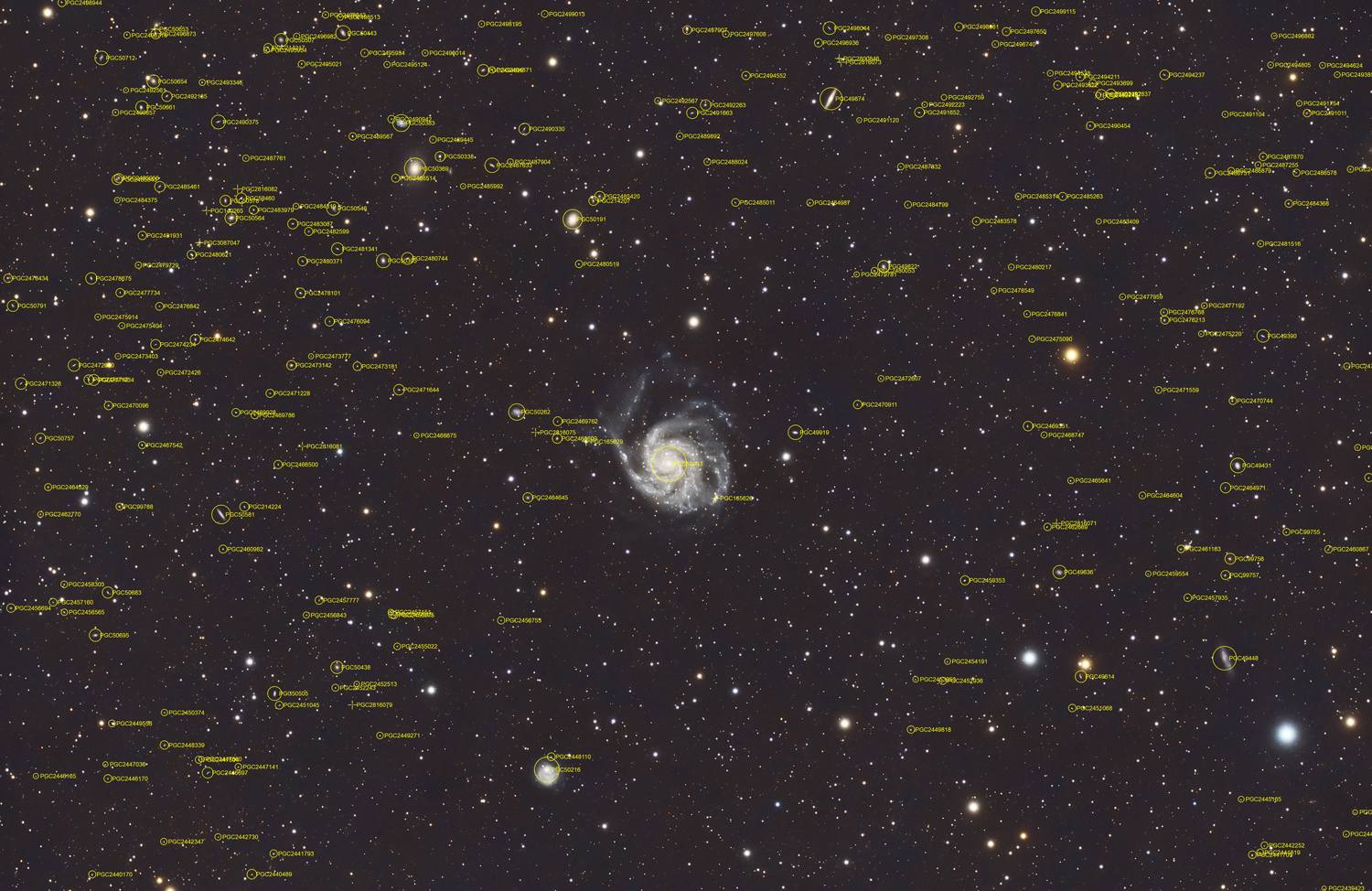
Click on the picture for a larger view ▲
Details of the image
The picture was taken in my Backyard with the following equipment and settings.
Camera QHYCCD247C
Telescope TSAPO65Q · 420mm · f6.5
Filter Astronimik Luminance L2 (48mm / 2")
Guide camera QHY5L-II
Guide scope TSL60D · 240mm · f4.0
Mount Skywatcher AZ EQ-6
Exposure time 28 x 300" = 140 minutes
ISO Unity Gain @ -20°C
Everything is controlled by my Astro-PC via remote desktop and wireless LAN.
Software: Sequence Generator Pro, PixInsight, Photoshop CC
The license of my pictures
All images, otherwise clearly indicated, in this post are my own work.
You can use it for free if you credit them to @astrophoto.kevin.
 Attribution-ShareAlike 4.0 International (CC BY-SA 4.0)
References
http://www.messier.seds.org/m/m101.html
http://www.messier.seds.org/xtra/supp/m_NED.html#m101
http://simbad.u-strasbg.fr/simbad/sim-id?Ident=M+101
https://en.wikipedia.org/wiki/Pinwheel_Galaxy
https://de.wikipedia.org/wiki/SN_2011fe
http://www.rochesterastronomy.org/sn2011/sn2011fe.html
https://de.wikipedia.org/wiki/Scheinbare_Helligkeit
https://www.spacetelescope.org/images/opo0907f/
https://iopscience.iop.org/article/10.1086/505689/meta
Thank you very much for visiting and reading!
If you have any questions or suggestions, please don’t be afraid to let me know of anything you thought about this post in the comments below!








