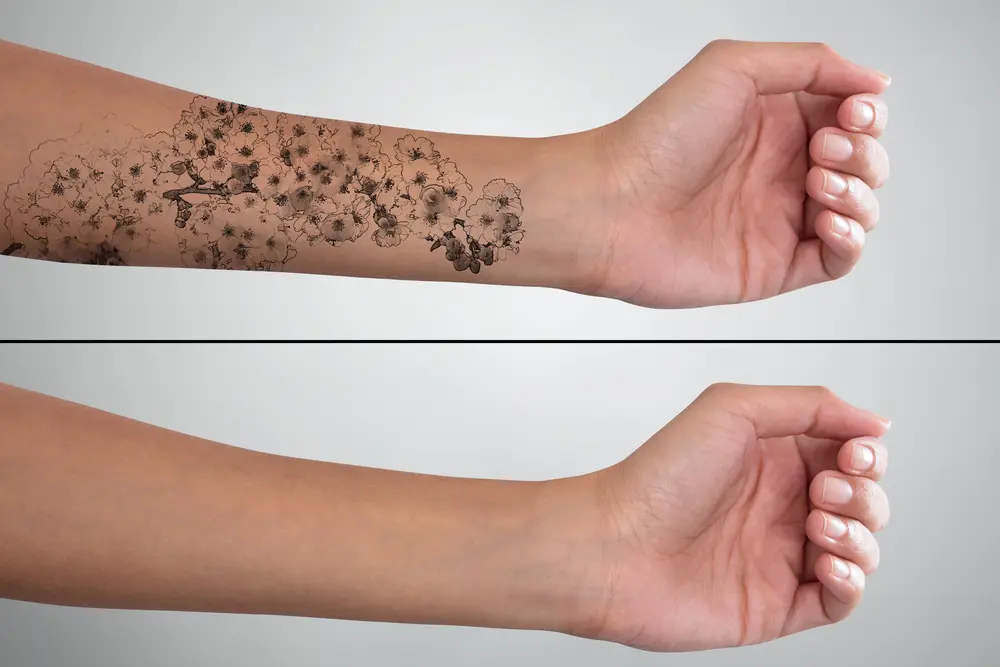
We all make choices that we regret in our lives. Sometimes, those choices don't have any lasting consequences, and other times, they do. Unwanted ink can feel like a regret that won't ever go away, but with tattoo removal, you can get back to the clear, uninked skin you want.
Understanding Tattoo Removal
Methods of Removal
There actually are a handful of ways that tattoos can be removed, but after reviewing them, you will see why laser removal is the most effective and popular.
Laser Removal
This is the most common and effective method of removal today. It involves shattering ink particles with a laser so that the particles can be removed and processed out of the body by the immune system.
Dermabrasion
This method of removal involves the use of a medical grinding tool that removes the layers of skin that contain the particles of ink. This essentially removes the tattoo. This treatment isn't very popular because it can be painful, and therefore is usually performed using local, regional, or general anesthetic.
This method leaves the client with an open wound that needs care after the treatment is done. Plus, more than one session of dermabrasion is usually needed in order to completely remove the tattoo. Additionally, this method can result in significant scarring.
Chemical Peels
Trichloroacetic acid (TCA) peels can be used to remove tattoos. This mild acid is applied to the skin to remove the outer layers of the skin, including tattoo ink, similar to dermabrasion. This treatment also results in an open wound that requires care afterward.
Surgical Excision
Another method for removing unwanted ink is surgically removing the piece of skin that hosts the tattoo. While this is an effective method, there are some significant downsides. It can only be done on small tattoos because removing large tattoos would mean removing a large piece of skin and therefore require a skin graft. After the small tattoo is removed, the edges of the skin are sewn together so there is no open wound. This results in a surgical scar.
How Laser Removal Works
Now that we know why laser tattoo removal is the best option when trying to rid yourself of unwanted ink, let's learn about how the treatment works.
The Basic Process
During the laser removal process, the technician will guide a laser over the area of skin that has a tattoo. When most of us think of lasers, we think of a continuous beam of light that a professor might use during a lecture or that we might use to play with a cat. The laser used for removal is different in many ways. Rather than produce a continuous beam of light, these lasers produce pulses of light energy, and the color of visible light produced may change.
Each pulse of light penetrates the skin and then is absorbed by the tattoo ink. As the ink particles absorb the light pulses, they heat up and shatter. After the treatment, your immune system flushes the particles of ink away from the tattoo location, making the tattoo appear lighter. This continues until the tattoo is no longer visible.
The Q-Switched Laser
Tattoo removal uses a special type of laser called a Q-switching laser. This laser produces intensely powerful, brief pulses of light energy that typically only last for a couple of nanoseconds. The brevity of the energy pulses is helpful both in protecting the skin cells and in aiding the shattering of ink particles.
Ink particles are extremely small: usually only nanometers in diameter. Because of this, they only need to be heated up for a very brief time to shatter due to thermal expansion, or the tendency of particles to expand when heated. In fact, the goal is not to heat up the entire ink particle, but only half of it. The opposing hot and cool forces are what rip the ink particle apart.
The brevity of the energy pulses also works to protect your skin cells. In contrast to ink particles, skin cells are much larger. They would need to be heated up for a much longer period of time to be damaged. The Q-switched laser effectively allows practitioners to selectively shatter ink particles while leaving the surrounding skin healthy and intact.
Targeting Tattoo Ink
There is a myth that laser removal is only effective for black and dark tattoos. Decades ago, there was difficulty in removing lighter color tattoos, but technological advances have ensured that all colors can successfully be removed by lasers.
To understand how targeting tattoo ink works, let's revisit a lesson learned in elementary science class. Visible light, the white light produced by the sun or lamps, is white because it contains all the colors of the rainbow. We can see this when a prism is used to break the white light into each of its separate colors. When we see a red object underneath white light, it appears red because it is actually absorbing all the other colors in the visible light spectrum and reflecting the color red.
The goal of laser removal is to have the ink particles absorb the laser light so they can shatter. Because different colors of tattoo ink reflect and absorb different light, the visible light wavelength of the laser has to be adjusted so it can be well absorbed by the ink. So, if the practitioner is trying to remove visibly red ink, they would use visibly green laser light to do so.
The Immune System
Once the laser shatters the tattoo ink particles, your immune system does the rest of the work. Your immune system is a network of organs, cells, and chemicals that fight infections in your body caused by foreign objects and microbes. Once the ink particles are shattered, they are small enough for the immune system to move to the lymph nodes so they can then be flushed out of the body.
Frequently Asked Questions
How Long Should I Wait Between Sessions?
You should wait about six to eight weeks between laser removal sessions. This is because it takes several weeks for the body's immune system to effectively remove the shattered ink particles from the location of the tattoo and flush them out of the body. While it might seem like the tattoo will disappear faster if you get in as many sessions as possible, this actually isn't the case.
When you get a tattoo, the ink is deposited at different depths of the skin. When you get a laser treatment, the light only reaches the most shallow layer of ink particles. It's like a shadow - the most shallow ink particles absorb the laser light and block it from reaching ink particles that are deeper within the skin.
It's only once the shattered particles have been removed from the area by the body's immune system that the deeper ink particles are able to absorb the laser light. Because it takes about six to eight weeks for your immune system to clear the treated area, going in for another laser session before then would be pointless.
How Long Will It Take to Remove My Tattoo?
When you first meet with your practitioner to have a consultation, they will use their professional experience to estimate how long it will take for your tattoo to be completely removed. Generally, it takes somewhere from 12 to 16 months.
What Factors Affect Laser Removal?
Removing a tattoo is always takes time and patience, but there are some other factors that can affect the length and effectiveness of your laser removal.
Skin Tone
When a laser penetrates your skin, it goes past the outer layer of skin, the epidermis, to the second layer, called the dermis, where the tattoo ink is deposited. The goal is for the laser to penetrate the dermis without causing any damage to the epidermis.
Darker skin tones tend to take a lot longer to successfully remove a tattoo because it requires a higher wavelength in order to not cause damage to the epidermis. A low-frequency wavelength on dark skin can cause scarring, hyperpigmentation, or hypopigmentation. The higher wavelength causes less damage, but is also less effective for removal, extending the treatment time.
Tattoo Location
The success of your laser removal can largely depend on the location of the tattoo. Generally, the closer the tattoo is to your heart, the most quickly and effectively it can be removed. This is because not all areas of the body have similar blood and lymph node count.
The areas with the large blood and lymph node counts, like the face and neck, are the easiest to remove tattoos from. The upper and lower back, as well as the arms, also have high lymph node and blood counts and are relatively easy to remove tattoos from.
Ink Quality
Tattoos are unique not just in design, but in composition. That is, not all tattoo inks are created equal. Tattoo artists use a variety of compounds to create their inks. Some compounds are easier to remove than others.
Aftercare and Quality
How you care for your tattoos after receiving them can have an impact on how easy it is to remove them. When you get a tattoo, there is always some damage to your epidermis: the outermost layer of your skin. Although even high-quality tattoos result in some damage to your epidermis, lower quality ones result in far more damage and can take much longer to fully heal.
If your tattoo is of lower quality or wasn't cared for well afterward, you may have scarring, which can make your tattoo more difficult to remove.
Tattoo Age
As your tattoos get older, they tend to degrade. That's why older tattoos can appear faded. Generally, older tattoos are easier to remove with a laser because they already have begun degrading.
Ink Colors
We've already discussed how practitioners go about removing different colors of inks. And although scientific advancement has allowed us to effectively remove tattoos of all colors, it can take longer to remove colors like green, pale blue, and yellow. Black tattoos are the easiest to remove.
Size
One of the biggest factors in the time it takes to remove your unwanted ink is the size of your tattoo. A larger tattoo will typically require more sessions to remove than a smaller one.
Depth of Ink
Professional tattoo artists tend to use more ink when creating a tattoo and penetrate the dermis farther to deposit the ink deeper within the skin. This gives the tattoo a more defined look and helps to not fade over time.
This is why stick-and-poke tattoos are likely to fade over time, because they are deposited relatively shallowly in the dermis. Tattoos that are deeper within the dermis take more time to remove.
Immune System
When going through laser removal, your immune system does a great deal of the work. A healthy immune system is important in order to effectively remove the shattered ink particles from the body. If you suffer from immune conditions, it may take your body longer to completely remove the ink.
Smoking
Smoking cigarettes can actually reduce the chances of successful tattoo removal by 70% over a ten-session period. If you are serious about removing your unwanted ink, then you should not smoke while undergoing treatment.
Cover-Ups
Sometimes, people want to change parts of the tattoo they have or cover it up with a new tattoo in the same place. If this what you're doing, then you won't need to undergo as many treatments because you only need to lighten the tattoo enough to cover it, not erase it completely.
On the other hand, if you are looking to remove a cover-up tattoo, that means completely removing not only the cover-up tattoo but the original tattoo below it. This means that there is a lot more ink to be removed, and you can expect to require more sessions in order to successfully remove it.
How Should You Care for Your Tattoo After Laser Sessions?
After having a tattoo removal session, you need to make sure to take special care of your skin, just like you did when you initially got the tattoo. For the first three days after laser treatment, you will want to keep the treated area protected with a thin layer of antibiotic ointment, then keep it bandaged with sterile gauze. Change the gauze and ointment regularly to keep the area clean.
After three days of applying ointment and bandaging the treated area, you want to keep the area clean and dry during the rest of the healing process. Gently clean the treated area with mild soap and water, and pat the area dry.
Conclusion
Don't let yourself be held back by the decisions you've made and now regret. You don't have to keep living with tattoos you regret. Getting laser tattoo removal is the easiest and most effective way to clear your skin of unwanted ink.






