
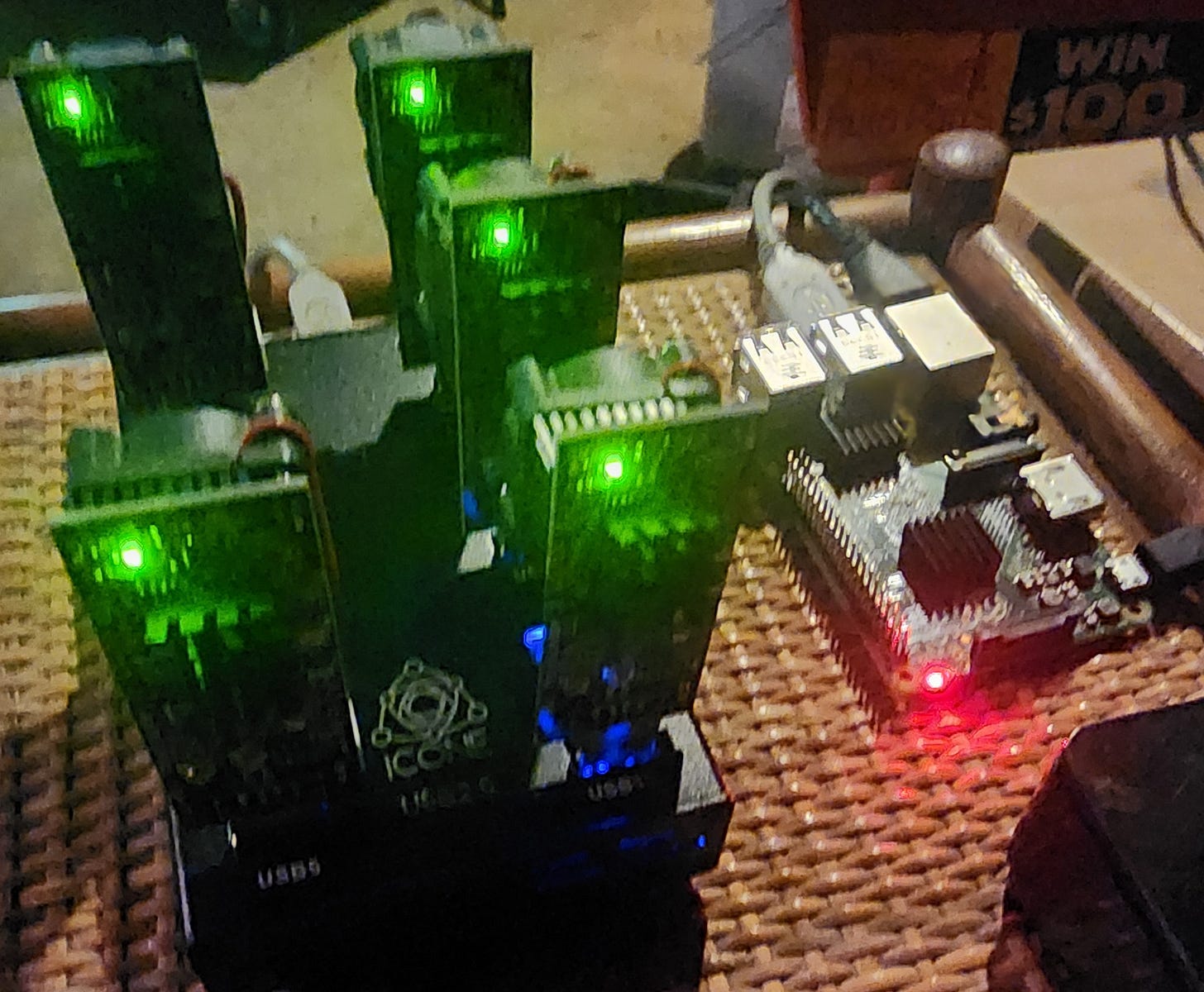
Five Moonlander 2 sticks running headless on a Raspberry Pi 3. No monitor. No babysitting. Finally.
Thanks for reading Voytek's Substack! Subscribe for free to receive new posts and support my work.
I bought my first Moonlander 2 USB miners years ago when I was deep in the mining rabbit hole.
If you know, you know.
Back then I had Antminers running, I was tracking hashrates obsessively, and if I found a miner at a decent price — I bought it. Didn’t matter what it was. I wanted every hash I could squeeze out of anything with a chip in it. The Moonlanders were these small Scrypt ASIC USB sticks, barely documented, discussed mostly in obscure Bitcointalk threads with maybe five to ten people total. I grabbed five of them before they disappeared off the market.
And for a while, I tried.
The Babysitting Problem
If you ran Moonlanders back in the day, you already know exactly where this is going.
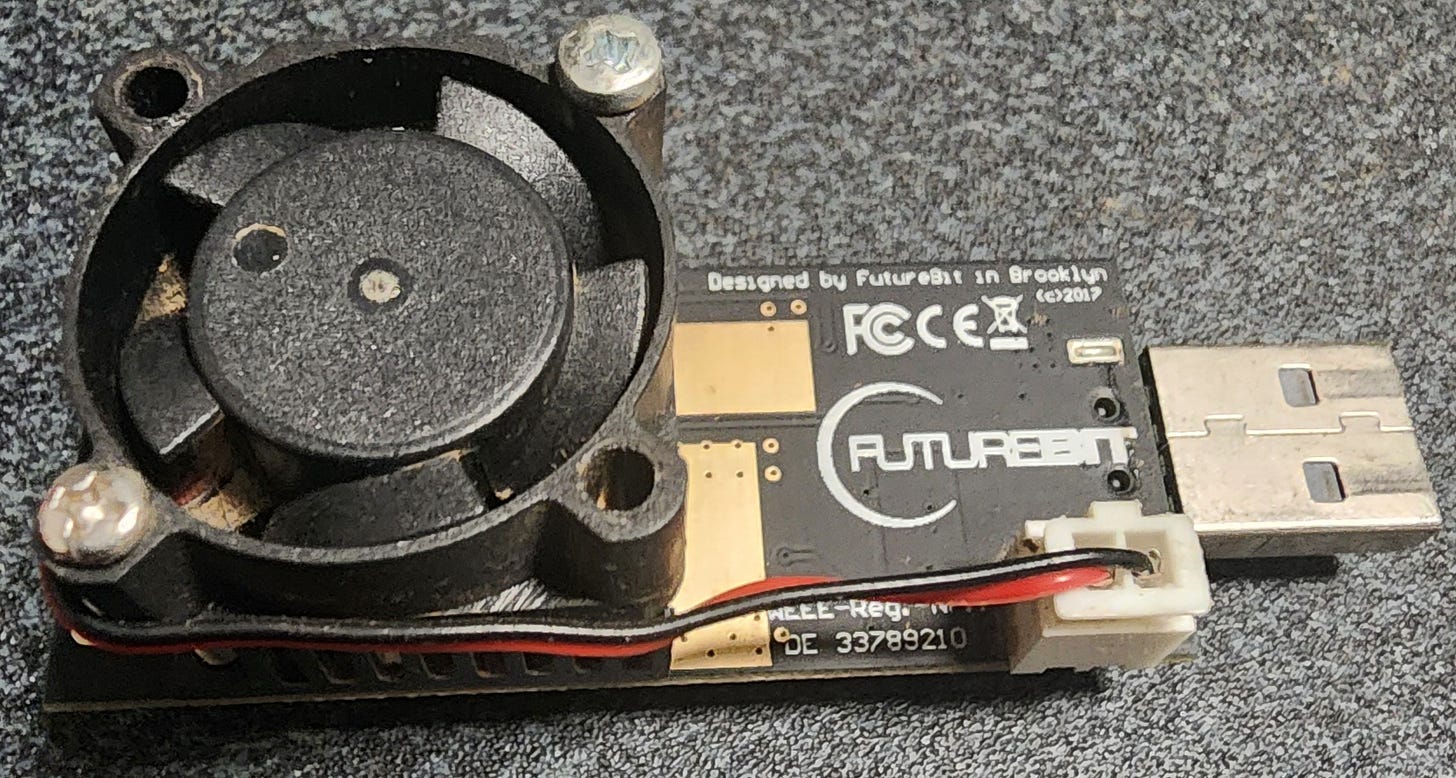
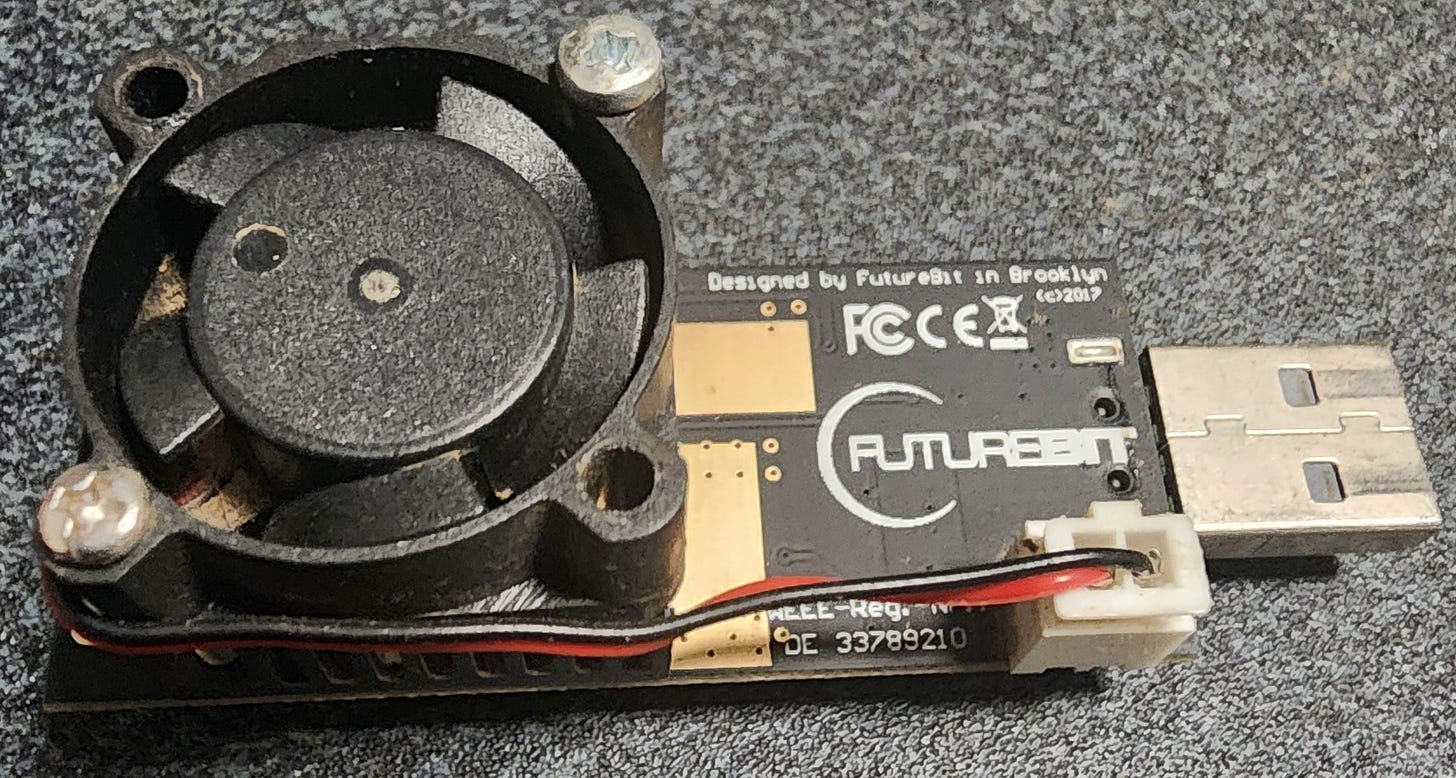
The FutureBit Moonlander 2 — small, low power, and absolutely relentless at finding new ways to stop working.
The red LED on each stick blinks when it’s mining. That blinking red light becomes your whole world. You check it constantly. You walk over to the rig just to look at it. And inevitably — sometimes twice a day, sometimes more — you’d glance over and half the sticks would just be sitting there. Solid. Not blinking. Dead.
BFGMiner might still be running. It might even be reporting hashrate. But if that red light isn’t blinking, it’s not mining. That was the first hard lesson — never trust the software over the hardware. The LED tells the truth.
The fix was never quick either. You had to quit BFGMiner, power cycle the USB hub, sometimes reboot the Pi entirely, then start everything back up and watch each stick come back to life one by one — red lights blinking again, green stable light solid. Then twenty minutes later, you’re back checking on them.
I even bought a mini screen just so I could hook a keyboard up and manage them without dragging a full monitor over. That’s how deep into it I was.
I had three Antminers running at the same time. The Moonlanders weren’t adding anything meaningful to my operation in terms of hash. But that wasn’t really the point. The point was I wanted to build something, learn Linux, and squeeze every last kilohash out of every device I owned. That was the mindset.
Eventually though, the babysitting wore me down. I didn’t have time to keep playing with them. They annoyed me more than they rewarded me. So I powered them off, put them in a drawer, and moved on.
Nine Years Later
Recently I pulled them back out.
Not because Scrypt mining on a Pi 3 is going to retire me — it won’t. The economics haven’t improved on that front. But I’m in a different place now. I’m building trading bots, working with multi-agent systems, automating crypto workflows. And I wanted a real hands-on Linux and automation project. Something physical. Something I could build a proper system around.
I figured I’d get them running again quickly.
A few hours later, I had something I didn’t have the first time — an actual system.
What I Built This Time
The hardware is the same. Five Moonlander 2 sticks on a Raspberry Pi 3, mining Scrypt to litecoinpool.org. Nothing changed there.
What changed was the approach.
Persistent Session with tmux
The first thing I set up was a tmux session so the miner runs headless. SSH in, start it, disconnect, and it keeps running in the background. No monitor. No keyboard sitting next to the rig. No mini screen. Just a clean terminal session that lives on the Pi whether I’m connected or not.
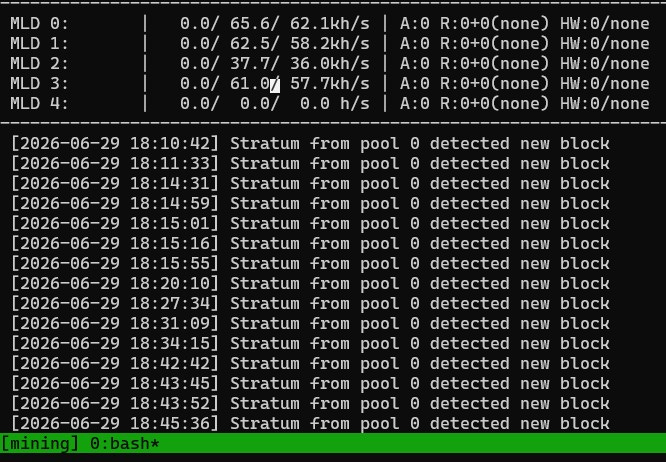
That green bar at the bottom — [mining] 0:bash* — means the session is alive and running whether I’m connected or not. Old school miners will recognize this immediately.
Clean Startup Script
Everything runs through a single shell script now. Correct working directory, proper BFGMiner flags, API enabled, device behavior controlled. No more “I forgot to set that flag” bugs. One command and the whole thing starts clean.
Watchdog — The Real Game Changer
This is the piece I wish I had nine years ago.
The watchdog script queries BFGMiner’s API on port 4028 on a loop. It checks the hashrate on each stick individually. The moment a stick drops to near zero — which these things absolutely still do — it automatically disables it, re-enables it, or triggers a restart sequence. No human intervention required.
The same problem still happens. The sticks still drop out. The difference is the system handles it now instead of me.
Flask Web Dashboard — Full Visibility
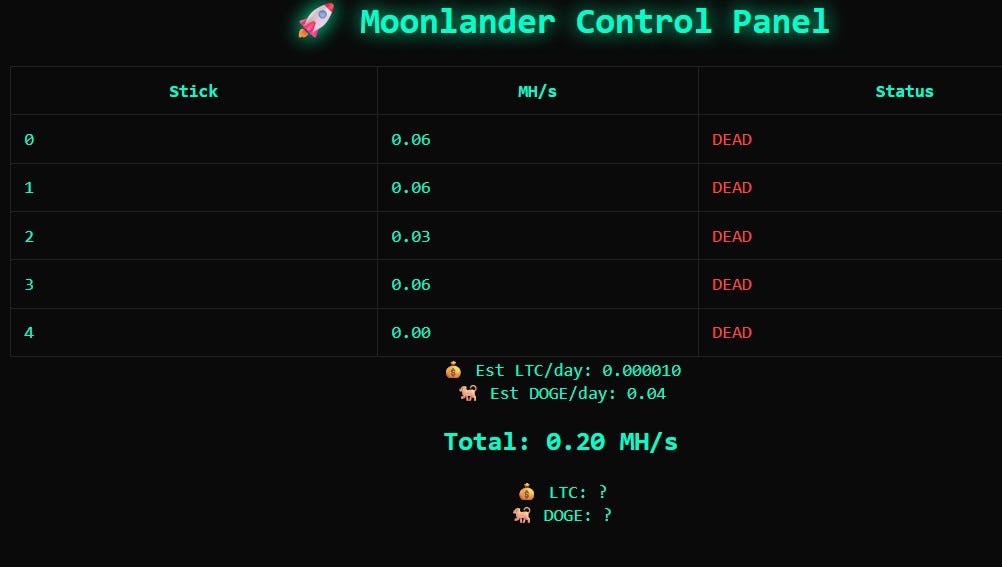
All five sticks flagged DEAD — caught instantly by the dashboard. No walking over, no guessing. The system sees it before I do. That's the whole point.
I built a dashboard in Flask that gives me full visibility from any browser on my network. Per-stick hashrate, status indicators — GOOD, LOW, DEAD — total hash across all five sticks, a live chart, and estimated LTC and DOGE earnings. Cyberpunk neon UI because why would you build something boring.
Available at the Pi’s local IP on port 5050. No more SSH-ing in just to see if everything is still alive.
That screenshot above isn’t a failure. That’s the system working exactly as designed — catching what I never would have seen until I walked over to check.
What Actually Changed
The hardware didn’t improve. The Moonlanders are the same temperamental little sticks they always were. The Pi 3 is the same Pi 3.
Same hardware. Nine years later. Completely different outcome.
What changed is that I stopped trying to operate unstable devices and started building resilient systems around them.
That shift in thinking — from reactive to proactive, from manual intervention to automated recovery — is the same pattern I apply now to everything I build. Trading bots, arbitrage systems, automation pipelines. You don’t sit there and watch them. You build them to handle their own failures and you get visibility into what’s happening without needing to be present.
The Moonlanders taught me that the hard way the first time.
This time, I built it right.
Why This Is Worth Writing About
These sticks still barely make money. I want to be honest about that. This was never about profit.
It was about Linux fundamentals. Automation. Observability. System design. Learning how to take something frustrating and unstable and engineer something around it that just works.
Those skills compound. Everything I figured out building this — watchdog logic, API polling, dashboard visibility, headless operation — shows up directly in more serious projects. The mining rig is just where I practiced it.
If you had Moonlanders back in the day and eventually gave up on them, I get it completely. I did too. But if you ever pull them back out, don’t just try to run them the old way.
Build a system around them.
That’s when they finally become useful.
More builds coming. Stay tuned.
Whatever you’re building today, keep goin’! 🚀🔥
— Voytek.ai
Thanks for reading Voytek's Substack! Subscribe for free to receive new posts and support my work.
If you enjoy this content and want to support the builds, grab me a coffee ☕
👉 ko-fi.com/askvoytek
Thanks for reading Voytek's Substack! Subscribe for free to receive new posts and support my work.
Thanks for reading Voytek's Substack! Subscribe for free to receive new posts and support my work.






