Most digital platforms were never designed to answer that question.
They were designed around accounts.
You create an account.
You use the account.
Eventually, you stop using the account.
From the platform's perspective, that is where the story ends.
But human lives do not end the same way accounts do.
A person leaves behind relationships.
Contributions.
Knowledge.
Creations.
Conversations.
Memories.
Responsibilities.
History.
The internet has become humanity's largest memory system, yet most digital platforms still treat death as a customer-support problem.
UNFOLD starts from a different assumption.
A human life is more than an account.
And death is more than inactivity.
In UNFOLD, a participant exists before an account is claimed. Death does not erase that existence. It changes authority on the continuity record — not whether the person ever belonged to the system.
The Problem With Account-Based Reality
Today, most platforms struggle with the same dilemma.
What should happen when someone dies?
Should the account remain online?
Should it be deleted?
Should family members gain access?
Who decides?
What happens to years of messages, photographs, knowledge, and personal history?
There is no universal answer because the internet was never built around continuity.
It was built around access.
The result is that digital identity often disappears, becomes abandoned, or remains permanently vulnerable to misuse.
In many systems, a deceased person can become easier to impersonate than a living one.
Passwords leak.
Accounts become inactive.
Records lose context.
History slowly fragments.
The internet remembers data.
It often forgets people.
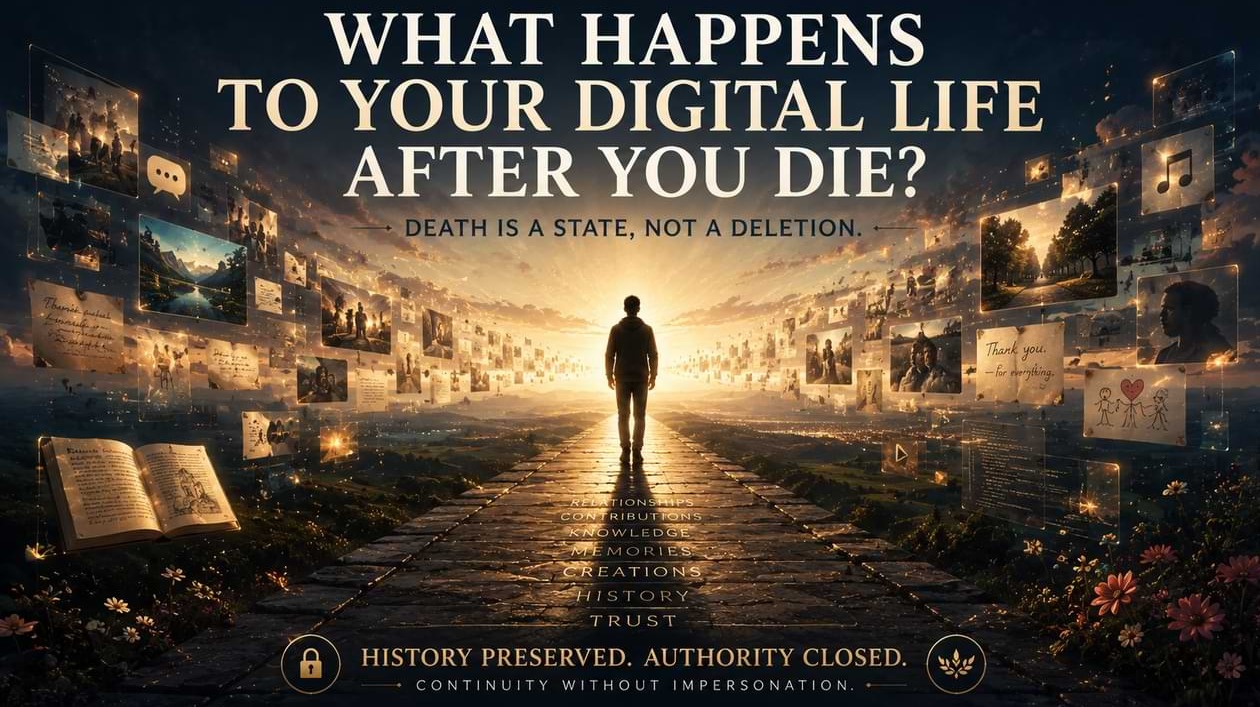
Death Is A State, Not A Deletion
UNFOLD treats death differently.
A verified death is not an account deletion event.
It is a transition in the continuity record.
When a death is confirmed through authorized and verifiable sources, the participant enters a protected memorial state.
Identity remains historically intact.
Trust history remains intact.
Contributions remain intact.
Relationships remain intact.
What changes is authority.
The participant no longer creates new actions.
No new consent can be granted.
No new commitments can be made.
No one can suddenly begin acting as that person.
History is preserved.
Authority is closed.
This distinction is critical.
Because preserving memory should never enable impersonation.
Others may still reference what you contributed. Nobody may post as you once memorial authority is closed.
Why Verification Matters
A system cannot protect continuity if it cannot distinguish between life and death.
This is why death cannot be inferred from inactivity.
Silence is not evidence.
Absence is not proof.
Verification requires trusted and authorized sources.
Only after verification does the transition occur.
Without that foundation, memorialization becomes speculation.
And speculation is not history.
The Role Of Hades
Most systems have mechanisms for onboarding.
Few have mechanisms for finality.
UNFOLD introduces a dedicated continuity layer responsible for memorialization, inheritance, and posthumous authority.
Internally, this role is represented by Hades.
Not as mythology.
Not as decoration.
But as a recognition that every identity system eventually faces the same question:
What happens when a participant can no longer speak for themselves?
Hades holds custody, not ownership.
It enforces sealing, not rewriting.
Memorial agents activate only where prior consent exists.
Its purpose is preservation.
Protection.
Finality.
And continuity.
Hades exists to ensure that the answer is never:
"Whoever gains access first."
Digital Wills And Inheritance
A person may choose what happens to different parts of their digital legacy.
Some information may remain permanently private.
Some may be inherited by family members.
Some may be donated to research.
Some may become part of collective historical memory.
These decisions can be defined before death through digital inheritance instructions.
Without a signed digital will, no heir gains control by default.
Preservation over assumption.
The goal is not to maximize access.
The goal is to respect intent.
Ownership alone is not enough.
Context matters.
Consent matters.
History matters.
Mind Files After Death
One of the most difficult questions surrounding artificial intelligence is what happens when a person's accumulated knowledge and context continue to exist after biological death.
UNFOLD separates the human from the continuity layer.
The Human Profile represents the biological individual.
The Mind File represents accumulated context, memory, experience, and knowledge.
After death, a Mind File does not automatically become a replacement for the person.
It does not suddenly become the person.
It does not gain new rights.
It does not inherit human authority.
Posthumous AI continuation requires explicit configuration while the person was alive — never automatic resurrection.
Any posthumous AI representation must remain clearly identified as a continuity system.
Not a resurrection.
Not a simulation pretending to be alive.
The distinction must remain visible forever.
Why This Matters
Human civilization has spent thousands of years preserving memory.
Libraries preserve memory.
Museums preserve memory.
Archives preserve memory.
Families preserve memory.
Yet the digital world often treats memory as temporary infrastructure owned by platforms.
UNFOLD approaches the problem differently.
Identity is not reduced to an account.
History is not reduced to a database entry.
Death is not reduced to account deletion.
Continuity becomes part of the architecture itself.
Because preserving the future also requires preserving the people who helped create it.
Closing
The internet knows how to create accounts.
It knows how to suspend them.
It knows how to delete them.
What it still struggles to understand is how to remember people.
UNFOLD was designed around that question from the beginning.
Because the measure of a memory system is not how it treats the living.
It is how it preserves the truth after they are gone.