CoinMarketCap, the main cryptocurrency trading aggregator, has added several new indicators to the system for evaluating exchanges and trading in digital assets. This is not the first attempt of the service to influence the problem of artificially overstating trading volumes, with the help of which dubious trading floors are trying to attract new users. What has changed at CoinMarketCap and why many were dissatisfied with the innovations - read the DeCenter material.

On the most visited cryptosphere website - CoinMarketCap aggregator (CMC) - big changes have taken place over the past month: the system for assessing the quality of trading crypto assets on exchanges has been replenished with several new metrics at once. New parameters were introduced in stages, during May, and on June 4, the CMC team announced the completion of work in the company's official blog.
The first direction of the changes is related to the assessment of the trading pair: in addition to the trading volume reported by the exchange, a “confidence” parameter has appeared that the trading data is true. The second new indicator is liquidity. And the third area concerns the rating of exchanges: now it has become the main indicator of the number of users.
“Sorting by these three factors should give a more complete picture for each trading pair, providing users with the opportunity to make a better decision about which platform to trade them on,” CMC believes.
Liquidity
The liquidity parameter has a value from 0 to 1000. It shows how easy it is to buy or sell an asset in a given pair. The more liquid the pair, the higher the chance of avoiding the so-called slippage - making a transaction at a price different from the quoted price. The lower the chance of slippage, the lower the transaction costs.
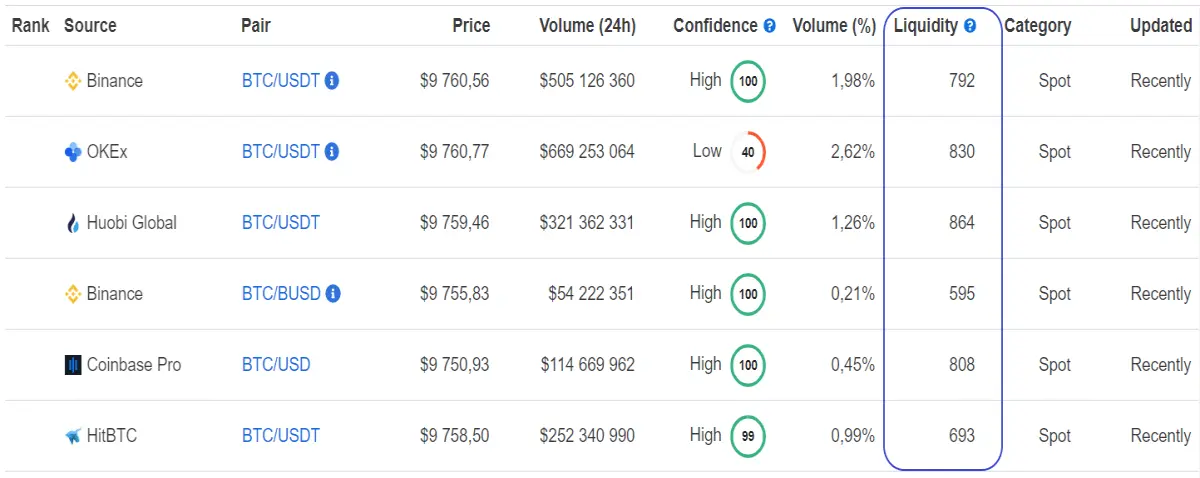
For example, a trader places a market order to buy three bitcoins for $ 9000 in a pair of BTC / USD. But on the exchange there is only one bitcoin sold at this price, the rest are $ 9050 and $ 9100, respectively. Therefore, the order will be executed for a total of $ 27,150, and not $ 27,000, as the buyer expected. The average price of 1 BTC in this case will be $ 9050. Slippage is $ 50 lost on every bitcoin due to low liquidity (transaction costs).
A large number of sellers and buyers at different prices in a trading pair means high liquidity, and vice versa.
Web traffic
The second parameter is the number of exchange users. Since the CMC cannot require access to traffic data from exchanges, the aggregator decided to use its own assessment - Web Traffic Factor. It collects data from third-party trackers such as SimilarWeb and Alexa for various metrics - for example, pageviews, the number of unique visitors, the percentage of bounce rates, and so on.
As explained in the CMC, in the spot market, the vast majority of whose participants are individual users, the trading volume is determined mainly by liquidity and the number of traders. However, trading manipulations, such as intra trading (committing artificial transactions to overstate trading activity) or dumping on commissions, remain a big problem for the cryptocurrency market.
In CMC, this phenomenon is called "trading volume inflation" and consider it the main problem of the cryptocurrency market. So that users can evaluate the "purity" of trades, CMC decided to openly monitor both parameters.
Each metric has its own “weight” in the final rating. The final value of the Web Traffic Factor parameter also has a value from 0 to 1000. The most popular exchange will always have a value of 1000, the score for other sites will be calculated in comparison with the leader.
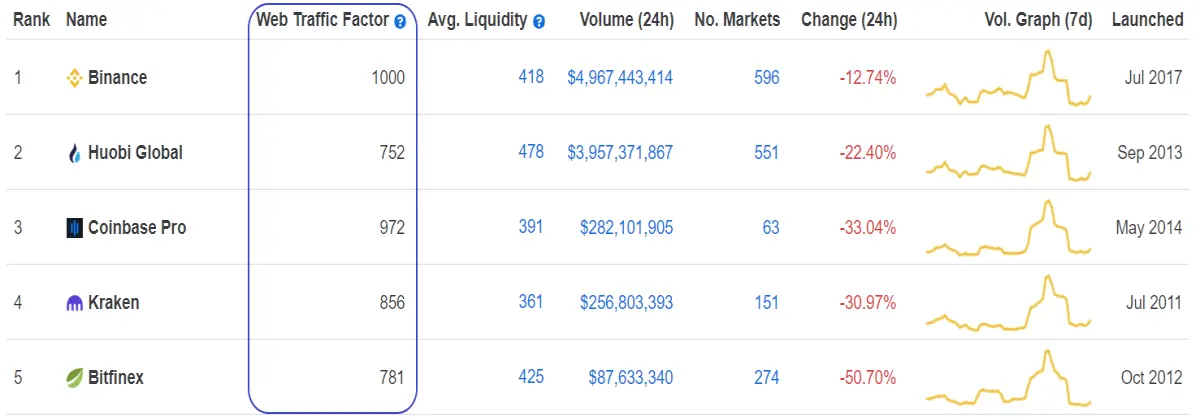
The current values of Web Traffic Factor for different exchanges can be found in the corresponding CMC rating. For trading pairs, it has not yet been indicated.
Confidence
In addition to liquidity, CMC evaluates each trading pair by the Confidence parameter. In fact, it shows how much the aggregator trusts official auction data reported by the exchange. The confidence parameter has three levels: low (confidence below 50%), medium (50–75%) and high (over 75%).
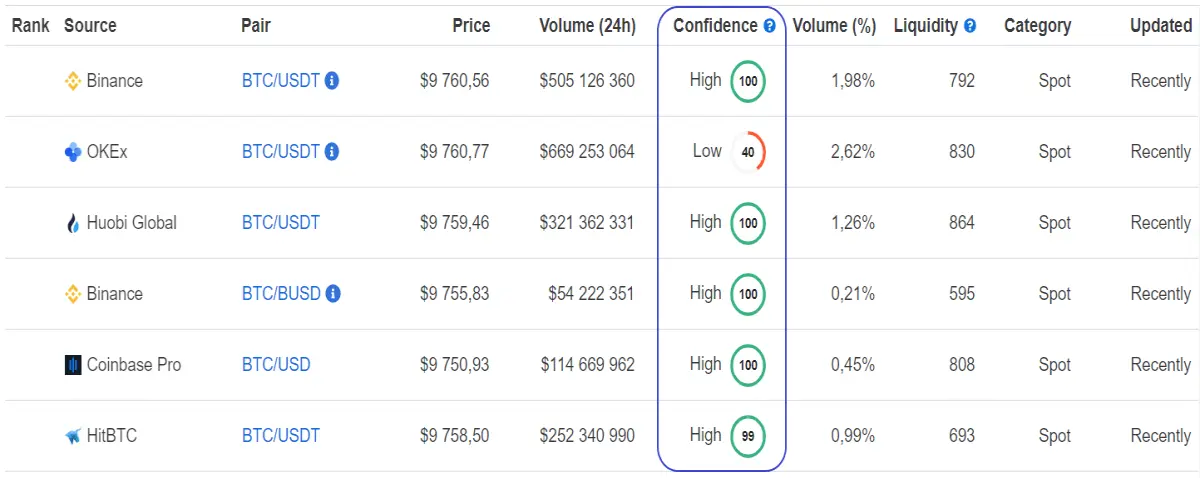
The CMC explained: “We calculate the liquidity of all market pairs and the approximate level of traders on the exchange using Web Traffic Factor. Adding these factors taking into account time and trading, we create a machine learning model to estimate the normal volumes for each individual trading pair reported by the exchange. So we can identify deviations when the site reports a much larger volume than our model predicts. ”
Simply put, if in a short time on the exchange, trading in a pair unreasonably immediately increases several times relative to a certain “norm”, then the CMC will automatically lower the level of confidence.
Reasons for change
Due to its extremely high attendance, CMC is of particular importance for cryptocurrency market players. After all, the higher the exchange or crypto asset in the aggregator rating, the potentially more traffic with CMC it can attract.
Initially, CMC only collected data sent independently by exchanges. This created opportunities for manipulation. The aggregator has been repeatedly criticized for the fact that the first places in the ranking of exchanges were held by little-known trading floors.
An active discussion about fake trading began after the famous report of the American Bitwise Fund. It was prepared as part of the application for the release of Bitcoin ETF, filed with the U.S. Securities and Exchange Commission (SEC) in early 2019. One of the claims of the SEC was the lack of reliable methods for verifying the reporting of trading exchanges. Then Bitwise conducted a study, according to which it stated that only 5% of the total volume of BTC trading on several exchanges can be called genuine. At these sites it was proposed to track the price of an asset. However, then the SEC did not arrange these arguments, and the commission rejected the Bitwise application.
After this, a number of high-profile studies on the problem of fake trading on crypto exchanges came out. Traders began to demand from aggregators to change the rating methodology.
The CMC team recognized the existence of problems and in the spring of 2019 created an exchange association called the Data Accountability and Transparency Alliance (DATA), the purpose of which was to create common rules and requirements for the transparency of trading platforms for the market. Later, the Cointelegraph announced that 70% of the exchanges on the CMC are members of the association. Since then, there is no information on the work of the association.
In addition, since 2018, the Adjusted Volume parameter has been working on the CMC, which was an indicator that was “cleared” of fake or wound deals and was intended to present a more fair rating of exchanges.
At the same time, CMC competitors introduced new ways to define “white” exchanges. So, CoinGecko, the second most popular bid data aggregator, released a metric called Trust Score. The CryptoCompare portal launched its benchmark for exchanges.
The role of binance
Meanwhile, the introduction of the adjusted volume parameter did not solve all the problems - the dubious exchanges still “occupied” the top of the CMC exchange rating. In early April of this year, the project team suddenly announced that it was acquired by the Binance exchange. In a communication on this occasion, both parties assured that the CMC will remain a separate organization, independent of the new owner.
Since criticism negatively affected the reputation of CMC, this could affect the attendance of the resource, which is the main source of its monetization. Probably, then it was decided to renew the methodology for evaluating exchanges. Carilin Chan took up this, after a deal with Binance, who succeeded CMC at the helm of its founder, Brandon Ces.
This is not to say that the introduction of new parameters satisfied the crypto community. Firstly, the attendance parameter, Web Traffic Factor, became the main one in determining the place in the ranking of exchanges (instead of trading volume). For this reason, Binance took first place in the top, although at the beginning of April it was on the 15th line. Some saw this as playing along with the new owner. Even Binance CEO Changpen Zhao did not like the priority of traffic, which he wrote about on his Twitter account.
In addition, CMC removed the adjusted trading volume parameter. As the DeCrypt portal noted, on April 3, after the acquisition of the aggregator by the Binance exchange, the adjusted trading volume on Binance per day amounted to $ 2.1 billion against official data of $ 6.7 billion. Now, the adjusted data is not available.
Dissatisfaction was also expressed by representatives of cryptocurrency exchanges competing with Binance. In an interview with Cointelegraph, OKEx CEO Jay Hao compared the acquisition of an aggregator by Binance to a bank buying a credit rating agency, which is an unacceptable practice in the financial sector. Huobi top manager Kiara San said the new owner of CMC has compromised the neutrality of the service.
Bitfinex CTO Paolo Ardoino, in contrast, said that “people can change their ownership structure as they see fit and set whatever metrics they want.”
Criticism from the crypto community forced Changpen Zhao to publish a lengthy explanation in which he reiterated the independence of CoinMarketCap, although he described how the change in methodology was agreed upon with him.
The CoinMarketCap administration emphasizes that the latest changes are only the “first phase", the system for evaluating exchanges and assets will continue to be updated.