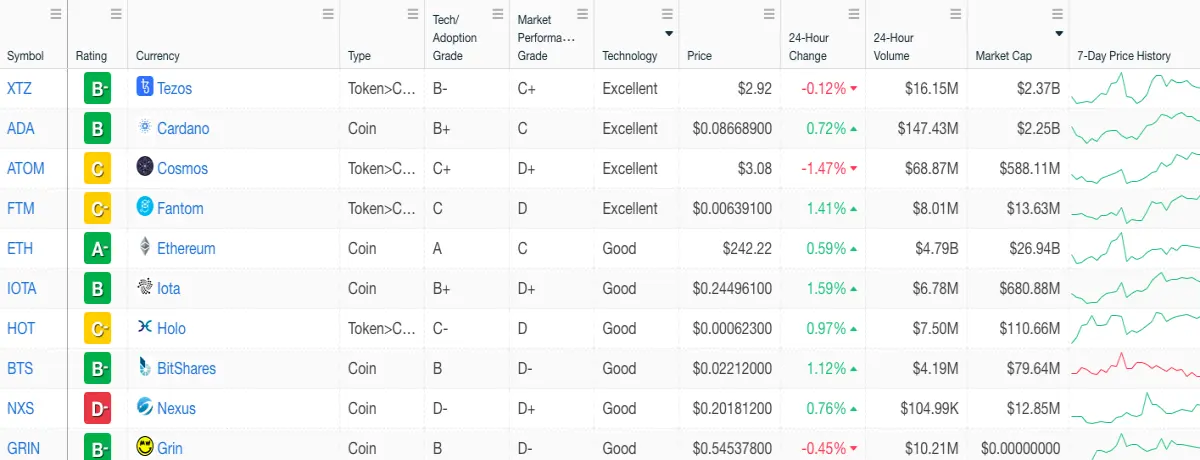
The long-awaited Cardano Shelley update will be activated on June 30. This was announced at the end of May by project founder Charles Hoskinson. The update activates the dPoS algorithm, adds the possibility of staking to the system and makes the project more decentralized. Waiting for Shelley accelerates the price of the Cardano coin - since May it has grown by 70%. What will change in the network, what opportunities will open to its users and what are the prospects for Cardano in the cryptocurrency market, DeCenter figured out.

Why should Cardano be updated
Recall the backstory of Cardano, because recently the media rarely wrote about the project.
Cardano was launched in 2015 by a group of investors and entrepreneurs led by eminent mathematician and Ethereum co-founder Charles Hoskinson. He set out to build a decentralized system with smart contracts, dAaps, sidechain and his own currency - an analogue of Ethereum, but more scalable, fast, confidential and decentralized.
The project team approached the matter thoroughly. Smart contracts for Cardano were written in the Haskell programming language, which is considered one of the most secure and perfect, and to achieve consensus, a new Ouroboros PoS algorithm was developed, which provides for the participation of all coin holders in the vote. The main feature of Cardano architecture is multi-level network construction:
The first level - Cardano Settlement Layer (CSL) - is responsible for conducting transactions and wallets
The second level - Cardano Computation Layer (CCL) - where all the calculations of smart contracts and dAps go.
Due to this, an error in smart contracts will not affect transactions and vice versa. Both levels can exist independently of each other.
After conducting a series of closed and open ICOs in 2015-2017, the project team managed to raise $ 63 million. At the end of December last year, the coin grew almost three times in a week, after which it fell 90% from the maximum of $ 1.3. Most popular ADA in Japan, South Korea and Thailand.
Cardano's roadmap is divided into five periods, named after famous artists.
The first stage - Byron - began in September 2017 and continues to this day. He assumed only the launch of the main Cardano network and ADA coins, as well as the construction of the crypto community of the project. Users can buy and sell coins using Daedalus and Yoroi wallets, but there are no smart contracts and other services promised by the team.
The blockchain of the project is managed by nodes controlled by three organizations developing the project:
Swiss NPO Cardano Foundation - engaged in the development of the project, the community and government regulation;
Japanese Emurgo - develops commercial use of technology and venture direction;
Japanese Input Output Hong Kong (IOHK) - develops and maintains a network, is engaged in updates, including Shelley.
This management model is far from true decentralization: management organizations have complete control over the network.
The second stage - Shelley - will be launched at the end of the month. He will begin turning Cardano into a full-fledged decentralized system, activating the dPoS algorithm and ADA staking. Most importantly, users will be able to run the nodes themselves, delegate ADA to pools and participate in the protocol.
Closed beta testing of the update was launched in September 2019. And in February this year, Cardano developers activated the hard fork to implement the Ouroboros Byzantine Fault-Tolerant (OBFT) protocol - this was a transitional stage between the Ouroboros Classic and Ouroboros Genesis algorithms used in Byron, which will be used on the Shelley network.
On March 31, Cardano developers rebooted Byron, improving network performance and adding a number of updates to various components of the Daedalus node and wallet software — this is necessary to move the network to a new stage.
On April 27, the project team launched the genesis block of the closed test update network. The day before, they released a new wallet, Daedalus 1.0.0, with accelerated synchronization. It supports the Shelley update, but users will need to transfer coins themselves to the new version of the network.
On May 11, developers successfully launched a test network with Shelley called Friends and Family Testnet, which is available by invitation only. It included several dozen operators of staking pools. Feedback from network participants is still consistently positive - the errors found are cosmetic in nature.
What will change with the implementation of Shelley
On June 9, the Shelley update was presented to the public, and on June 16 the complete set of the system will begin as a whole. If there are no complications, the update will be launched on June 30, but in the case of overlays, this period will last until July 7. After that, users will need to update the software until July 20.
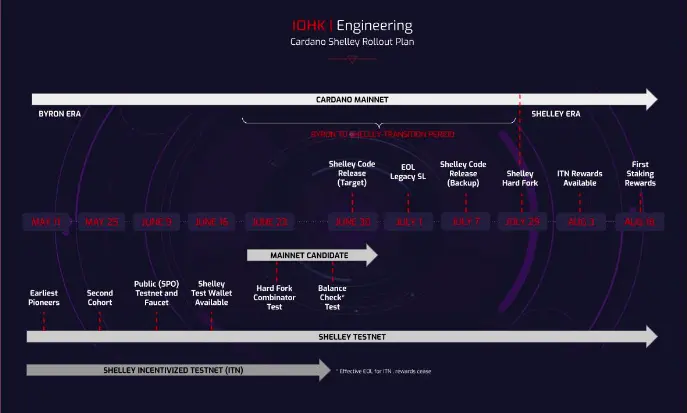
Prior to the final activation of the hard fork, the test network of the balance check will work - users must make sure that all of its funds have been transferred to the new network and that the stake is working. The first rewards for steaks will be available from August 18. A virtual Cardano community summit will also take place in early July to clarify the main points of the update.
The main distinguishing feature of the new blockchain is the addition of the possibility of staking. After updating to Cardano, the validation of blocks will occur due to the delegation of user coins to masternodes. At this time, the assets are frozen, and users are rewarded for submitting their funds for validation. For ADA holders, this is an analogue of passive income.
Staking profitability can be calculated on a special Ada Staking Calculator - it will be from 2.1% to 3.5% in ADA coins per year. For developers, staking is an opportunity to transfer control over Cardano to the community. After the update, each user will be able to create a node and delegate coins to pools.
IOHK and Emurgo, who are now responsible for the production of blocks, will initially continue to produce part of the blocks, but their share will gradually decrease until it decreases to zero. If serious flaws are found, the proportion of blocks produced by IOHK and Emurgo may be temporarily increased. But the developers believe that the “hybrid phase” will not last long and very soon the network will be completely controlled by the community. As most nodes go under the control of network participants, Cardano will become more decentralized and, as a result, will have more security and reliability.
The developers believe that after the Shelley update, the Cardano network will be 50-100 times more decentralized than Bitcoin or Ethereum, and the number of working staking pools will be about 1000 (against several dozen of Bitcoin). A 51% attack will become almost impossible. The level of decentralization that Cardano intends to achieve after the implementation of Shelley has never been achieved before.
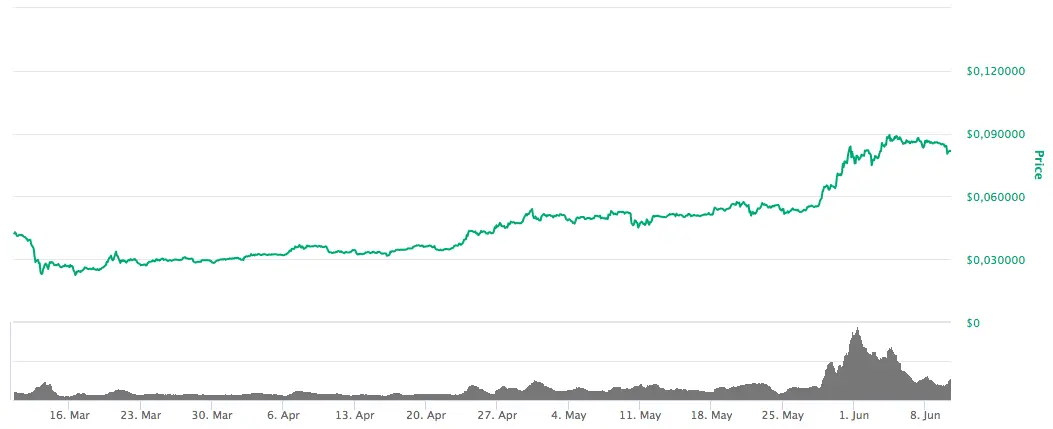
The average daily trading volume of ADA at the end of May grew over several days from ≈ $ 180 million to $ 900 million, and by June 1 it dropped to $ 290 million. It is noteworthy that Hoskinson himself in a conversation with CoinDesk noted that he considers the high price of the coin a reflection of its relevance and usefulness - it is the free market that will determine the fate of the project.
Cardano Developer Development Plans
Shelly is just the second leg of the Cardano roadmap. It is assumed that shortly after Shelly, the remaining updates will also be launched, which will make the project what the developers are claiming for - the most decentralized and scalable system. Consider the following milestones in the development of the project.
At the third stage - Goguen - smart contracts will be implemented, the second layer will be added, which is responsible for their execution, the ability to create and launch dApps, own tokens and tokenization of digital and physical assets, as well as the use of other cryptocurrencies in dApps work. A special programming language, Plutus, has been written for smart contracts, and based on it, another, simpler and more understandable language for simple users to conclude financial contracts and applications, Marlowe, is being developed.
The combination of Plutus and Marlowe will create “a new class of enterprise-class smart contracts with proven functionality that can support large-scale real-world implementations.” Goguen is being developed in parallel with Shelley - back in January, it announced the creation of an extended model of unspent outputs (EUTXO) for the implementation of smart contracts, which underpins Goguen. EUTXO will allow you to create more powerful smart contracts and divide their execution into several transactions.
Basho is the next phase where developers will focus on optimizing, improving core performance, increasing scalability and interoperability of the network to better support the growth and operation of dApps with high transaction volume. One of the main innovations will be the introduction of sidechains - blockchains of the second layer.
The final stage - Voltaire - involves the introduction of a voting system and a “treasury”, in which users can use their shares and voting rights to influence the future development of the network, and part of all operational fees will be directed to the development of the network. After this, Cardano will become a self-contained and fully decentralized self-sustaining system.
While work is underway to develop updates, the project team does not stand still. At the end of March, the release of the scaling technology Ouroboros Hydra - the off-line protocol of the second level. This will allow implementing a number of new functions, including micropayments and insurance contracts. The technology is based on Hydra sharding - dividing the blockchain into separate parts that are not integrated into the main network and process transactions outside it. Each part can process up to 1000 transactions per second, and with the goal of 1000 pools, the network can carry out up to 1 million transactions. So far this is a fantastic and unattainable result for any payment system, but the developers believe in its implementation.