UART Communications: The Backbone of Serial Data Transmission
In the field of communications and data transmission, UART (Universal Asynchronous Receiver/Transmitter) stands tall as one of the fundamental protocols for facilitating serial data transfer between devices. It plays a vital role in enabling seamless communication between different components, microcontrollers, and systems across a wide range of applications.
In this article, we will delve into the complexities of UART communications, exploring its operating principles, advantages, disadvantages, applications, and the future of this essential communication protocol.
UART Communication Protocol
Introduction to UART Communications
UART, short for Universal Asynchronous Receiver/Transmitter, is a widely adopted serial communication protocol used for data transfer between electronic devices. It has been a fundamental communication method in the electronics industry for decades, enabling devices to exchange information without the need for a common clock signal. Instead, UART uses start and stop bits to frame the data being transmitted, allowing devices to synchronize during communication.
The simplicity and versatility of UART have made it a popular choice in many applications, from industrial automation and embedded systems to wireless communication devices and the Internet of Things (IoT). Despite the emergence of more complex communication protocols, UART remains a fundamental part of modern electronics due to its flexibility and ease of implementation.
How UART Communication Works
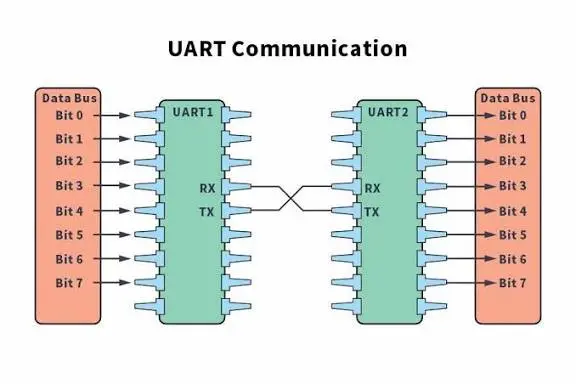
UART communication essentially consists of two main components: a transmitter (Tx) and a receiver (Rx). The transmitter converts parallel data into a serial data stream, while the receiver converts the serial data stream back into parallel data for processing.
Start and Stop Bits
UART communication uses start and stop bits, along with a data frame, to facilitate reliable data transmission. A data frame typically consists of a start bit, data bits (usually 8 bits), an optional parity bit for error checking, and one or more stop bits.
During data transmission, the start bit signals the beginning of the data frame, and the receiver synchronizes itself with this signal. Data bits carry the actual information to be transmitted, and optional parity bits help detect errors. Finally, stop bits indicate the end of the data frame.
Asynchronous Operation: One of the defining characteristics of UART communications is their asynchronous nature. Unlike synchronous communication protocols, UART does not rely on a shared clock signal between the transmitter and receiver. Instead, each data frame is self-contained with its own start and stop bits, allowing UART to operate efficiently even when devices have different clock rates.
Baud Rate and Synchronization: To ensure accurate data transmission, both the transmitter and receiver must be configured with the same baud rate. The baud rate refers to the number of bits transmitted per second. By synchronizing baud rates, devices can accurately interpret the data being transmitted and received.
Adjusting the baud rate allows for different data transmission speeds, with higher baud rates supporting faster communication. However, a balance must be struck between speed and reliability, as high baud rates can lead to errors in long-distance or noisy environments. UART Communication Advantages
This communication offers several advantages, making it the preferred choice in various applications:
Simplicity: The UART protocol is relatively easy to implement, making it compatible with a wide range of microcontrollers and devices. Its straightforward architecture allows for easy integration into electronic systems.
Versatility: UART can be used in both point-to-point and multipoint configurations, enabling flexible communication between devices. Whether it's a one-to-one connection or a one-to-many connection setup, UART can accommodate numerous network architectures.
Low Overhead: The protocol itself has minimal overhead, meaning that the data frame contains a relatively small number of bits beyond the actual data. This efficiency makes UART an ideal choice for applications with limited bandwidth or processing power.
Asynchronous Operation: The absence of a shared clock allows UART to operate effectively in situations where devices operate at different clock rates. It simplifies device design and eliminates the need for precise clock synchronization between devices.
Protocol Disadvantages
While UART offers many advantages, it also comes with some limitations:
Short Transmission Distances: UART is best suited for relatively short distances due to signal degradation over long cables. As transmission distance increases, the risk of data errors also increases, making UART less suitable for long-distance communication.
Limited Error Correction: While optional parity bits aid in error detection, UART lacks the advanced error correction mechanisms found in other protocols. Consequently, it may not be the best choice for applications requiring high data integrity and reliability.