
The five popular false myths about BTC/crypto, which the majority of crypto users believe are true, are:
1. BTC is an alternative to fiat money/currency.
2. BTC has a positive intrinsic value.
3. BTC price reflects BTC intrinsic value.
4. Buying BTC/crypto for a long time is an investment in BTC/crypto.
5. Hardware crypto wallets are the most secure crypto wallets.
The truths are:
1. BTC is a fiat digital currency on the blockchain. This fact is directly reflected in the title of the famous paper of BTC inventor. For the reason that BTC is a fiat currency, it can not solve problems caused by other fiat currencies/money. Therefore, BTC can not be an alternative to the current fiat money system, because BTC is a part of the current fiat money system.
2. BTC has positive extrinsic values, but zero intrinsic value.
The fundamental economic law: the adjusted to inflation price of any asset, in the long run, move close to its intrinsic value. This fundamental economic law was never broken in the history of all human civilizations. For the reason that BTC has zero intrinsic value, in the long run, BTC price, adjusted for inflation, will move close to zero. For this reason, value investors like Warren Buffett, Charlie Munger, Peter Lynch, Li Lu, Howard Marks, etc. do not speculate on BTC price movements, but instead invest in assets with intrinsic values growing over time, mostly in companies with strong long-run competitive advantages and pricing powers.
3. BTC price is not the same as BTC intrinsic value. They are very different “animals”. But, there is the relation between them expressed by the fundamental economic law: the adjusted to inflation price of any asset, in the long run, move close to its intrinsic value. BTC price, adjusted for inflation, in the long run will move close to zero, because BTC intrinsic value is zero.
4. Time horizon is a false criterion for investment, in the same way as an issuer or limited supply are the false criteria for fiat money/currency.
The correct criterion for a fiat asset/currency is the following question: is an asset/currency backed by and convertible to a commodity, like gold, or not? The correct criterion to distinguish speculation/trading from investment is a purpose.
If users look on price movements and expect to make profit from buying/selling assets then this is speculation/trading.
If users do not care about prices and buy assets in expectations that the intrinsic value will increase over time then this is investment.
If users buy assets to protect their wealth then this is insurance.
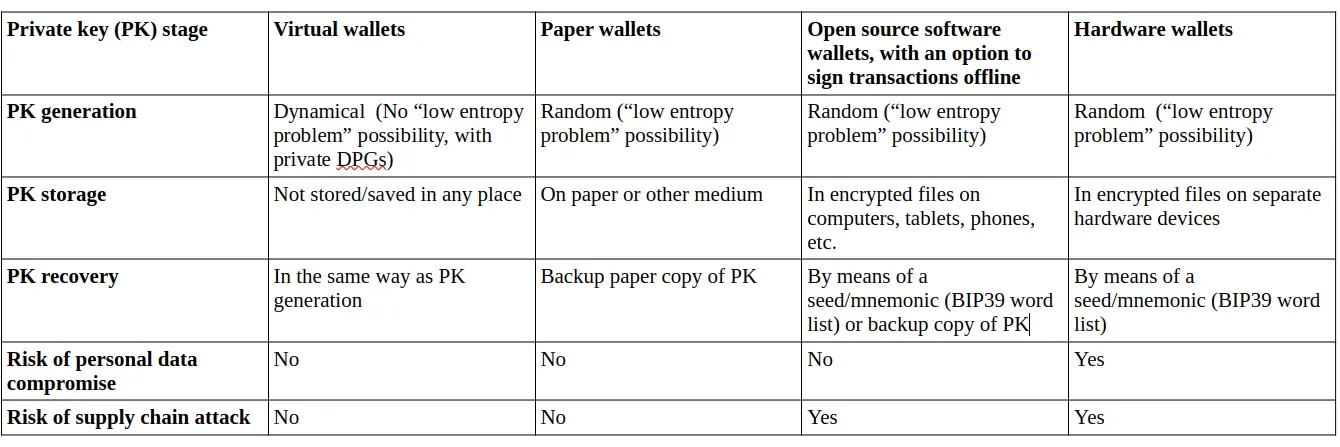
5. The most secure crypto wallets are virtual wallets because they have no vectors attacks and vulnerabilities that other wallets have (no physical attacks, no supply chain attacks, no “low entropy” problem, no risks related to personal data compromises, etc.). For the whole history of crypto industry (17 years) there was no a single hack of a virtual wallet, but there were many hacks of hardware/cold and software/hot wallets. The most famous is the Bybit hack, which resulted in the loss of over $1.4 bln. The recent Coldcard losses over 115 mln. due to “low entropy” problem, demonstrated to public some hidden risks and vulnerabilities in hardware wallets. Prominent on-chain investigator ZachXBT publicly dismissed hardware wallets as "complete garbage".
When people buy hardware wallets, their data is collected and stored in corporate databases. If these databases are compromised then the personal data is exposed to criminal networks, which leads to increased risks of phishing, spam, social engineering attacks, malware infections, home break-ins, $5 wrench attacks, etc.
The second, ranked by security after virtual wallets, are paper wallets. They are not as secure as virtual wallets because they store private keys on paper or other medium, but they are more secure than hardware and software wallets, because they do not have supply chain vulnerabilities and risks associated with personal data compromises.
Paper wallets have a larger surface of possible attacks than virtual wallets. Here is a list of possibilities, how paper wallets usually get compromised:
Compromised Generation Tools (Malicious Generators): In the early days of Bitcoin, many users often used online JavaScript-based paper wallet generators. If the website was hosted on a compromised server, or if a user used a fake/phishing generator, the website secretly used a weak or pre-determined random number generator. The creator of the site already knew the private keys and could steal the funds later. The generation of private keys and seeds should be done with offline generators to avoid the risk of compromised private keys/seeds, in paper wallets.
Physical Theft or Visual Exposure: Photos taken of paper wallets, physical recovery notes left in unsecured locations, or webcams recording a user printing or writing down a private key have led to targeted thefts.
Printer Memory Exploitation: Modern network-connected printers often save copies of printed documents in an internal hard drive or cache. If a paper wallet was printed on a shared or office wireless printer, a technically adept person with access to the printer's local memory logs could retrieve the image of the private key.
Some famous historical examples:
The BitcoinPaperWallet.com Backdoor/Scam (2018–Ongoing) – Millions Lost (Cumulative)
Originally a trusted open-source platform founded by Canton Becker, the site was sold to an anonymous buyer in April 2018. The new owners quietly altered the underlying JavaScript code. The generator began providing users with pre-determined "testing keys" or recording the private keys directly to a server. Unsuspecting users printed their paper wallets thinking they were completely offline, only for their funds to be swept months or years later once substantial crypto balances were deposited.
The WalletGenerator.net Vulnerability (May 2019) – Potential Millions at Risk
Security researchers at MyCrypto discovered that one of the top paper wallet generation sites had diverged from its public GitHub code. Instead of generating unique cryptographic keys using true client-side entropy, the site's live bulk-generator was caught cycling through a deterministic pool of only 120 unique keys per session. This meant completely unrelated users were being handed identical public/private key pairs. Such vulnerability is called the “low entropy” problem. Though patched quickly after the public exposure, any paper wallets printed during the affected periods were highly compromised.
Virtual wallets do not use random generators to avoid the “low entropy” problem. Instead, they use dynamical generators.
Users of online virtual wallets can reduce risks of server-side attacks by using “salting” or other methods together with offline tools to generate private keys and seeds.
The third, ranked by security, are open sourced software wallets, which allow users to sign transactions offline and do not collect personal information. Examples of such wallets are: Bitcoin Core, BlueWallet, Electrum. These wallets can be used to sign crypto transaction offline, with private keys generated by virtual wallets and deleted/removed from the software wallets, after signing transactions. In this way, private keys never will be exposed to internet and will not be saved/stored in any place. Therefore, they can not be hacked, stolen, compromised, damaged, forgotten, confiscated, etc.
Hardware wallets are only on the fourth place, ranked by the security criterion.
Users, who use virtual or paper wallets, do have the direct access to their private keys, but users, who use hardware or software wallets, do not have the direct access, only an indirect access, via software interfaces provided by wallets manufacturers. If other people have access to your private keys, via these or other software interfaces, then they can use them not in your best interests.
Virtual, paper wallets and some open sourced software wallets do not have all the risks associated with personal data compromises, because they do not collect any personal information from users.
Summary table
The reasons, why the majority of crypto users believe in these five false myths are:
1. These crypto users use not correct criteria for fiat money/currency (issuer, limited supply, etc.), instead of the correct criterion (is the currency backed by and convertible to a commodity, like gold/silver). In addition, they can not understand that cash is fiat money, not commodity based money, in the 21st century. When a person understand that cash is fiat money/currency, the person can look at the title of the famous paper of BTC inventor: Bitcoin: A Peer-to-Peer Electronic Cash System" and come to conclusions that:
a) electronic cash is digital fiat money/currency;
b) a peer-to-peer system is a blockchain;
c) a peer-to-peer electronic cash system is a digital fiat currency on a blockchain.
2. These crypto users confuse extrinsic values with intrinsic values.
3. These crypto users confuse values and prices and lack the knowledge of the fundamental economic law: the adjusted to inflation price of any asset, in the long run, move close to its intrinsic value.
4. These crypto users use the not correct criterion (time horizon), instead of the correct criterion (purpose).
5. These crypto users confuse popularity and convenience with security, and lack the technical knowledge to understand the hidden risks and vulnerabilities of hardware wallets.
P.S. If you ask AI about these myths then you will get wrong answers.





