
In this post, we consider the Four knights’ game in chess.
- e2e4, e7e5.
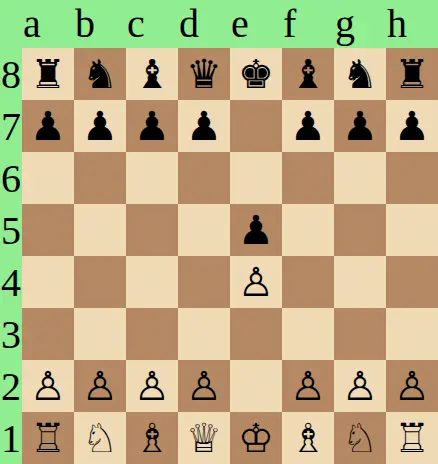
2. g1f3, b8c6.
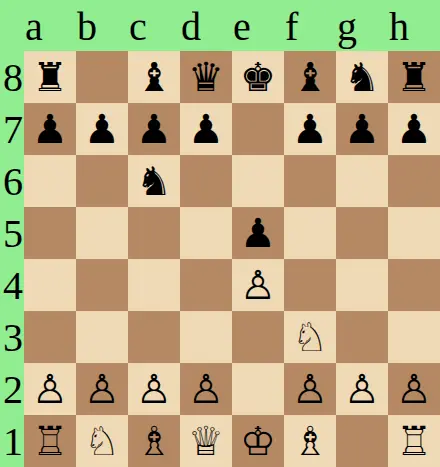
3. b1c3, g8f6.
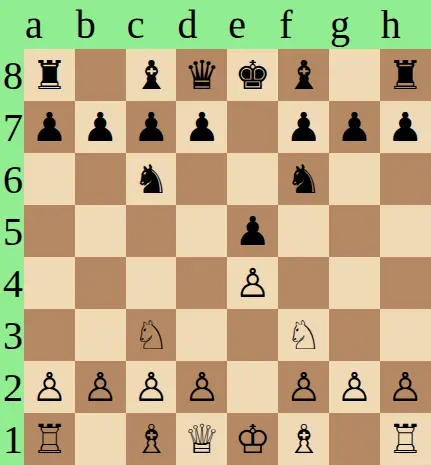
4. f1b5, f8b4.
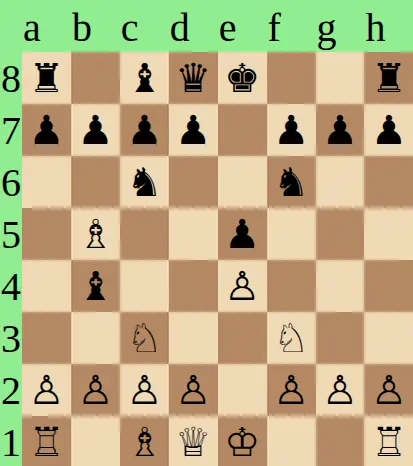
5. e1g1, e8g8.
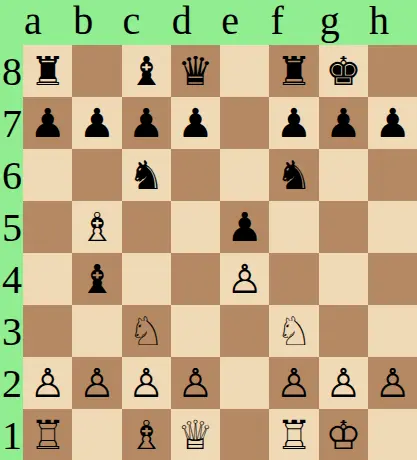
The Four Knights Game is a classical chess opening dating to the mid-19th century, characterized by the symmetrical development of both knights to their natural squares. Popularized for its adherence to opening principles, it was frequently played by elite masters like Capablanca and Tarrasch in the late 1800s.
The opening received early theoretical attention in Howard Staunton's seminal work, The Chess-Player's Handbook (1847), which analyzed knight-centered lines and highlighted the Four Knights' potential for equalizing chances through mutual development. Staunton, a leading authority and tournament organizer, praised such setups for their adherence to classical principles, though he noted opportunities for sharper play if one side deviated from symmetry. This publication helped solidify the opening's recognition, coining its name based on the distinctive alignment of the four knights targeting the center.
Notable early adoption appeared in competitive play, including the First American Chess Congress in New York (1857), where Louis Paulsen opened against Paul Morphy with the Four Knights, leading to the Spanish Variation (4.Bb5). Morphy, as Black, responded with 4...Bc5, ultimately winning in 28 moves that showcased the opening's resilience and potential for complex middle-games. Such contests demonstrated the line's solidity, often resulting in drawn or even positions despite the Romantic preference for unbalanced fights.
By the late 19th century, the Four Knights was viewed as somewhat drawish due to its inherent equality, contrasting sharply with aggressive alternatives like the King's Gambit or Evans Gambit that dominated the era's literature and matches. This perception stemmed from games where both sides achieved safe king safety and central control, limiting decisive breakthroughs unless errors occurred in the transitions to the middle-game.
Prominent adopters included Isidor Gunsberg, who in the 1890s frequently employed 4. a3—now known as the Gunsberg Variation—to challenge blacks pin and assert queen-side space, influencing its nomenclature and early theory. José Raúl Capablanca, facing the opening often in his career, contributed to blacks defensive resources in the early 1900s, demonstrating equal play via timely breaks like ...d5. Mikhail Botvinnik occasionally featured it in simultaneous exhibitions during the 1930s and 1940s, using it to showcase classical development against weaker opposition, as seen in his 1930 win over Y. Rokhlin.
In modern databases, the Four Knights appears in fewer than 1% of elite games from the 2000s onward, reflecting its marginal status among top grandmasters who prefer sharper alternatives. However, it enjoys sustained popularity in online blitz and rapid formats, where its traps and simplicity suit fast-paced play, with Lichess and Chess.com studies showing higher adoption rates at intermediate levels. Recent adopters include young grandmasters like Wei Yi and established figures such as Magnus Carlsen and Alexei Shirov, who have employed it in blitz events during the 2020s for surprise value and solid equality.
For more info, see [3-6].
If you want to know how to play chess without any registrations, uploads, installations on any device connected to internet (including a mobile phone) then, see [1].
If you want to know how to earn some money/crypto by playing chess games online then, see [2].
References:
1. https://www.dynpass.online/tools/chess/start.html
3. https://www.youtube.com/watch?v=-FRuDd_oXz4
4. https://www.chessable.com/blog/four-knights-game/
5. https://www.chessgammon.co.uk/blog/four-knights-game/
6. https://chessklub.com/chess-openings/four-knights-game/





