
Because popular cryptocurrency makes it difficult to exceed $ 10,000. What determines the rise and fall in price. How does Bitcoin placement affect the ... generational divide.
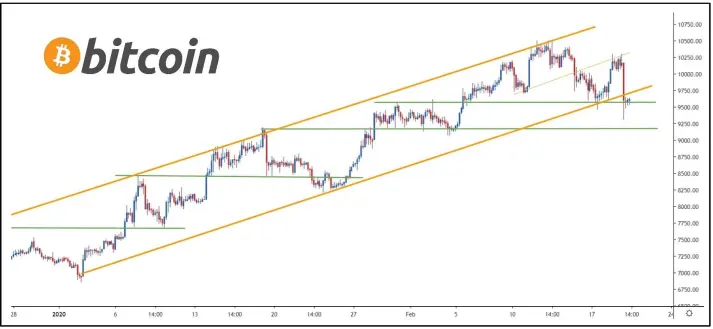
Yesterday's decline of Bitcoin by $ 900 from 10,200 to 9,300, although recovering some of the losses immediately, has called into question the continuation of the uptrend. As we can see in the 4 hour chart, the channel with the orange parallel lines clearly broke. The support (green horizontal line) functioned as a security pad, resulting in the Bitcoin price trading around $ 9,600 in recent hours. If it breaks down, the next support stands at $ 9,200.
Of course, we had similar corrections in altcoins as well. So far there has been no specific reason for this sudden correction. In one version, it could be related to the unscheduled maintenance of Binance, the largest crypto exchange marketplace.
Binance, however, was quick to reassure the public with a statement. Ensure that it works properly and that all of its clients' funds are safe.
The most convincing explanation is that this is nothing more than one of Bitcoin's usual steep moves. The increase that has been made lately is significant, so it is expected that there will be attempts to secure profits. By the beginning of the year, Bitcoin's growth had surpassed 50%, while in other cryptocurrencies their rate of growth was much higher.
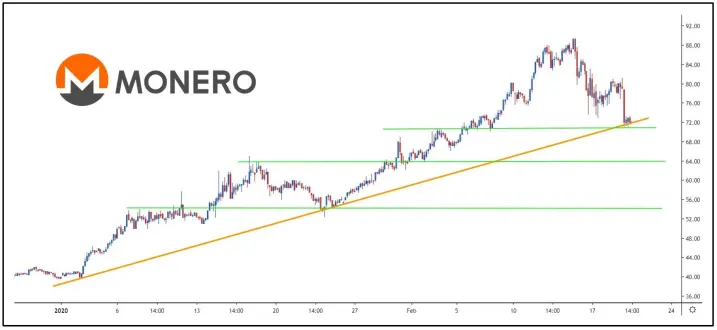
For example, in the following 4-hour chart we see the Monero (XMR) in a pair with the euro, which landed just above the trend line. If it breaks down, the green horizontal lines are possible support levels. Monero, since the beginning of the year until last week, has gained 125%.
What determines the rise and fall of the Bitcoin price
The course of the crypto market, like any other market, depends on two variables: cash inflows and outflows. Let's look at Bitcoin for these two parameters, starting with the effect of impending halving in May. What does halving mean? That the money supply from the production of new coins is planned to be cut in half every four years. This has two consequences in practice:
The first is how the pressure from the sellers is reduced. For the past 4 years, 1,800 new Bitcoins have been created every day, the vast majority of which are for sale. If we do a rough calculation, the 1,800 Bitcoins make us about $ 15-20 million that go on sale every day. In other words, this means that new, fresh, $ 15-20 million dollars need to enter the market every day just to keep the price of Bitcoin down and not a cent.
The second concerns the rarity. The rate of inflation after halving in May will be reduced to a critical 1.8% of the existing volume. Why is this important? It will be about the same as the corresponding increase in the annual rate of gold supply, which is 1.6%! In other words, for the coming four years, it will be as rare as gold, and the next, even rarer.
Another reason that it is difficult to get $ 10,000 worth of Bitcoin is that whenever it exceeds this limit, it has been observed that the addresses associated with the Plus Token pyramid have been sold. As we have mentioned in previous articles, many Bitcoin and Ethereum have been accumulated, but they are starting and ending.
In terms of demand, the key parameter is that of institutions that are slowly entering the space. Bitcoin overturned power correlations. So far, the big players have been the ones who have the advantage. Those who bought high were the marinas, but now the roles have been reversed. For the first time in stock market history, big Wall Street players will have to buy far higher than the average individual who believed in the Bitcoin philosophy in a timely manner.
Finally, the generation gap should be mentioned as an important factor. Crypto is an asset held by younger people as they feel more intimate with it. Older adults do not understand it or do not readily understand its philosophy and its particular way of working.
An Intervista survey conducted in Switzerland on 1,500 people, commissioned by Migros Bank, was made public last week. The results have shown that cryptocurrencies are becoming increasingly popular among Swiss. 7% of 18- to 55-year-old savers hold cryptocurrencies in their portfolio. However, the rate varies with age.
In the younger group of respondents (between 18 and 29 years), 13% said that crypto will become even more important for them in the future. Of those over 55, only 0.5% said they believed in long-term growth. In the long run, however, it is a matter of time for the wealth now concentrated on the older to pass on to the younger.





