
Goal: To understand what SKALE Network is, and its importance as “THE” Layer 2 Scaling Solution for Ethereum. Diving deep from the basics to more elaborated concepts while discovering all the resources to keep up to date and make the most of SKALE either as an investor or as a Blockchain Developer.
WELCOME to the SKALE WORLD |
Where you can forget about the limitations of traditional blockchain development!
Before we jump right into the topic… This article is intended to be a Crash Course to educate someone new to SKALE. Therefore it is fundamental that we have a good understanding of what Blockchain is first— Either as an introduction or as a review… Let’s take a quick look

Everything starts with a list that shows who owns what:

Let’s say you want to send money (1 coin) to your friend — A transaction is created

You created the transaction then the list is constantly and automatically updated by creating a block with the current values, therefore with a new transaction a new block is created and added next to the previous block, thus generating a chain of blocks : THE BLOCKCHAIN
When a block is filled it is set in stone and becomes a part of the irreversible timeline of data. Each block is given an exact timestamp when it is added to the chain.
So is Blockchain just a database ?
…More than that, Blockchain is:
Digital
- Data is stored electronically on a computer system.
- It’s online.
Distributed
- Anybody with internet can access it (view only).
Decentralized
- No one owns it or controls it (community owned).
Immutable
- The data entered can’t be reversed (nor edited).
How is Blockchain safe ?
with every transaction, a Hash is created using encryption,you can ensure that no one can fake the transaction - not even yourself. Each transaction is contained within some notes about that recently solved math problem.
Each block contains its own hash, along with the hash of the block before it, as well as the time stamp. Hash codes are created by a math function that turns digital information into a string of numbers and letters. If that information is edited in any way, the hash code changes as well.
Blockchain is one of the most talked-about technologies in business right now. Blockchain technology has the potential to drive major changes and create new opportunities across industries — from banking and cybersecurity to intellectual property and healthcare. However it is still an emerging technology on a relatively early stages.
Scalability is one of the most important problems in blockchain and has been the focus of both industry practitioners and academic researchers since Bitcoin was born.

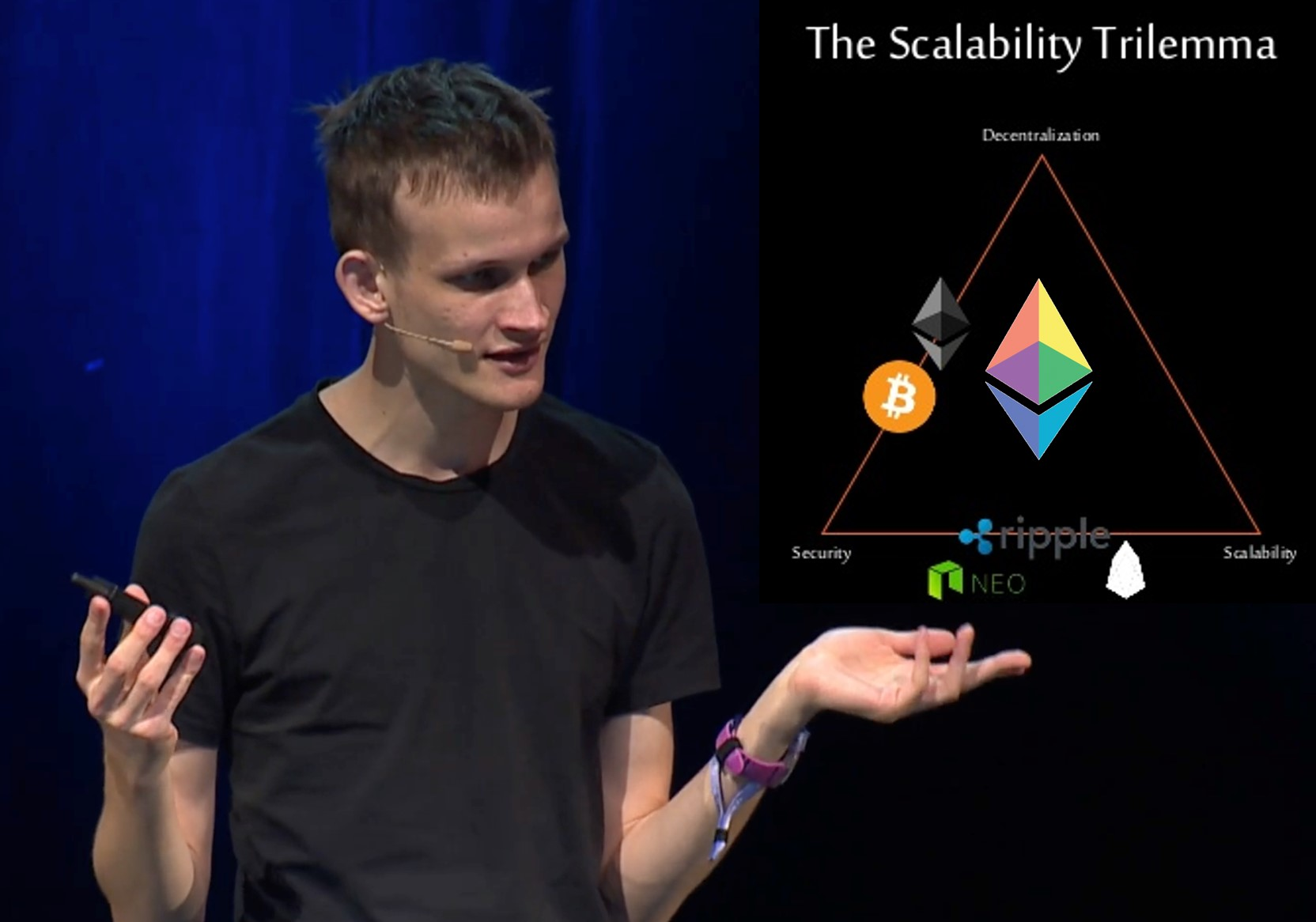
“Why is scalability so hard? I often talk about the ‘scalability trilemma’, where I say that blockchain systems have to trade off between different properties. And it’s very hard for them to have three things at the same time, where one of them is decentralization. The other is scalability, and the third is security.”
→ Vitalik Buterin, November 2017
Scaling solutions are technical adaptations and improvements to blockchain networks focused on solving the scalability trilemma. There are generally four categories of blockchain’s scaling solutions:
- Layer 1 on-chain solutions.
- Layer 2 off-chain solutions.
- Scalable consensus mechanisms.
- Distributed ledgers.
Layer 1 solutions require changes to be made onto the codebase of the actual blockchain. This entails enhancing the core features and characteristics of the blockchain.
Layer 2 is a collective term for solutions designed to help scale applications by handling transactions off the main Ethereum chain (layer 1). This is helpful in the short-term, as it relieves the Ethereum network of congestion, and in the long-term, keeps the blockchain free of “unnecessary” transaction history.
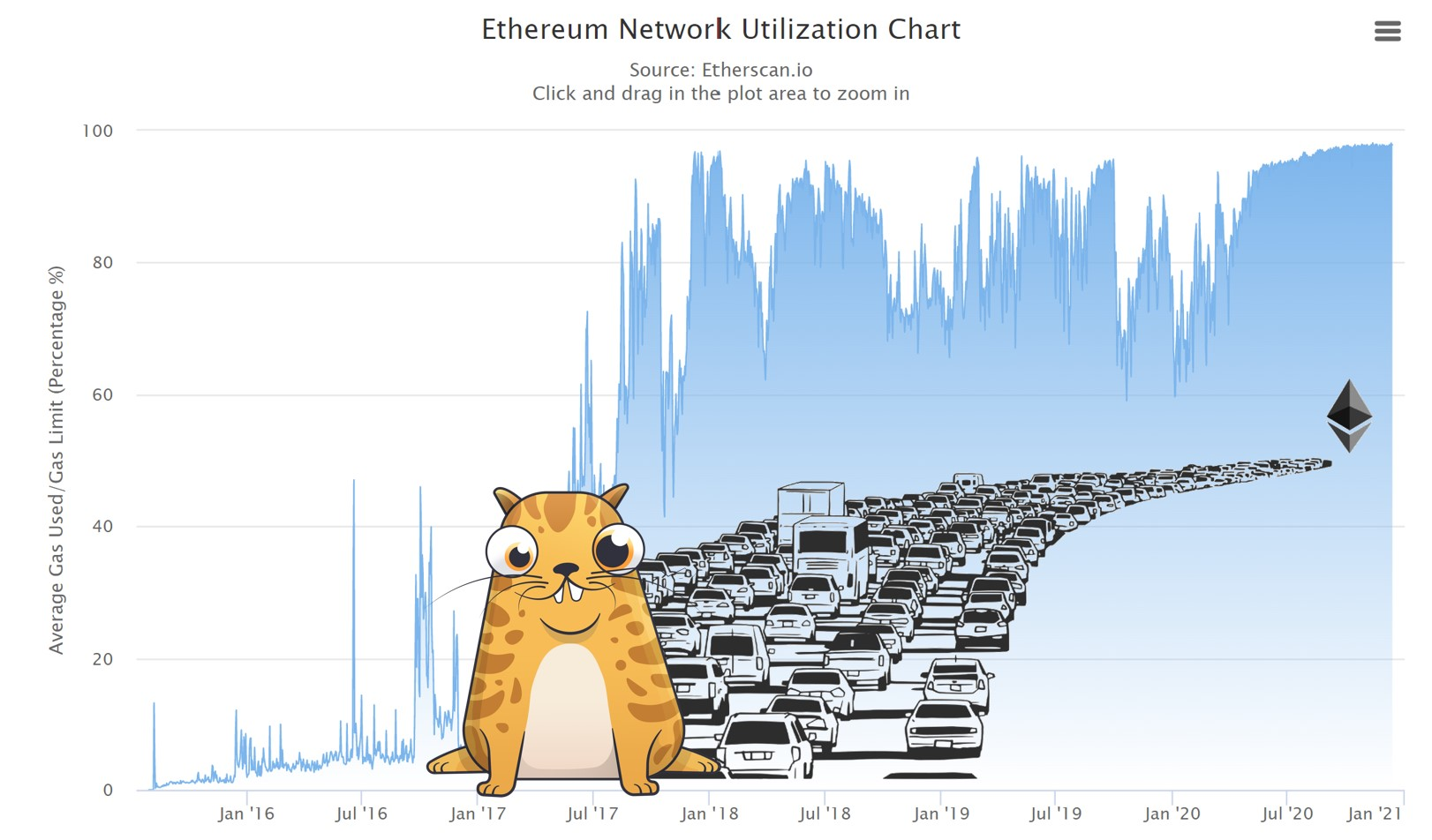
Ethereum is the biggest ecosystem to build Decentralized Applications and its Network utilization just keeps increasing.
However Ethereum isn’t quite ready yet. Transactions take a long time to clear and paying for every basic function is expensive and creates a poor user experience. Both poor throughput and cost have been massive barriers to any meaningful adoption.
- Ethereum needs to be able to handle more transactions per second (TPS) coupled with more nodes without increasing the size of the nodes in the network (More nodes means more security) — Increasing node size isn’t practical because only those with powerful and expensive computers could do it.
- It can be unnecessarily expensive to use blockchain applications.
- Some use-cases, like blockchain games, make no sense with current transaction times.
- Not only Ethereum but also Bitcoin among other blockchain networks have scaling problems.

SKALE is an elastic and decentralized blockchain network connected to Ethereum that supports high-throughput and low-latency transactions without the high transaction costs found in Ethereum, public mainnets, as well as thousands of independent blockchains, sidechains, storage chains, and other types of sub-chains.
As a Layer 2 scaling solution it forms an execution layer in the form of high-performance chains that facilitate transactions based upon on-chain escrows.
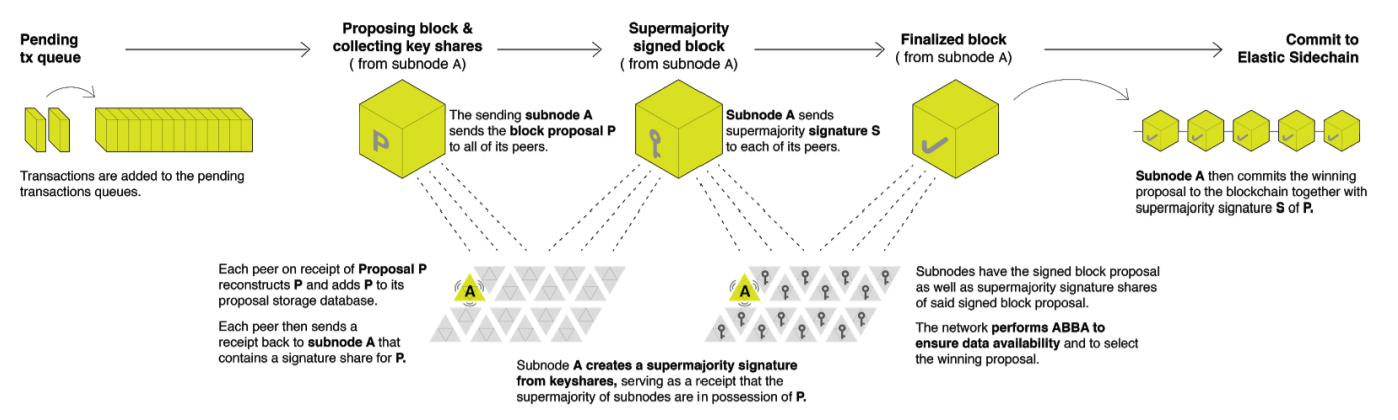
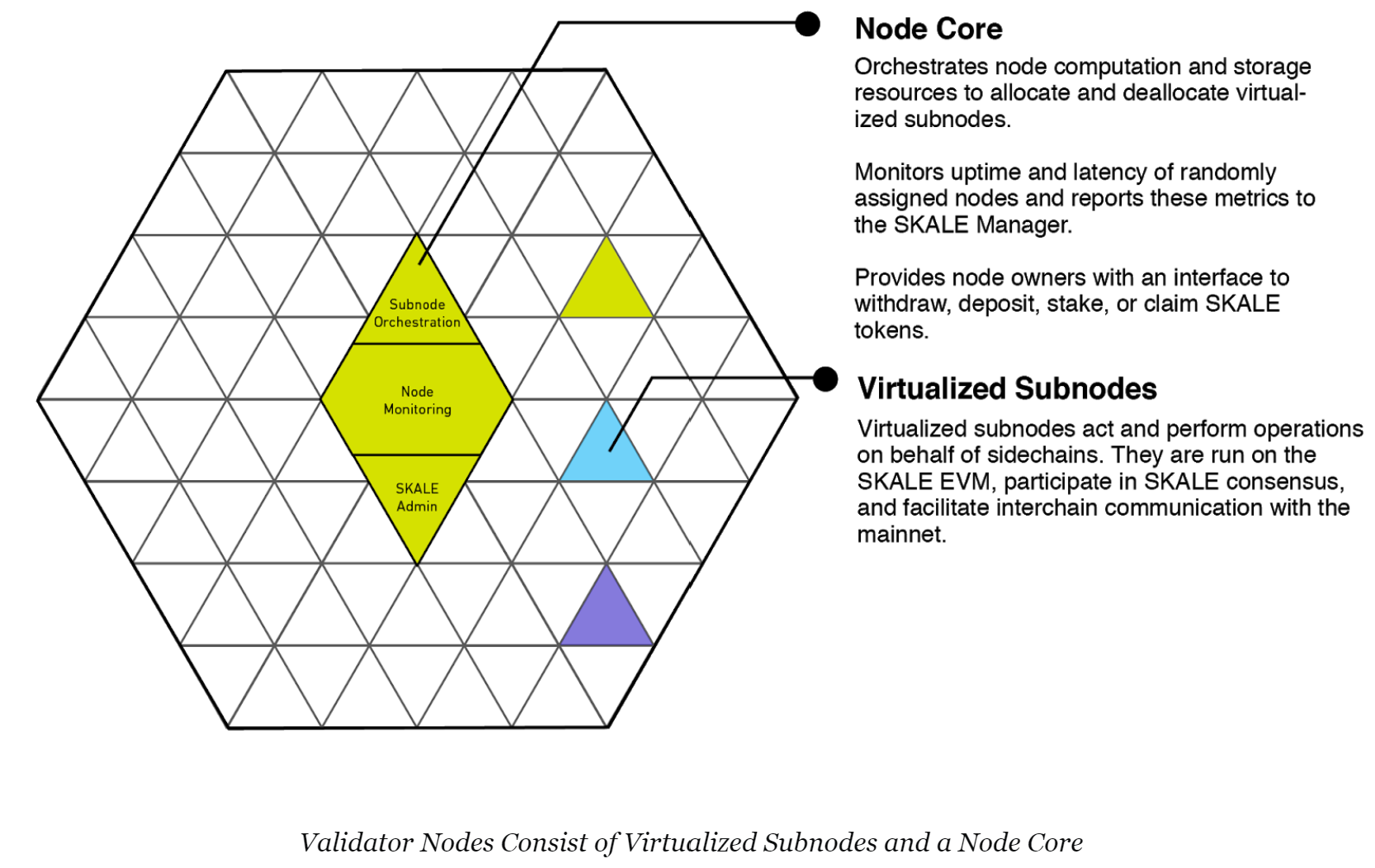
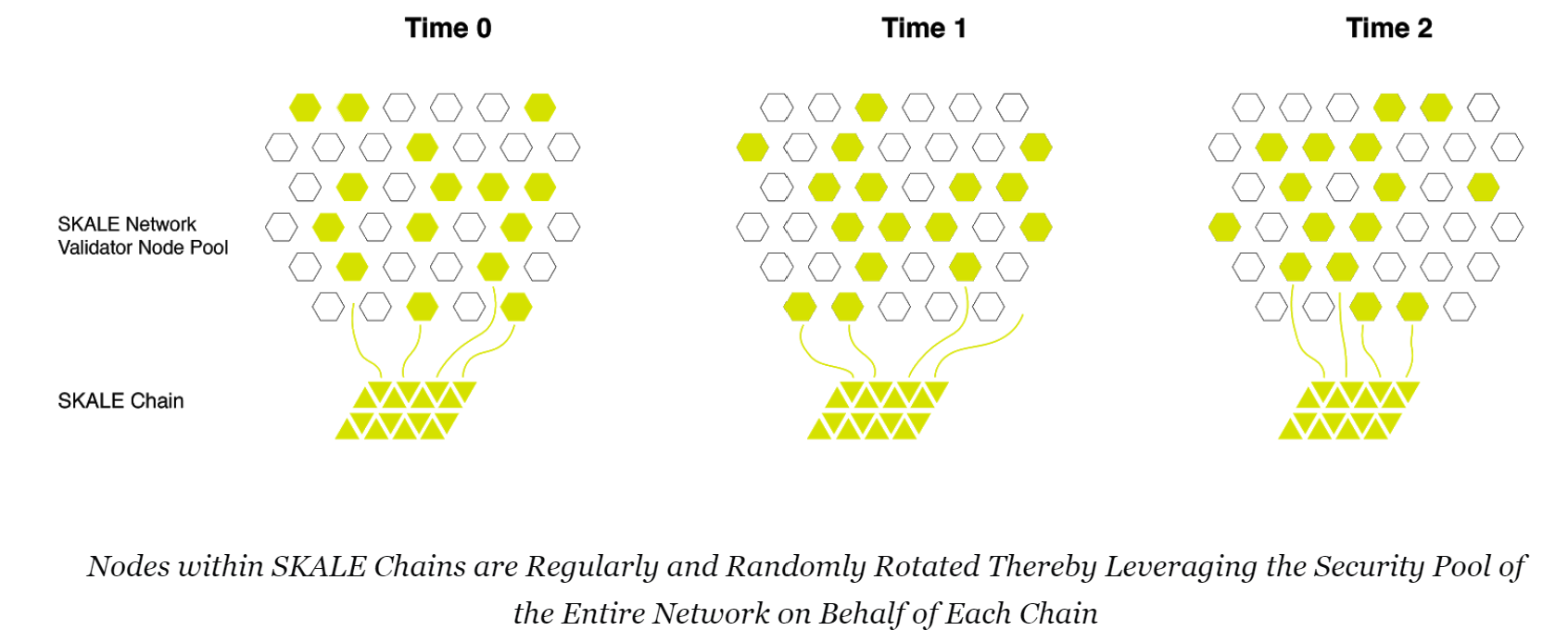
The SKALE Network is continuously adding more decentralized nodes around the world. A sub-set of these nodes are grouped together to create the SKALE chain for the particular application that the developer requires. Allowing them to execute Smart contracts, chain messaging for managing the tokens, decentralized storage and more cool features…
As a developer you can decide the size (Small — Medium — Large) of chain that you need to meet your requirements depending on the stage of the application. → As your solution grows, your SKALE Chain will grow with you
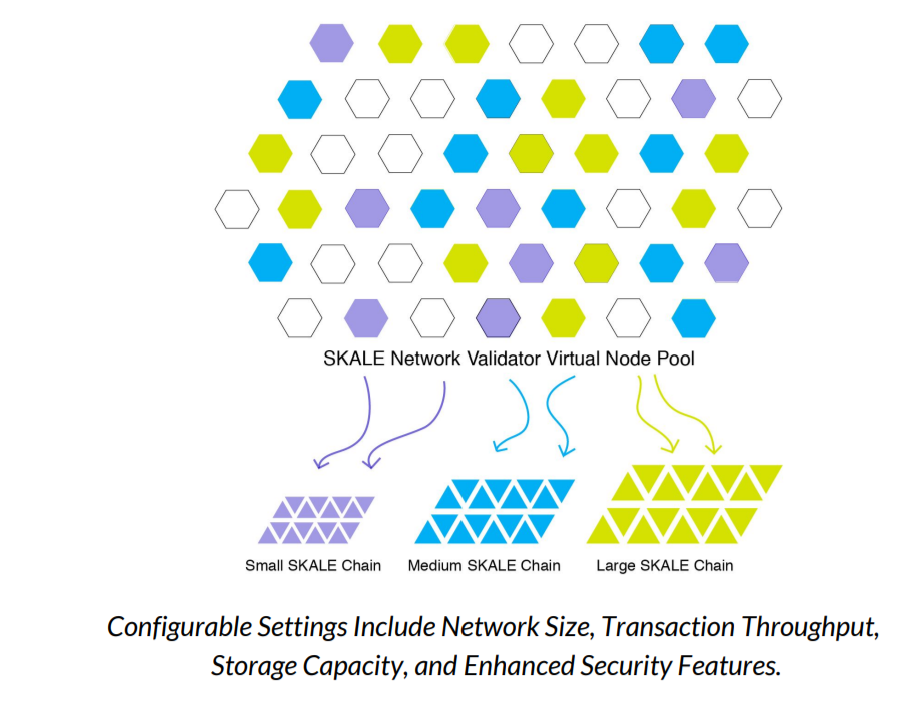
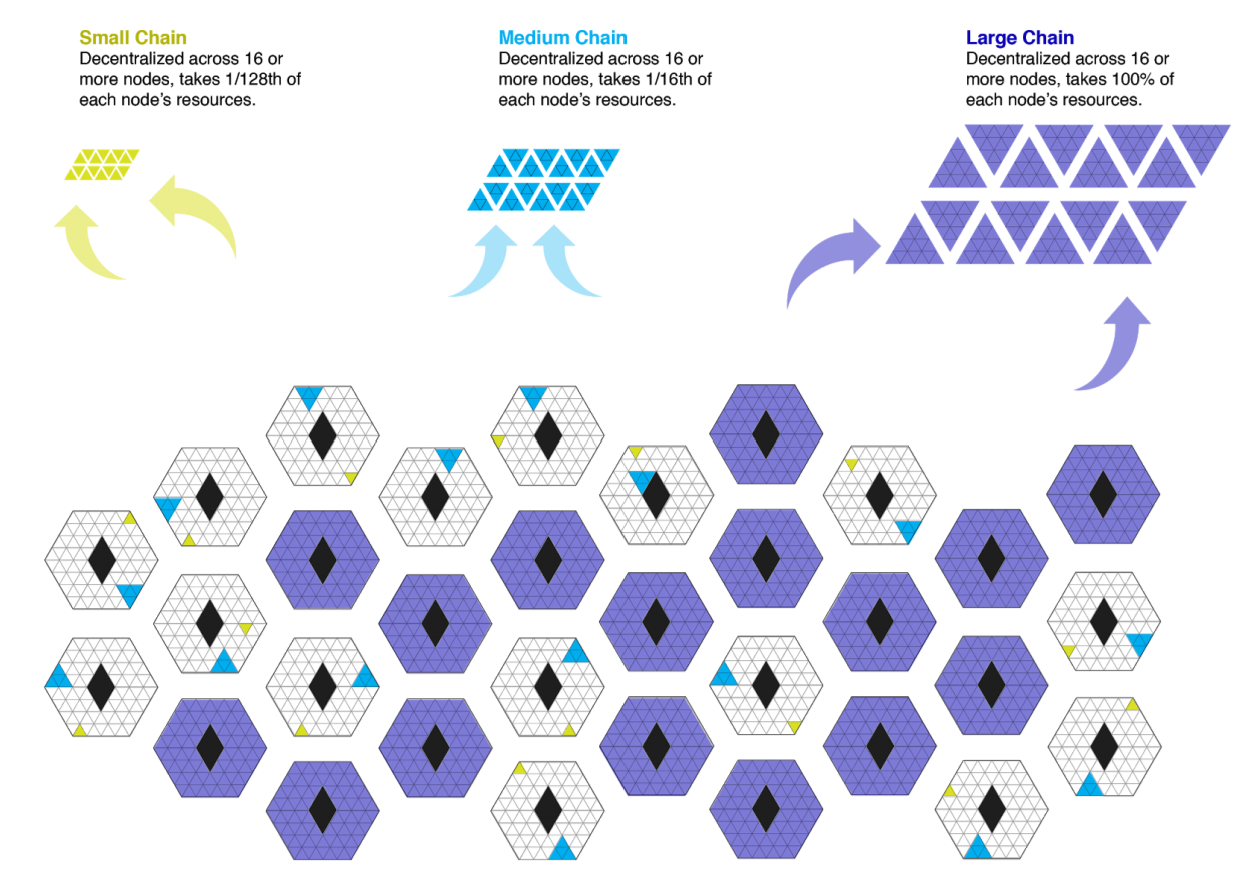
SKALE is empowering Ethereum Decentralized Applications (dApps) to scale Smart Contracts in a secure, reliable, cost-effective manner with these Elastic Side Chains by building a layer of infrastructure on top of Ethereum that will allow developers to build their projects faster and with better performance.

The network offers expanded storage capabilities along with embedded connectivity and interchain messaging with the Ethereum mainnet.
All of this is performed using a pooled transaction validation and security model that is:
- Efficient.
- Scalable.
- Collusion-resistant
- Grounded in 4 pillars.
1. Leaderless.
In many other existing decentralized / distributed consensus protocols, there is a leader (block) elected for each round to propose some data for the network to run consensus and reach agreement on. Whereas SKALE is different.
SKALE protocol serves:
- To prevent collusion amongst network participants.
- To ensure that all virtualized subnodes participating have a fair chance to propose a
blockwithin a chain.
2. Asynchronous.
In an asynchronous timing model, there are no bounds or expectations placed upon how long it will take for a message to be delivered within the network. This model accurately captures the current state of how the Internet functions, where nodes in the network fail and messages are dropped all the time.
3. Byzantine Fault Tolerant (BFT).
BFT is the standard for security in distributed systems; which guarantee that nodes in a network can always agree on the same consensus in the present of <⅓ malicious nodes.
Amongst various implementations of BFT, those which are asynchronous (ABFT) are amongst the strongest because these account for the possibility that some messages between honest participants are being delayed or not being delivered to their intended recipients.
4. Threshold Signatures.
Threshold signatures are used for supermajority voting. Upon creation of an Elastic Sidechain, Boneh Lynn Shacham (BLS), Private Key Shares (PKS) are created using joint-Feldman Distributed Key Generation (DKG) and issued to each virtualized subnode.
For each PKS, there exists a verifiable public key PK which is stored and made publicly available on the SKALE Manager for signature verification purposes.
Threshold signature is a distributed multi-party signature protocol that includes distributed key generation, signature, and verification algorithms.
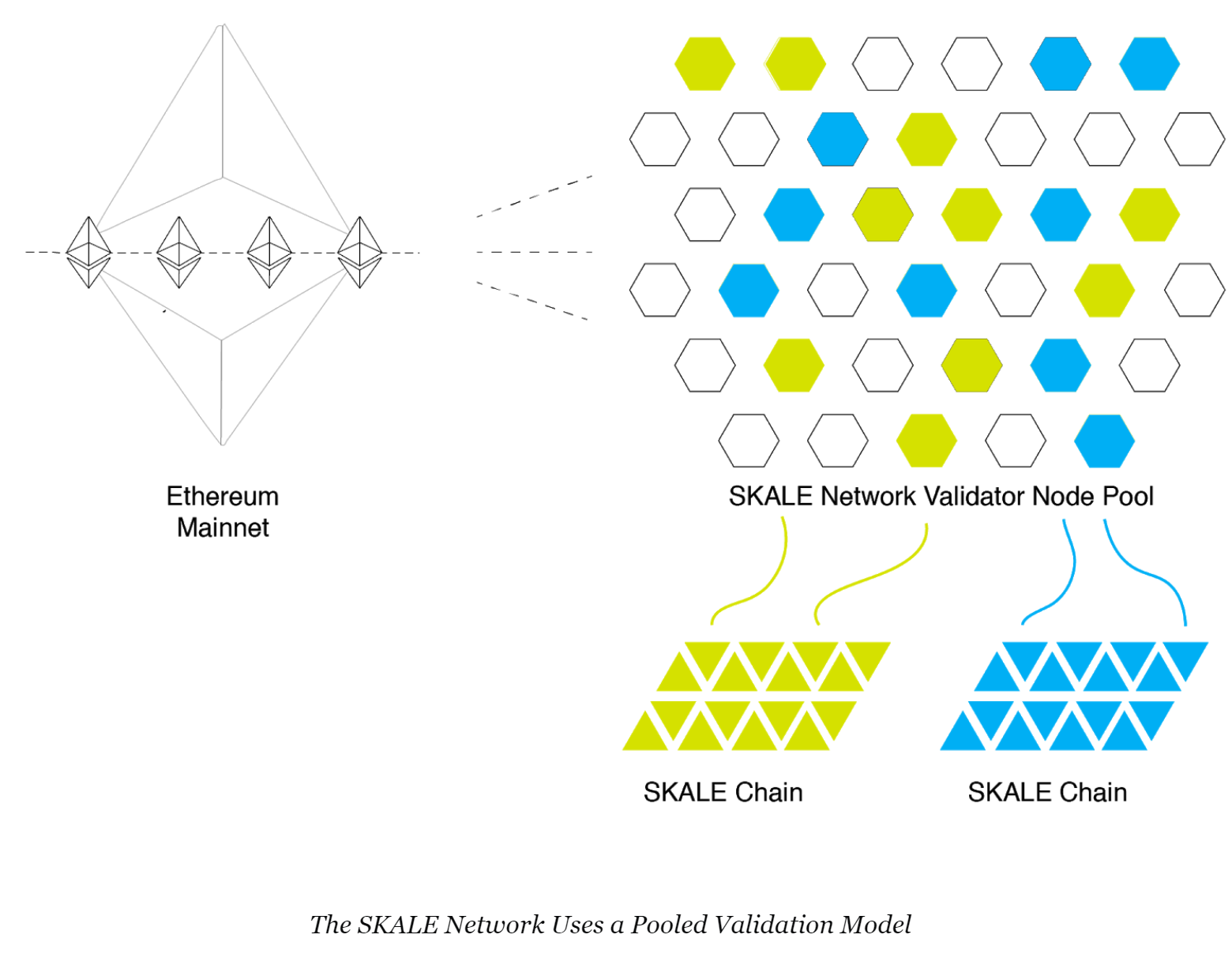
The SKALE Network contains thousands of independent nodes in combination with security guarantees of a Layer 1 but architected to use resources in a more efficient and versatile way.
A thousand validators in the SKALE Network, for example, can support 8,000 independent chains. These chains could range from the smallest of sidechains to very large public or private blockchains.
How the Network operates and is organised ?
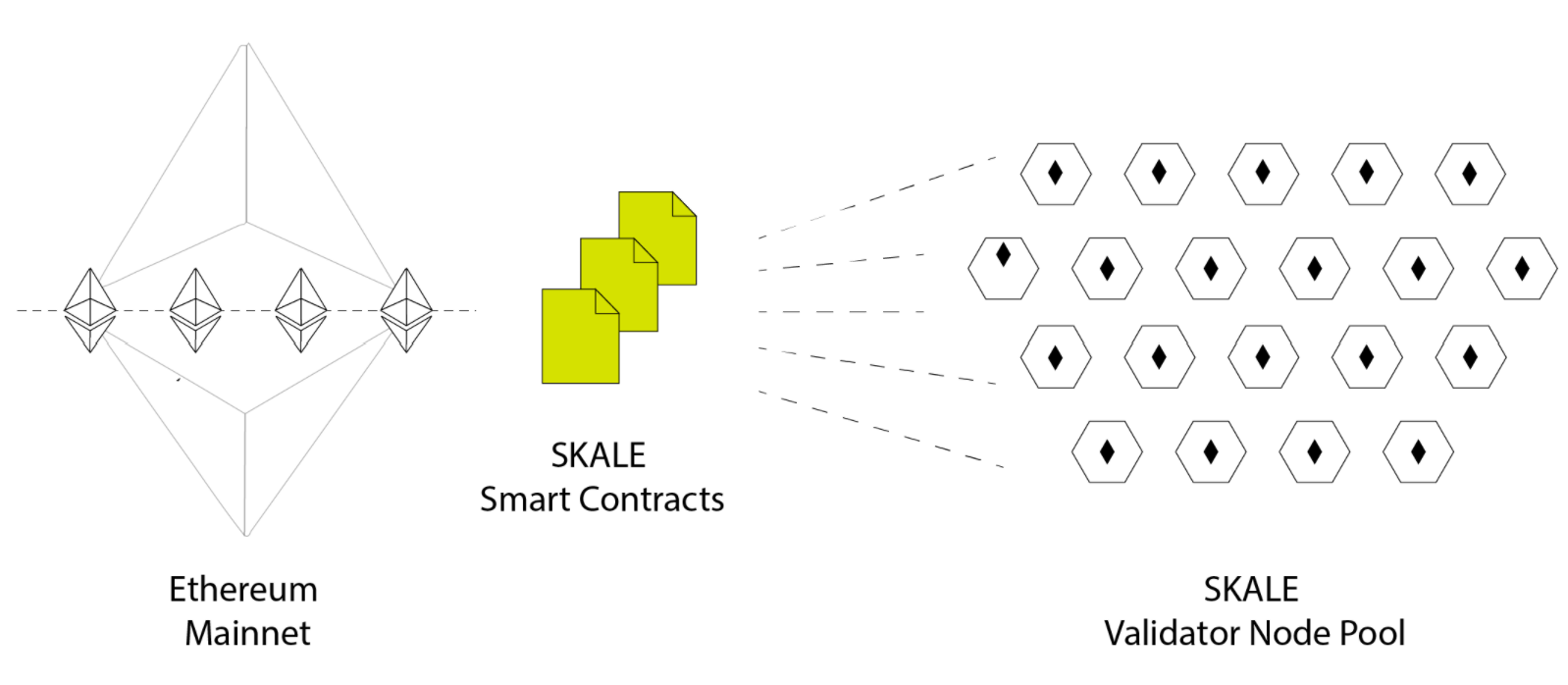
How does SKALE connect to Ethereum?
App-specific chains connect to Ethereum via the SKALE Manager smart contract that exists on the Ethereum mainnet and serves as the point of entry and exit to all other smart contracts in the SKALE ecosystem.
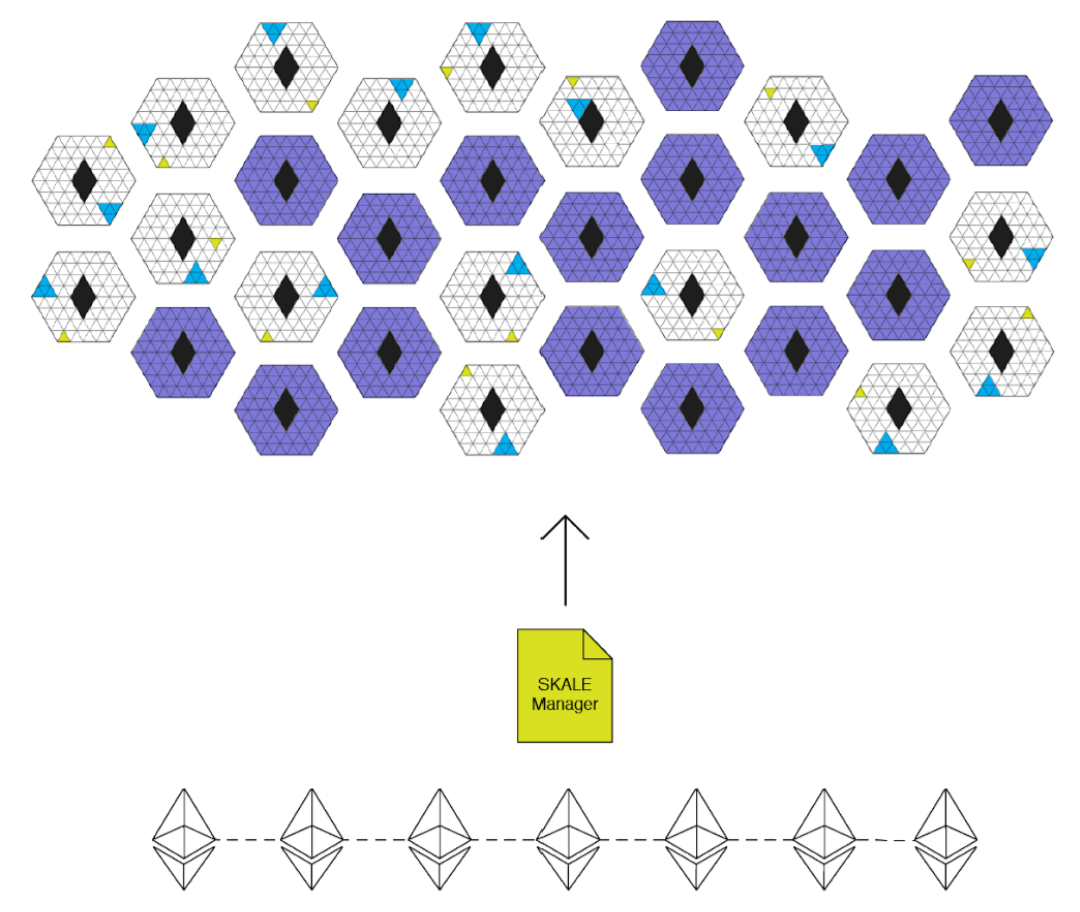
dApps deposit their tokens to the SKALE Manager smart contract, which manages the orchestration of all entities within the network, inclusive of Elastic Sidechain creation / destruction, Node creation / destruction, withdrawals, and bounties.
👉For a better understanding of the SKALE security mechanism → check out the Part 1 and Part 2 articles where Jack O'Holleran explains why Randomness, Rotation, and Incentives are Critical for Secure Scaling.

TruffleWeb3Ether.jsERC-20ERC-721ERC-777
Stable coins
Wallets
- Metamask
- Bitski
- Fortmatic (Magic)
- Torus
- Portis
“SKALE is deeply integrated to the blockchain developer community. The quantity of smart developers, teams, tools, components, ecosystem initiatives built for Ethereum dwarfs anything we see elsewhere. There is real momentum and I don’t see other networks being able to ursurp.”
→ Jack O’Holleran (SKALE Network, CEO)

The Internet and all technological innovations of the industry 4.0 have radically transformed business models and influenced almost every sector and form of interaction and communication in our society.
Especially since the implementation of blockchain we open new doors to programmable money, digital identity, tokenized assets, public/private keys, open finance, decentralized ledgers, and many other innovations will no doubt have a similarly transformational effect. To those in working in the blockchain space, decentralized solutions are an almost inevitable evolution of technology and commerce. To them, Web 3 is just the next phase in line with the Internet, Web 2, mobile telephony, and cloud computing.
The digital transformation generates synergy creating new opportunities and new economic models, however it is a long term game that is still in development. Many components and layers need to be built out and/or mature. One of the key components in this emerging technology stack is a security and execution layer that provides for high performance elastic sidechains.
The primary benefits of elastic sidechains include increased transaction throughput, faster transaction finalization, and reduced transaction costs. These capabilities all translate into improved user experiences and a more sustainable economic model. Additional benefits of elastic sidechains include increased storage capacity and greater transaction processing control. The use of sidechains can also improve the development process by accelerating app development and the introduction of new features.
That explains why SKALE is and will continue to disrupt multiple areas…
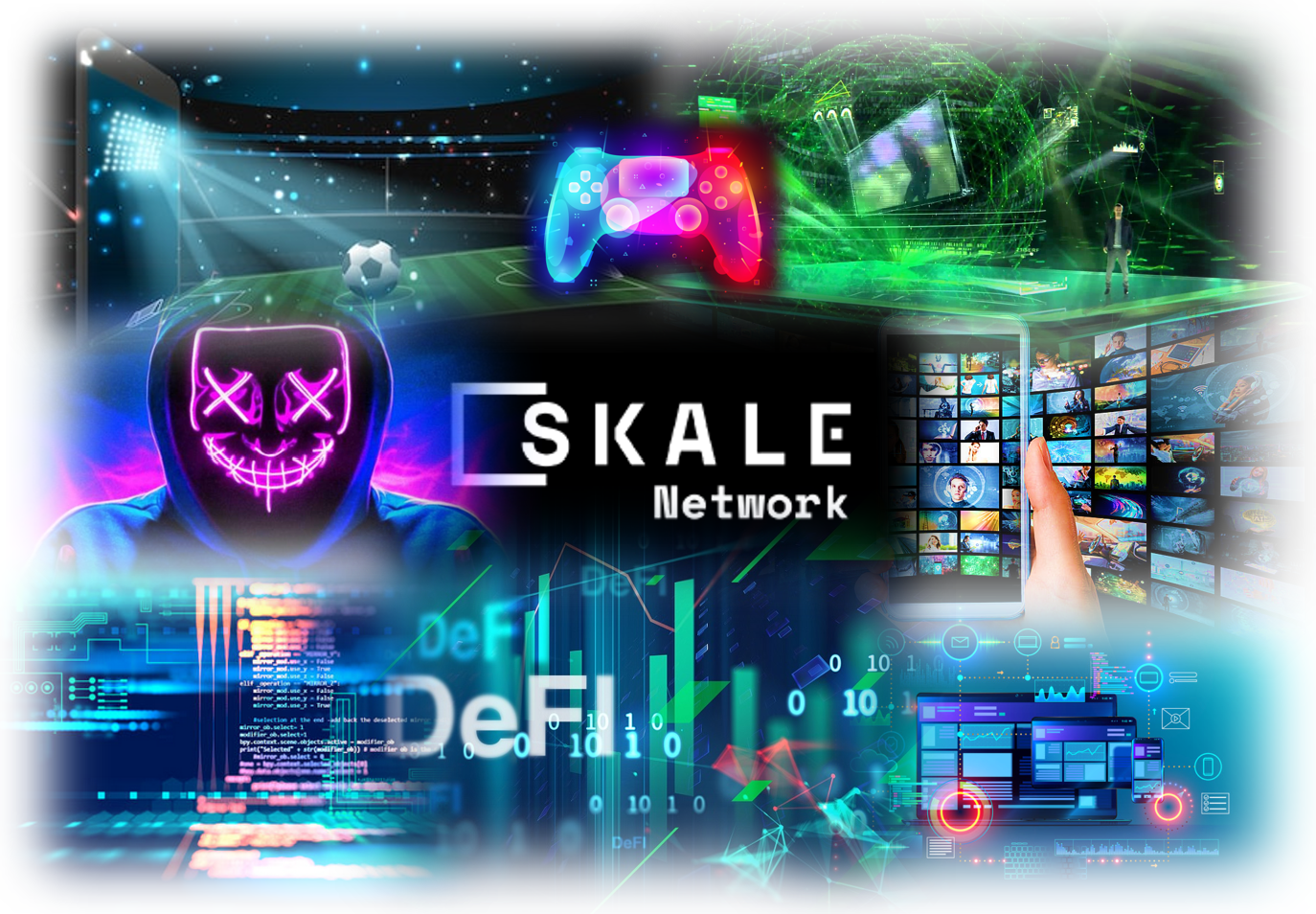
- Decentralized Finance (DeFi)
- Trustless Sports Betting/Prediction Markets
- Online Games
- Collectible Games
- Content Streaming
- Privacy and Data custody
- Any Decentralized Application (dApp)
👉 For a more detailed approach of the use cases → check out the Part 1 and Part 2 articles where Christine Perry dives deep into each of them.

Let’s consider first these 4 key factors on a general level:
- SKALE is part of the
Ethereumecosystem. Blockchainwill disrupt non-blockchain solutionsWeb3will replaceWeb2- SKALE believes in
Lean Start-upby building what users want
…However beyond that:
- SKALE’s team is building connection to other blockchains (e.g. To bring BTC into ETH ecosystem) as well as working on a native fast and reliable oracle (Every SKALE chain will end up having a built in oracle)
- For Large SKALE Chains the throughout is up to 2000TPS. Block times are subsecond. Meaning low latency and fast finality.
- There are No gas fees in the SKALE network as developers can rent a chain by paying $SKL tokens rather than users paying per interaction.
- SKALE is Eliminating unnecessary complexity so that you can speed up your dApps and smart contracts in no time while using an existing deployment script (e.g. — truffle) and just change 2 lines of code to deploy your solidity smart contracts to a configurable decentralized elastic sidechain.
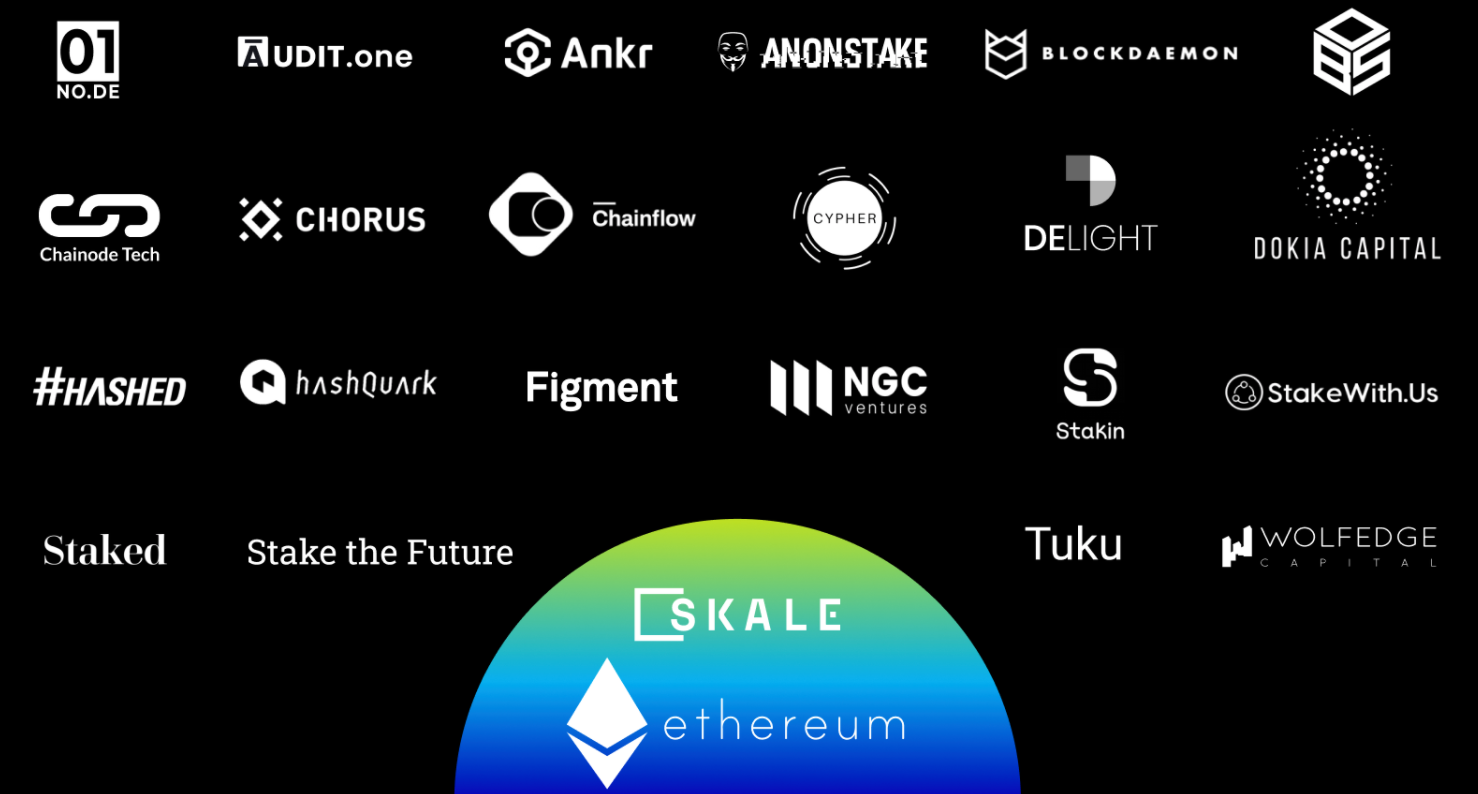
- The SKALE Network have an extremely strong set of validators which range from experienced network operations teams, crypto miners and ETH developers. Many of the initial SKALE validators will also support ETH2.
So what are the benefits of the new approach?
- More fair and equitable process to get tokens into the hands of a much larger number of people.
It eliminates the advantage of using bots or scripts for frontrunning, and creates a more level economic playing field.
- Tokens from wallets of various sizes are distributed across the entire validator pool with each validator receiving delegations from small and large token holders.
Effectively democratizing staking and opening the network to wider participation.
- SKALE is built to run on tens of thousands of nodes and an uncapped number of validators.
Minimum Stake Requirements will continually do halving twice the first year and then annually creating greater decentralization with more unique validator orgs as the network grows.

Considering the previously mentioned importance of Scaling Solutions, there are multiple projects striving to solve the problem that the Scalability Trilemma represents. However we can also compare SKALE with AWS, a competitor outside of the blockchain space…

- When comparing AWS to SKALE we are comparing replicated reliable services.
Most people wouldn’t want a website which is unreliable and un-replicated.
SKALE vs AWS
SKALE’s vision is to replace AWS and turn every Web2 site into a blockchain (As an execution engine forWeb3 and DeFi)
- To get to this SKALE will get to millions of nodes and thousands of blockchains, so the team is targeting long-term goals.
- SKALE is decentralized whereas AWS is centralized.
Centralized companies can’t compete with decentralized entities for companies and projects that need and want blockchain functionality in a centralized manner.
There are some enterprise use cases where they are valuable, but blockchain is about disruption and changing of ownership, data rights, control, profit sharing, and other features.
- SKALE has added file storage to solidity/EVM so people can run all kinds of websites.
- Anything you can run on AWS will run on SKALE as the team proposes.
SKALE wants people to be able to build decentralized alternatives to Google, Facebook or Uber.
- AWS provides No Incentive to innovate (Their incentive seems to be based on bumping up prices each year).
- SKALE validators have incentive to innovate thanks to a dynamic pricing mechanism (similar to the one used in ETH2) that adjusts pricing to automatically balance demand and supply.
Once validators start innovating it should automatically lead to lower prices.
- Currently many validators plan to run SKALE nodes on AWS
They will soon realize that this is not cost effective and hopefully will innovate on their own hardware or better on dark computational power (There are a lot of under-utilized data centers around the world)
- In the Long term SKALE intends to be more cost effective than AWS.
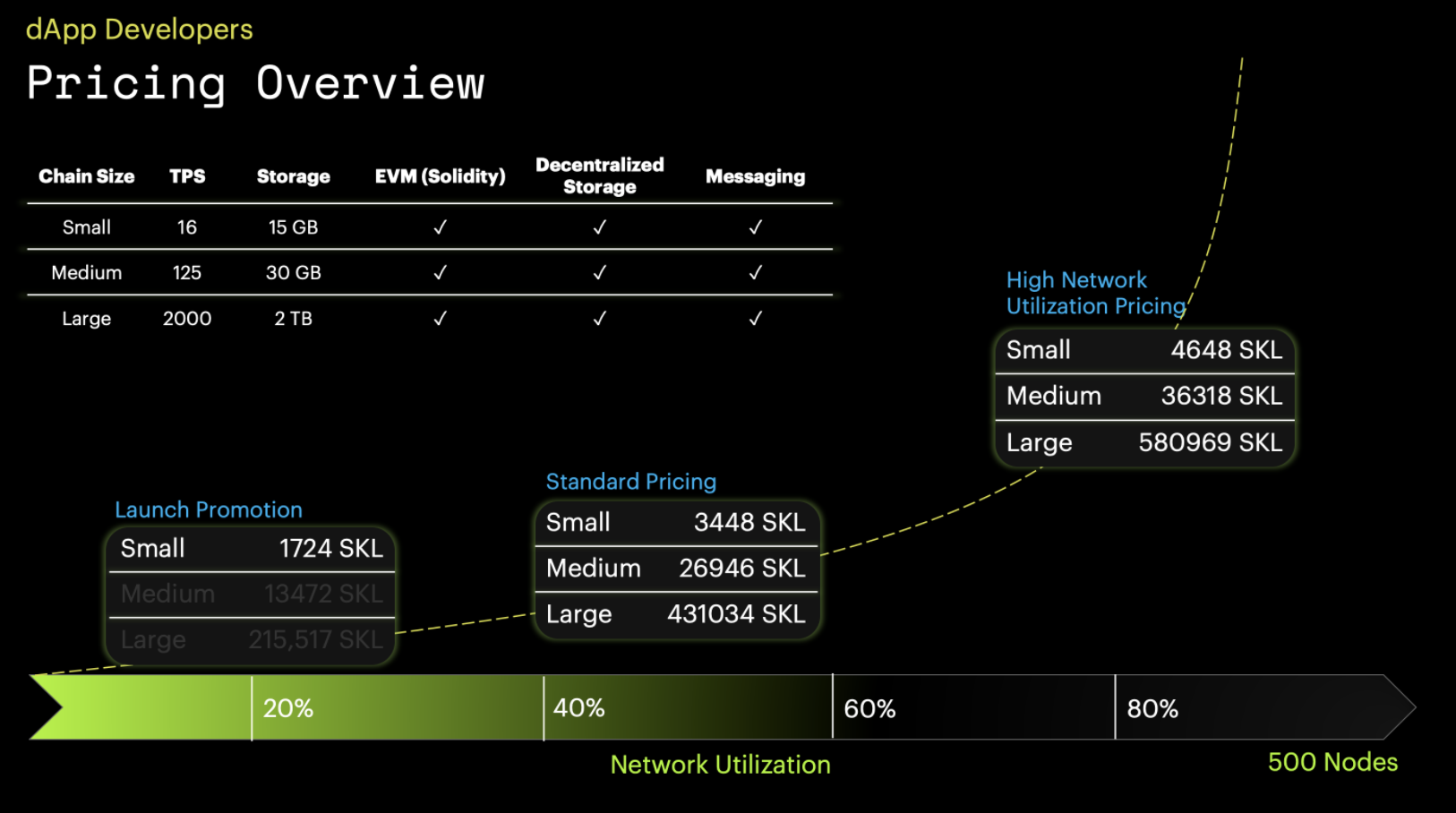
The idea algorithm for price dynamics 💡 …
To set optimal load for the network.
- If the load is more than the target 80%, → the price starts increasing slowly.
- If the load is less than 80% → the price starts decreasing slowly.
The algorithm comes from an empirical observation that similar things exist in the real world.
For example ✅ it is a known fact that office space rental prices in San Francisco follow similar dynamics depending on whether office space occupancy is above or below 90%
…Having said that, let’s come back to the...

SKALE vs other Blockchain Networks
- The SKALE Network is a custodial execution (Layer 2).
Non-custodial approaches use a system of fraud proofs to allow funds to move between chains.
- SKALE uses BLS signatures, deposit boxes within the Ethereum mainnet, and other mechanisms to allow for custodial ownership and use within the network.
Which allows it to leverage the security guarantees of the mainnet but gain the performance inherent in Layer 2.
- SKALE uses the Ethereum mainnet for staking and for other critical operations.
Other Layer 2 models attempt to use mainnet interactions to run verification and/or fraud proofs.
- SKALE can also support non-custodial Layer 2 efforts via BLS Roll-ups and eventually will support other proven L2 solutions as they progress from research phase to production ready.
- SKALE counteracts the security risks by using a pooled validation model so that each independent sidechain is protected with the resources of the entire network.
Traditional sidechains gain performance and low latency by using a smaller number of validator nodes but at a potential risk to the transaction integrity (under the theory that smaller sets of nodes are more susceptible to collusion and bribery).
SKALE vs other layer 2 protocols
The philosophy behind the development of the SKALE Network is directly in line with the view of employing multiple elastic sidechains which generates multiple advantages:
- The ability to deploy and scale sidechains quickly.
- The use of a pooled validation model for dependable chain validation (even for small sidechains), expandable node configurations, and full-state smart contract processing.
In addition SKALE is providing architecture that can deploy best in class research around scaling tech such as Rollups, state channels, and other methods.
SKALE is built on Ethereum and built in an integrated manner to Ethereum so every dApp can use SKALE out of the box and all of the tooling and wallets that work on Ethereum.
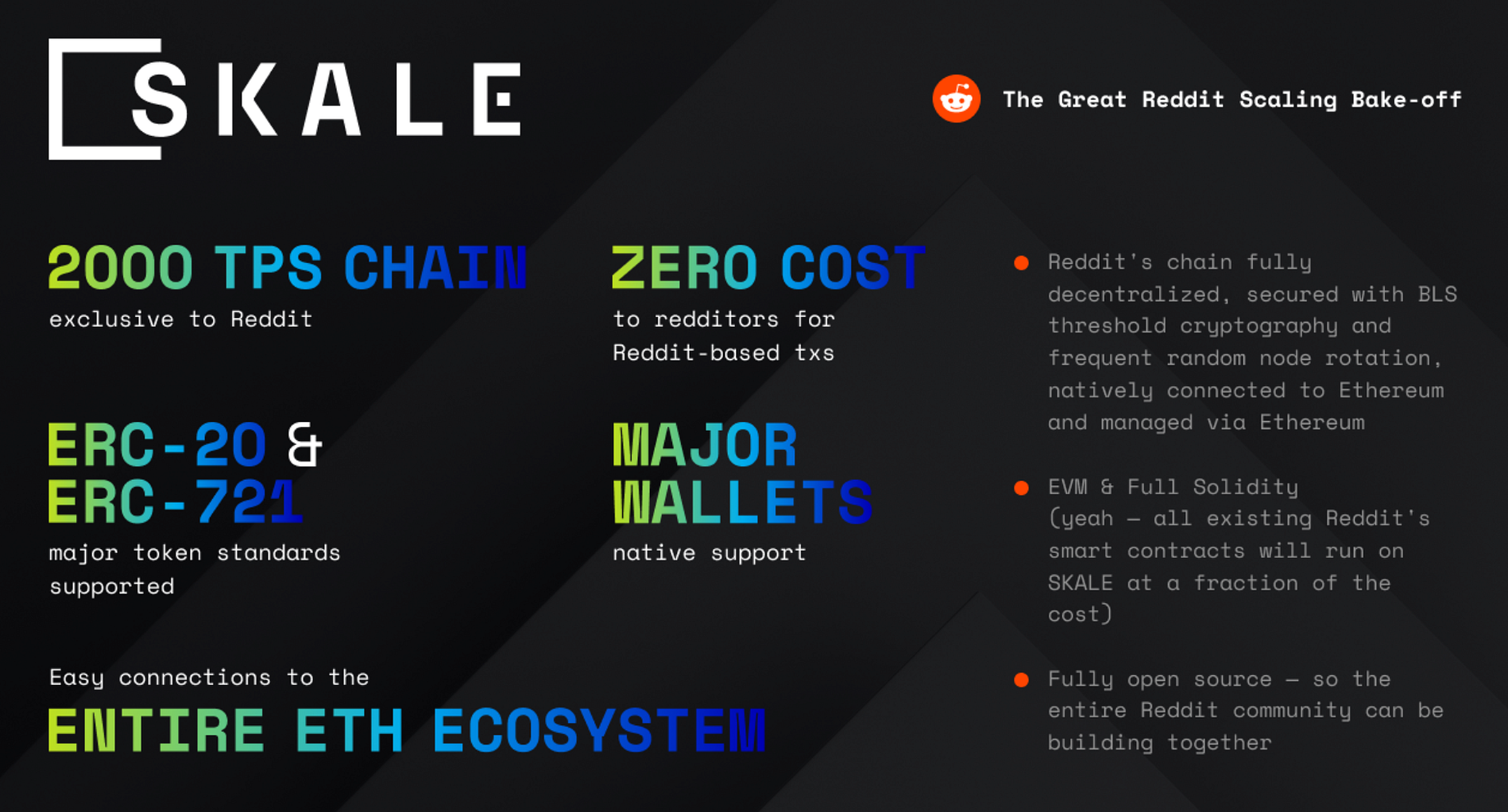
In conjunction with the Ethereum Foundation, Reddit is inviting Ethereum scaling projects to show the community how your scaling solution can be used to bring Community Points to mainnet in The Great Reddit Scaling Bake-Off. The goal is to find a solution that will support hundreds of thousands of Community Points users on mainnet today, and can eventually scale to all of Reddit (430 million monthly users).
SKALE vs POLKADOT ?
Polkadot is another Layer 1 competitor to Ethereum — Whereas SKALE is a Layer 2 solution to/for Ethereum. —
The Polkadot initiative was initially led by Gavin Wood, an Ethereum co-founder. Wood, like many other Ethereum co-founders such as Charles Hoskinson, have gone on to launch their own projects, because many of them were not quite satisfied with how Ethereum’s ongoing development was progressing.
However, the Ethereum ecosystem is thriving an will not be toppled. There is too much developer traction and ecosystem growth. The developers that choose to build on Ethereum are not moving over to “faster” chains today for many good reasons.
The far more likely scenario that we will see in the coming years is not a replacement for Ethereum, but many other platforms like SKALE which complement Ethereum’s capabilities.
How will SKALE become non-obsolete when ETH2 comes into fruition / Will Layer 2 be less useful as it is now?
ETHEREUM 2.0 IS NOT A COMPETITOR TO SKALE! 🤗
They are different kind of Networks and are fully interoperable.
SKALE is using ETH as a security layer, and can move to ETH2 when it becomes available and secure.
There will be even a greater opportunity to bring Ethereum to billions of users if ETH2 and SKALE collaborate.
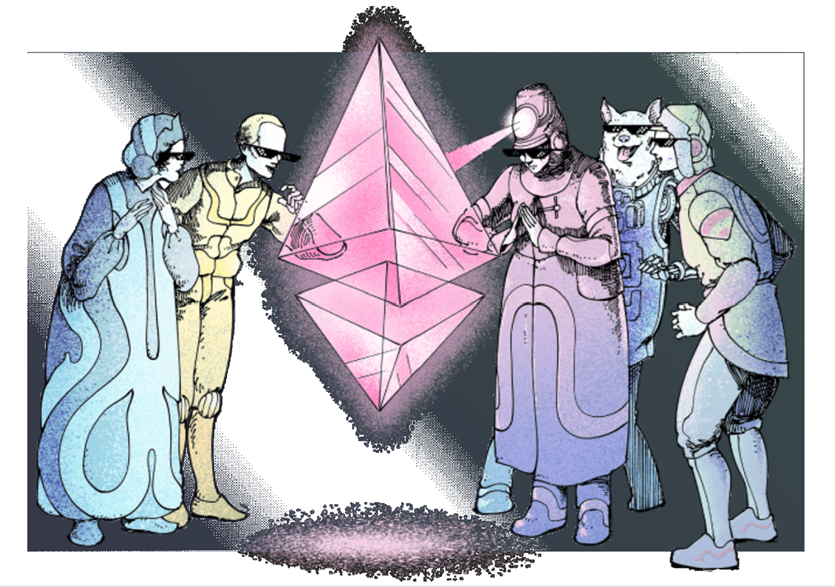
SKALE is not only a Scalability Solution but also has a lot of interesting and useful features 😲 such as:
- Privacy.
- File storage.
- Machine learning models on oracle inputs.
- Many others that provide added value to dApps and therefore their developers.
How will SKALE facilitate the transition from ETH to ETH2?
SKALE’s team see great overlap with ETH2. Many validators that validate SKALE want to validate ETH2 and vice-versa (There are many things in common).
👉 Check out the SKALE Validator & Delegator Token Economics
ETH2 is an incremental improvement on Ethereum. ⏳
It may take a number of years for it to be implemented and to become fully operational and stable.
Assuming ETH2 is compatible with ETH1 there is limited work from SKALE’s end.
- Only a re-deployment to ETH2 would be needed.
- However there will be some incompatibilities between ETH1 and ETH2 but they will be part of phase 2.
- Ethereum 2.0 doesn’t get to the level of scaling required to get to mass adoption on its own, when dApps are still sharing a blockchain or shard with each other.
Not even close (maybe 100 -160 TPS which is an improvement for sure from today).
- The root problem persists with the fact that each dApp must share a back end with other daps.
- SKALE is focused on dApp specific blockchains that connect to the Ethereum Mainnet.
When every app has its own backend it doesn’t get impacted by usage of other dapps.
Imagine if your email 📩 was slower and expensive to use due to high search volume on Google! 🤔
What SKALE does is unique because it gives to Decentralized applications the power and efficiency of having a smaller validator set, while maintaining the security that comes with having a larger validator set.
We wouldn’t want our email to slow down just because there’s too much activity with Google search, but that’s how blockchain dApps are right now, with the dApps sharing a back end with other dApps.
As Andreas Antonopoulos said, and as we have seen with Ethereum, engineers will continue to push the limits of a network’s capacity…
We will continue to see a single dApp ( like CryptoKitties in 2017) or a single activity (2020 yield farming) clog most of the network.
Additionally having into consideration that a fully functional version of Ethereum 2.0 which would be available for applications to run their smart contract transactions on is at least 1.5 to 2 years from now whilst the scalability on Ethereum is required today. Layer 2 scaling solutions are just one component of the complex Ethereum 2.0 roadmap. The scaling solutions are designed to achieve faster blockchain transaction times, and lower fees, without compromising the security of the Layer 1 blockchain.
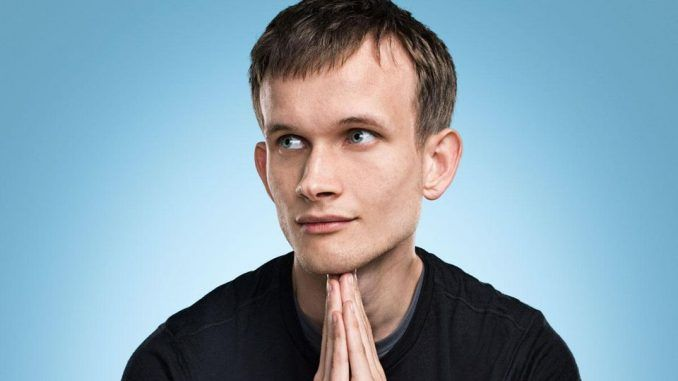
While these solutions may be the only chance for survival, Vitalik believes that The optimal solution would be a combination between the official Ethereum scaling solution and the Layer 2 solutions. The co-founder of Ethereum and the Ethereum Foundation, has stated that Layer 2 scaling solutions are starting to show results. “While everyone wasn’t looking,”
SKALE is part of the Ethereum ecosystem and will always be!
SKALE is a system for provisioning an arbitrary number of blockchains so that each dApp or even website can be on its own blockchain. If a dApp needs more capacity, it can go multichain with SKALE. This way, SKALE intends to be the decentralized cloud that powers Web3.
SKALE blockchains have L1-level security and are fully compatible and interoperable with Ethereum so that, for the dApps on SKALE chains: it would feel like they are still directly on the Ethereum MainNet.
In the future, SKALE will be able to connect to Bitcoin, libra and other blockchains indeed; for that to happen, is needed to implement threshold signatures compatible with ecdsa.
SKALE connecting to BTC directly means people will be able to use DAPPs fast while still keeping most of their money on the native BTC network.
In the latter case they will first have to go to wBTC that introduces an additional trust step, and then need to create another wallet on ETH main net.
If the coin is already wrapped people will be able to use it on skale since the Network already has ERC-20 bridge to transfer ERC-20 to SKALE
For direct BTC → SKALE they will be able to use their existing wallets.

The token is minted on the Ethereum mainnet (similar to to e.g. DAI, MKR, LNK, etc) It can move freely back and forth between the mainnet and SKALE network.
SKALE is launched on ConsenSys Activate
The “Proof of Use” distribution mechanism via Activate is designed to get tokens to holders whose primary purpose is utilizing network tokens for their intended purpose.
Users who acquire tokens during the launch are required to actively “prove use” of their tokens by delegating at least 50% of their purchased tokens for 90 days before being able to transfer them outside the network.
Proof of Use is a core pillar of Activate’s guiding methodology in order to fulfill their mission of attracting and building a community of individuals who recognise the importance of collectively participating and putting their tokens to work.
👉 Find out more about Proof-of-Use
What is the role of the $SKL token?
- Validators
stake$SKL in theSKALE Managerto earn fees and inflation rewards. 🤑 - Holders of $SKL can delegate their tokens to any validator in the
SKALE Network. 💻 - Paying
SKALE Chainfees. ⛓ - Governance and security of the Network. 🛡
ERC-777 to Support Delegation on Token Level
SKALE is built on an innovative ERC-777 token standard which supports delegation on the token level. ERC-777 is fully backwards compatible with ERC-20, which means that it is supported by all participants of the Ethereum ecosystem with ERC-20 support.
One of the important features that differs from ERC-20, is that with ERC-777, a delegator no longer needs to send the token to the delegation smart contract, but instead shares with the staking provider the secure delegation key while storing the tokens in the cold or hot wallet of their choice.
👉 Read up on the lockup schedules of the SKALE Network Token and keep in mind the important metrics for Token Launches
Is the network stable and cost-effective?
The pricing structure for the dApp fees (for example payment for renting blockchains) are governed by a network load utilization curve that balances the supply and demand of network capacity.
- When the network is under-utilized,
S-chainsare cheaper (to attract more dApps and more utility). - When the network becomes over-utilized,
S-chainsbecome more expensive (to attract more nodes—because rewards are high—and increase network capacity).
👉 For a better understanding → check out the SKALE Validator & Delegator Token Economics article
A comment from the CEO:
“I had many conversations today with people who now own a lot more SKL tokens than they did yesterday (they purchased today at a large discount from yesterday). We have so many believers who are taking part in this network. SKL is a utility token so has a value within a network. One of the core functions of the SKL token is staking the token in the network and getting a return on the token for the work of staking the token. This means if you own more SKL tokens and stake more of them, you get more SKL tokens in return for your effort. I’m happy to say we now have many more stakers in the network who have made big purchases for long term impact. I can’t comment on the market volatility, price, or give advice. But I’ll say that with each transition this network will get stronger and the community will get stronger.”
→ Jack O’Holleran (SKALE Network, CEO)

The N.O.D.E. Foundation partners with SKALE Labs, and other top entities and investors around the world to facilitate development of SKALE Network.
SKALE Labs is the core team involved in creating the technology specs, creating the code, and growing use and awareness of the network. SKALE Labs is headquartered in San Francisco, California.
THE N.O.D.E FOUNDATION
The The Network of Decentralized Economics is a Liechtenstein Foundation, has been created to carry out the mission of fostering a strong community of people and businesses to both leverage and contribute to the SKALE Network. To ensure the longevity of the Foundation, it has been allocated a percentage of the total pool of SKL tokens vesting over a 7 year period to provide it with a budget and resources to fulfill its mission.



Official community:
Foundation:
$SKL Price discussion:
Unofficial SKALE (SKL) HODL
You can view and join @SKALEhodl right away.t.me
Comunidad en Español :
SKALE Español
You can view and join @SKALE_ESP right away.t.me
Staking Group:
Activate x SKALE Staking Group
This is a read only channel for the SKALE Network Mainnet Launch on Activate! This channel will serve users with…t.me  Join the SKALE Discord Server!
Check out the SKALE community on Discord - hang out with 1,738 other members and enjoy free voice and text chat.discord.com 
SKALE is open source and welcomes contributions.

When deciding on if SKALE Network (SKL) is a good investment for you like with any other investment, taking into account risk and reward is crucial. Long term $SKL is more than likely to appreciate based on the fundamentals reviewed on this article of the SKALE Network project and the progress the Team is making towards their roadmap goals and milestones.
The cryptocurrency market is extremely volatile and hard to predict in the long term so researching the fundamentals and progress of SKALE Network is an essential task before deciding to invest any amount of funds for the long term with the aim of holding for months or years. When analysing the price of SKALE Network to form a price prediction for the short or long term, taking both technical and fundamental analysis into account is essential.
**Important note: 🕵 Anyone can create and name any ERC-20 token on Ethereum, including creating fake versions of existing tokens and tokens that claim to represent projects that do not have a token.
Similar to Etherscan, Uniswap automatically tracks analytics for all ERC-20 tokens independent of token integrity.
**Please do your own research before interacting with any ERC-20 token. 🔎
$SKL is currently listed in top Exchanges including:
Uniswap
A fully decentralized protocol for automated liquidity provision on Ethereumuniswap.org
⚠ It is critical that you use the correct token contract address.There are already a number of scams live trying to impersonate the $SKL contract. 🚫
✅CORRECT TOKEN CONTRACT ADDRESS: 0x00c83aecc790e8a4453e5dd3b0b4b3680501a7a7

- Staking is the process of locking tokens in a cryptocurrency wallet to directly support the security and performance of a decentralized network.
- It is the mechanism by which consensus in a Proof of Stake network is determined.
- In return for staking your tokens, participants receive rewards.
To stake on the Skale Network, token holders can either stake their tokens with a validator of their choice or operate their own staking validator. In return for maintaining the security and resiliency of the network, stakers are rewarded monthly through a percentage of the SKL rewards pool. The rewards pool is composed of aggregated protocol reward issuance and dApp fees. The amount of rewards received by stakers is proportional to the total number and duration of tokens staked.
To get started 👉 create an account on Activate
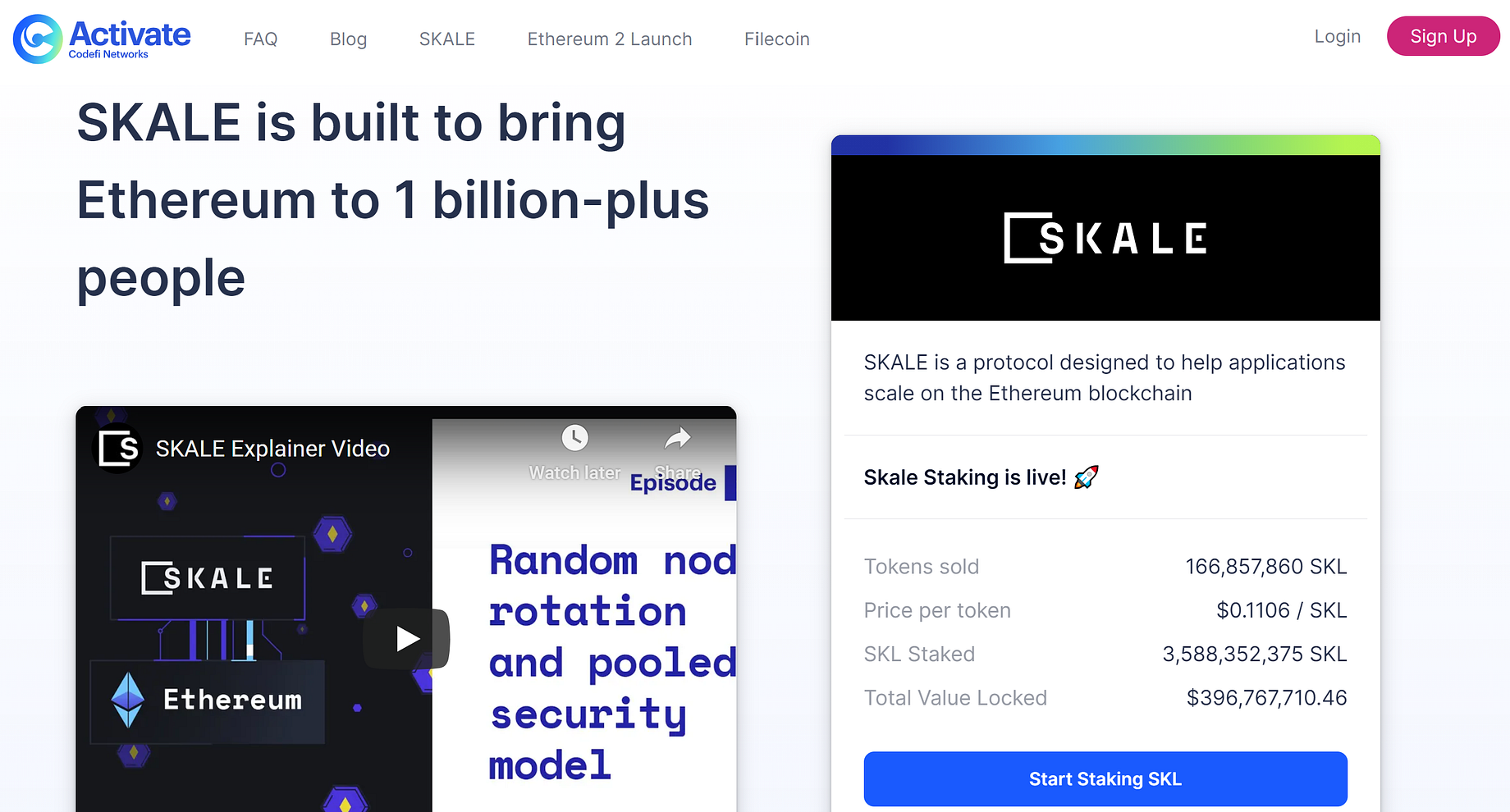
👉 And follow the instructions on the official Activate Staking Guide
Why is there a 90-day Lock-up period for the tokens?
This is designed to provide two things for the network.
- Network Health: The network is stronger, more stable, has more validation and security if there is a start period where tokens aren’t being traded. This is good for dApps and SKALE is focused on supporting dApp developers, which in turn helps every other part of the community.
- Compliance: Doing Proof-of-Use is more compliant toward regulations because it requires users who claim or purchase tokens during a launch to actively prove use (delegate) before they’re allowed to transfer or redeem them for alternative purposes.
Elastic sidechain within the SKALE Network is highly configurable, developers are able to choose the chain size, storage capacity, consensus protocol, virtual machine, parent blockchain, and additional security measures.
When creating a sidechain, a developer can configure their chain via a decentralized interface and then submits payment to the network in the form of SKALE tokens. The token amount depends on the size of the network and the duration of time they want to sponsor the network resources. There are several sidechain sizes (Small — Medium — Large) as well as duration options in months (3 — 6 — 12).
👉 To learn more about SKALE, or to get your own SKALE Chain to test it our for yourself, please check out the SKALE Network Developer Portal
If you found value on this article, please share it with someone that might also be interested in technology, programming, blockchain development as well as open to investment opportunities and crypto trading so that they can also learn about SKALE NETWORK. Feel free to (TIP) and follow me so that the message can reach a bigger audience. THANKS!
↓↓↓






