
INTRODUCTION
Levelling, smoothing and shaping are important processes that ensure uniformity in depths and discharge variations over a field, as a result, the irrigation water gets uniformly distributed to the root zone. While cultivating a crop, from the first day till it's harvest, surface soil is being continuously disturbed, so these practices are essential on every cropping season. For a marginal farmer, land levelling is expensive and sometimes intensively disruptive cultural practices can cause many topographical changes, as a large area may be left with no fertile topsoil, secondly, the pulverizing topsoil can also bring water penetration problems. Unless the topsoil is loosened and the subsoil hardpan is broken, the roots find difficult for penetration, shows low germination percentage and poor aeration also hinders microbial activity. Therefore it is essential to be done, before sowing that ensures equal distribution of water and nutrients, which in turn increases its productivity.
Farmers have been using many implements which is either animal or tractor drawn, even a levelling board is attached behind to many tractor-drawn implements. The land appears to be levelled despite having 10-15 cm difference of elevation. This creates undulations and crops standing near to patches die due to waterlogging and those standing at elevations sometimes suffer from nutrient deficiency, as the flowing water also brings top fertile soils to these patches.
INTRODUCTION TO INDIA
New technologies have been continuously introduced for making levelling more precise, the latest being laser levelling. This technology has been introduced to India by 2001, from Pakistan, with the help of CIMMYT, IRRI, ICAR. This machine was given its first try on field owing to a farmer named Dr Tyagi, located at Harpur district of Uttar Pradesh. When it was introduced, it faced a lot of criticism, it was not fully automatic, farmers found difficult to operate it priced 4-5 lakhs, excluding a tractor, and it was highly sophisticated and computer-based.
By 2005, there were hardly 20-25 units across India, that slowly increased to 50000 by 2010. This happened because many companies like DHASHMESH, TRIMBLE, LICA, LAND FORCE came forward and started producing more units, which brought the price to 2-3 lakh that made this machine affordable to more farmers.
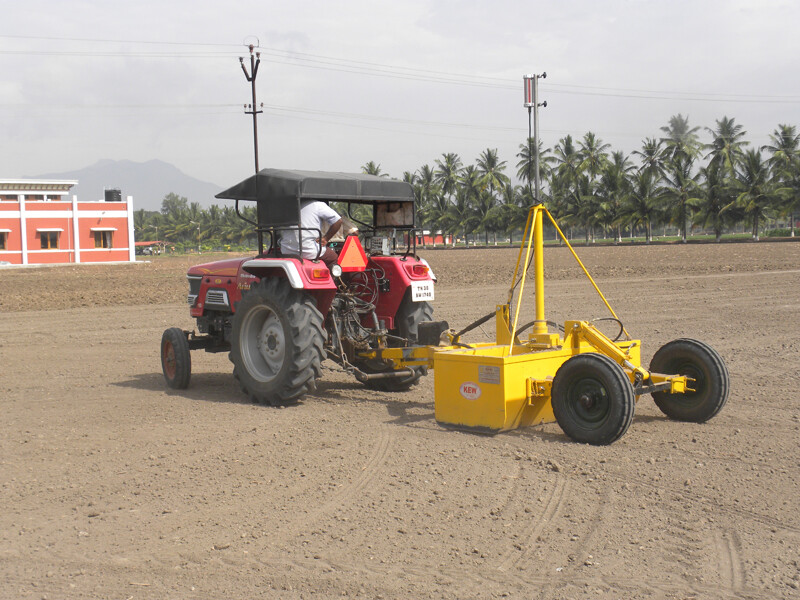
COMPONENTS
- LASER TRANSMITTER:- It is the first component, which is placed at a corner that can emit infrared rays. They are powered by a 6-12 volt battery, nowadays it can also be connected to tractors battery using a wire. It can cover a radius around 1200m.
- LASER RECEIVER:- They receives the rays from the transmitter and conveys the signal to the controller.
- CONTROLLER:- The signals received are then passed on to the hydraulic system. This can be either automatic or controlled manually.
- HYDRAULIC PUMP:- It is connected to a hydraulic system. It has an inlet and outlet where oil is passed. This controls the movement of the scrubber bucket.
- SCRUBBER BUCKET:- It is the most important component that does our work of interest. The size of the bucket is decided by the horsepower of the tractor.
WORKING
The mean height of the plot can be calculated using a surveyor's level, taking measurements at 10-15 places in a zigzag manner. Then the transmitter is set at the plot with that measured average. Mostly the tractor is driven in a circular manner around this transmitter, which reduces the chance of leaving void spaces unlevelled. As the hydraulic system receives the signal, it shifts the bucket up and down cutting the soil from elevated areas and dumping wherever necessary. This levels the land more precisely with a maximum variation of 2cm. The bucket can also be moved manually in the controller if the bucket cuts more deeply.
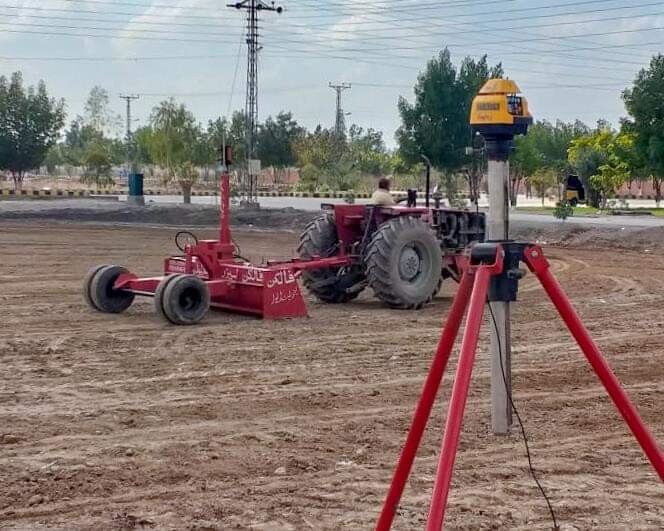
ADVANTAGES
- Land can be levelled more precisely with a maximum variation of 2cm.
- 4000 square meters of land(1 acre) can be covered within 2-3 hours depending on the elevation of the land.
- When irrigated by flooding or check basin method we can save about 25-45% water.
- The pump is also run lesser time, reducing the diesel consumption around 24%.
- Lesser duration for running pump, which not only saves fuel but also reduces CO2 release to the atmosphere, thus more eco-friendly.
- It increases the productivity of the crop, which gains 10-50% more profit for the farmers.
PRECAUTIONS
This is a highly sophisticated machine, so regular maintenance is highly appreciated. Regularly moving parts get wears and tears, so they must be replaced regularly. The moving parts should be always oiled or greased to reduce frictional effects, and proper storage after use also can prevent many parts from getting rust.
CONCLUSION
The production of units has increased and this latest technology has started governing many farmers fields, nowadays a farmer can even rent one for 600-800 rupees per hour. Farming these days are becoming more mechanised and precise and each individual is looking forward to making farming more sustainable. It also provides job opportunity for thousand in the manufacturing and service units. Thus this can be the milestone technology that can increase the food production which is necessary to feed the ever-increasing population of our country.
Source:
-
Kumari, Reena & Sharma, Babloo & Kumari, Pratibha. (2017). Laser Land Leveling For Enhancing Agricultural Input Use Efficiency. Indian Farmer. 4. 659-662.





