
Inflation's evil twin_ Shrinkflation:
It’s pretty safe to assume that all readers of this post are well aware of the term “inflation”. I mean we’ve all been feeling it over the last year or so. For those who've been living under a rock, however, inflation, in short, is the rise in prices of goods and services or the decline in the value of currencies. In fact, it's estimated that Global inflation in 2022 hit 8.75% marking its steepest annual rise since 1996, and although inflation has come down a bit this year it's still pretty high in many places.
Higher prices push up the cost of living, which causes employees to demand higher wages, which drives up the costs of production, which pushes up prices, and so on and so on.
In some regions, the inflation cycle has really spiraled out of control. In Argentina, Lebanon, Venezuela, Turkey, and Zimbabwe inflation rates have reached double and even triple digits in recent years. A phenomenon known as hyperinflation.
So, the cost of living is skyrocketing as manufacturers keep raising their product prices to offset their increasing production costs. In some cases, they risk losing their customers who- mind you- have less purchasing power.
It is a dilemma that companies find themselves in, as they must choose between their profits or customers. Here's where Inflation's prodigal son comes in_Shrinkflation
What is Shrinkflation:
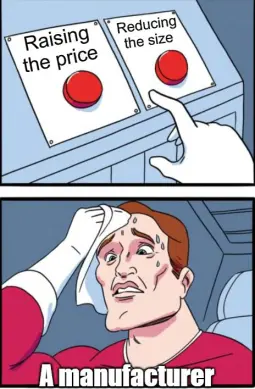
It is basically a way for manufacturers and companies to offset their rising production costs without having to raise prices. This is possible by simply reducing the size or quantity of a product while maintaining its sticker price. According Wikipedia:
“Shrinkflation is a rise in the general price level of goods per unit of weight or volume, brought about by a reduction in the weight or size of the item sold. The price for one piece of the packaged product remains the same or could even be raised. Shrinkflation allows companies to increase their operating margin and profitability by reducing costs whilst maintaining sales volume, and is often used as an alternative to raising prices in line with inflation” source
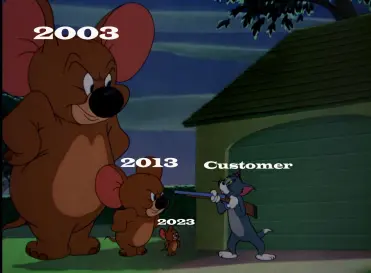
In other words, it is a sneaky way of cutting costs without alerting customers that they're paying the same or even more for less.
Instances of Shrinkflation:
In 2019, The UK Office for National Statistics conducted an analysis of size changes within the sample of goods, for the period July 2015 to June 2017. They concluded that there was a notable number of products that had been downsized during that short period of time. According to their report:
"we estimated that between 1% and 2.1% of food products in our sample shrank in size, while between 0.3% and 0.7% got bigger. We also observed that prices tended not to change when products changed size, consistent with the idea that some products are undergoing 'shrinkflation'."
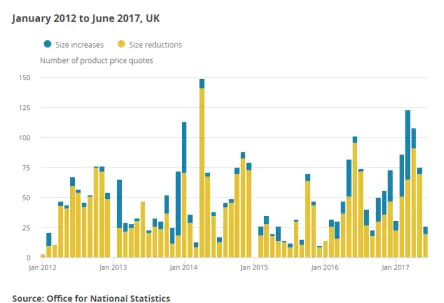
However, we don't really need official entities to notice the downsizing of goods and services we have. Although companies and manufacturers are trying to hide it from customers, I'm sure a lot of us have already noticed shrinkflation with so many products and on so many occasions.
Here are just 5-top examples that were interesting to me:

5- Gatorade:
Let's start with Gatorade_ a well-known American brand of sports beverage and food products.
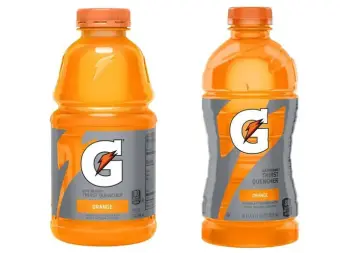
Gatorade downsized its 32-ounce bottle to just a 28-ounce one with about a 14% drop, despite both bottles being the same height.
Now, I'm not sure whether it is foolishness or a kind of warped sense of humor on the part of the company, as they claimed that they redesigned the bottle to be "more aerodynamic and it's easier to grab," YIKES
4- Quilted Northern Toilet Tissue:
It is sometimes said, life is a like toilet paper roll_ the closer you get to the end, the faster it goes.
Now, whether you believe in that saying or not, it is certain that toilet paper rolls are getting faster to end over time.
Here is an example of Toilet Tissue branded as Quilted Northern which dropped from 284 sheets down to 255. And their “soft and strong” version went from 328 to 295 sheets per roll...

3- Gain Detergent:
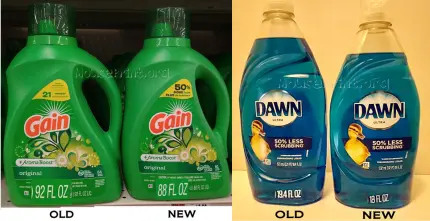
This time is about detergent and I have two examples for this one. Yup, Gain liquid laundry detergent has reduced its 92-ounce size container. As you can see, it lost four ounces and is down to only 88 ounces.
The other case is Dawn Dishwashing Liquid which has also gone from a 19.4-ounce bottle to down to only 18 ounces.
It is hard to tell any difference here, but maybe this good, because all moms and wives who use these brands would be taking to the streets if they knew the truth! LOL
2- BD Syringes:
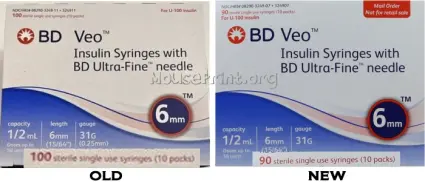
Now we have a more serious example. BD brand syringes (used for injecting insulin) have gone from 100 in a box down 10% to just 90.
The packaging has not changed at all. The size of the box is still the exact same, which makes people think they are getting the same amount, but they are getting 10% less.
What should one say? I mean food and detergents are one thing, but medical products are a whole different matter...Shame, to say the least...
No chargers, no earpods with new versions of iphone!
Let's have a drum roll, please because I'm about to introduce you to the most embarrassing case of shrinkflation, and it comes from Apple.
In 2020, Apple decided to remove charger adapters and earpods from its infamous release of iPhone 12.
It was such a shock to the world that even the most pessimistic leakers hadn't been apple predict it. What is really funny about it is that Apple claimed that its removal of chargers and headphones was for the environmental best interests. What creative they are!
According to Apple:
“There are also over 2 billion Apple power adapters out there in the world, and that’s not counting the billions of third-party adapters. We’re removing these items from the iPhone box, which reduces carbon emissions and avoids the mining and use of precious materials.” says Lisa Jackson, vice president of environment, policy, and social initiatives at Apple

If you really care about carbon emissions, how about stopping the production of iPhone clones every single year with little to no development?
Moreover, most people can't use their old adapters which take light years to charge newer iPhone devices. They will have to order separately from Apple, which means more packages have to be shipped off, and so, increased environmental consequences.
Let's not deceive ourselves, though, the real reason behind the removal of chargers and earpods has less to do with saving the planet and more with cutting costs...
Final thought:

Well, in this post I've been pretty critical of companies and manufacturers. It’s all well and good to criticize them, but to be fair, they are not the only ones to blame. As I mentioned earlier, Shrinkfaltion is nothing but a natural consequence of inflation.
If the cost of the raw materials needed to create a product increases, the company can pass those increased costs onto the customer by either raising the price of the product or maintaining it the same but reducing the size of the product.
Sometimes, companies can't simply raise their prices because they would be risking alienating their consumers. Additionally, some customers would maybe rather have a mini version of their favorite product than give it all up due to its increased price. Let’s consider once again that those customers are now having less purchasing power thanks to inflation.
In my humble opinion, more transparency is needed in this regard. We need a law that forces companies to place signs on products that have been reduced in size, alerting customers that they are getting less of a product than what they might expect. Customers deserve to have the right to choose between taking a downsized product and leaving it.
The silver lining is there are indeed efforts in some countries to put such a law in place. In France, Parliament is soon to debate a proposal that requires manufacturers to clearly label products that have been downsized while the packaging has remained the same.
Let's also not forget that the evil devil behind all of this is the fact that our traditional fiat currencies are radically designed to lose value over time. This is why many, including myself, believe that cryptocurrencies along with gold are the only safe havens out there.
What do you guys think about shrinkflation? Did you come across any cases of it?
I’m curious to read your opinions and thoughts…
Thanks for reading :)






