Some people wonder if bitcoin (and crypto in general) is a bubble, or a bubble, that can burst apart. The answer is not a simple yes/no, but deserves some nuance. In this article we explain to you if bitcoin is a bubble.
What's a bubble?
The economy moves in cycles. Sometimes the economy is doing well for years and there are golden mountains in sight. Property prices are then blown up beyond previous record highs. The sudden rise of these assets is not supported by the underlying foundations, but only by exuberant behaviour in the market. Bubbles cause investors' money to move to areas that are showing very rapid growth in a short period of time. VanDale defines a bubble as "a situation in which, due to great optimism, certain prices or prices have become too high, so that collapse is imminent". When there are no more people who want to buy at the top price, sentiment can change and mass sales can take place. Investors' money then moves back to other assets, causing the price to fall. That is the beginning of the bubble that explodes. A bubble is theoretically possible with, for example, shares, houses, companies or with new types of assets, such as the bitcoin.

Below we will discuss a number of well-known bubbles.
Tulip Mania (1636-1637)
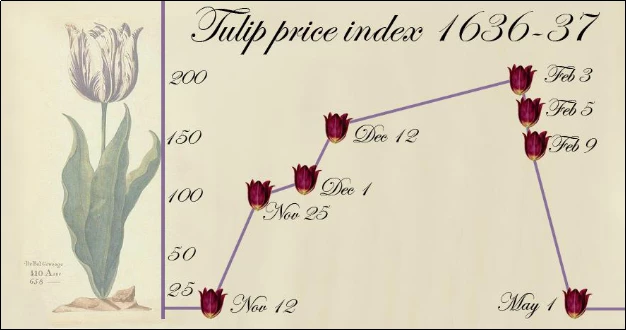
In the 17th century, the price of tulip bulbs in the Netherlands rose enormously in a short period of time. The price of a tulip bulb was at one point comparable to the price of a canal house in Amsterdam. There was an enormous difference between the actual value of a tulip and the price that was paid for it. In the first months of 1637, however, the tulip market collapsed completely. A few months later tulips were sold for 1/100 of the price a few months earlier. The tulip mania is seen by many economists as the first bubble in history. Tulips did not disappear after the bubble, of course, and are still an important part of the Dutch economy today.
Dot.com bubble (2000)
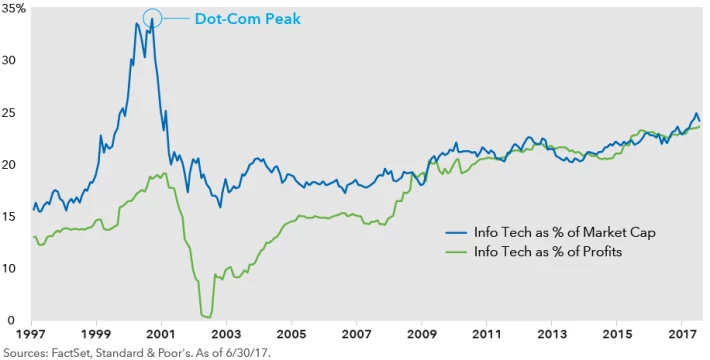
Around the year 2000, the value of Internet companies rose sharply in a short period of time. The Internet had just been around for a few years, and people were beginning to see its endless possibilities. Investors bought shares of technology companies for a high price, hoping that they could sell them later for more money. The valuation of technology companies skyrocketed. As long as you had .com in your company name, you were part of the hype. An example was Pets.com, which focused on selling products to people with pets. Many of these companies spent huge amounts of money, but hadn't found a way to become profitable yet. Investors put money into companies that had never made a profit before. It was pure speculation, based on the positive sentiment in the market. When, in 2001, it appeared that these companies could not live up to the sky-high expectations of huge profits, investors lost their confidence and a major correction took place. Investors sold their shares en masse, causing stock prices to collapse. Many investors lost their money. Also, many companies went bankrupt. The size of the Dot.com crash was estimated to be about 3-5 trillion dollars. But despite the bankrupt companies and the evaporated money, an important new technology survived: the internet.
Some of the young internet companies that survived the Dot.com bubble were Amazon, eBay and Google. These have completely renewed the sectors in which they operate. It took 17 years before the Nasdaq technology index was worth as much as it was during the Dot.com crash. For example, a share of Microsoft was 59 dollars during the peak of the Dot.com crash in 2000. The Microsoft share did not reach this amount again until the end of 2016.
Property market (2008)
After the Dot.com bubble, the Federal Reserve in America had deliberately kept interest rates low. Also in America the demands made on homebuyers were weak. Mortgages were granted to people who could not actually afford them. It is estimated that about 56% of the houses were bought by people who could not afford them under normal circumstances. In addition, it was assumed that house prices would continue to rise forever. Investors put their money en masse in houses. There was speculation on the housing market. House prices rose sharply due to the high demand for houses. When it turned out that house prices could indeed fall, many banks and other financial institutions got into trouble. Many people could no longer pay their mortgage and were forced to leave their homes. The banks were no longer able to sell these houses on the market at the desired price, causing the entire housing market to collapse. Some houses lost as much as 40% of their value. The house of many people had suddenly become much less valuable. Banks made big losses and some companies (like Lehman Brothers) even went bankrupt. The crisis in the housing market caused unrest in the financial markets, which eventually led to a global economic crisis.
What characterises a bubble?
Something is a bubble if it is traded for more than its intrinsic value. However, it is extremely difficult to determine in advance which market is certain to be in a bubble. This is because it is often difficult to determine the intrinsic value of something. Many bubbles are only determined with certainty afterwards.
A well-known anecdote is by Joe Kennedy, a wealthy American businessman. When, in the 1920s, he was advised by a shoe polisher in which shares to invest, he decided to sell all his shares. He thought that if the shoe polisher had advice on shares, the stock market would have become too exuberant. Shortly afterwards the stock markets collapsed (the crash of 1929), which led to a major economic crisis.
According to Nobel Prize winner Robert Shiller (who did research on bubbles in the economy) a bubble has the following characteristics:
- A sharp rise in price. The investment is expensive compared to one's own past.
- A period of euphoria, when people think that the price of a good can only rise. Of course, something cannot rise forever. But in that case, this rational consideration makes way for greed. The irrational suddenly becomes rational: you are almost crazy if you do not participate. People are afraid to miss the boat and only buy with the idea that something is increasing in value.
- A lot of media attention for the phenomenon.
- Stories of people who earn an enormous amount of money, so that other people also want to participate.
- A growing interest in assets among the general public.
- Theories that say that this time it's really different. Many bubbles are created by new developments. For example, around the year 2000 internet companies were new. People often think that because something is new, this time it is different.
Bubbles and new technology
However, the bursting of a bubble does not necessarily mean the end of that technology. Railways, radio and the internet all experienced a bubble before they went mainstream. Many revolutionary technologies that have changed the world have had to deal with a bubble in the past.
Bitcoin: the ultimate bubble?
The value of the bitcoin has increased enormously in a short period of time. Whereas at the beginning of 2017 a bitcoin was still worth around 1000 dollars, at the end of 2017 it was almost 20,000 dollars. That is a return of 1900%! The digital gold rush originated as follows. Many people, who know nothing about bitcoin or blockchain, have now joined the hype. These people were infected by stories of quick profits from friends and neighbours. As a result, the price has risen further. People were afraid to miss the boat, which is a phase that occurs with every bubble.
However, few people use bitcoin as a means of payment. People buy a bitcoin for 15,000 euros mainly to sell it later for more money to an even bigger madman. In that respect, the bitcoin is an example of the greater fool theory.
The bitcoin and the underlying technology (the blockchain) are still in full development. It is still uncertain what role they will play in our future society. The current price is therefore mainly the result of speculation. Dave Birch, an online payment expert, says that no one invests in bitcoin, but only bets on bitcoin. It is still unclear what the real, underlying value of a bitcoin is. Bitcoin and other cryptocurrencies are taking baby steps towards mainstream adoption.
In addition, the following well-known economists and investors agree that bitcoin is a bubble:
Warren Buffett says it's gonna end badly with the bitcoin.
Nobel Prize winner Joseph Stiglitz proposed to ban bitcoin, because in his opinion bitcoin serves "no social purpose". He warns that it is a bubble.
Economist Robert Shiller has been critical of the bitcoin. He received the Nobel Prize in 2013 for his research into the creation of bubbles in the economy.
Ray Dalio, the owner of the largest hedge fund worldwide, calls bitcoin a bubble.
Economist Nouriel Roubini (who became known for his warning of the financial crisis of 2008) calls bitcoin a "gigantic speculative bubble".
Billionaire and hedge fund manager Michael Novogratz states that bitcoin is the biggest bubble of our lives, but at the same time there is a lot of money to be made from it. He launched his own hedge fund to invest in cryptocurrencies and put millions of his own money into it.
Jeremy Grantham of investment fund GMO previously predicted the crises of 2000 and 2008 and now states that bitcoin is a bubble.
Alan Greenspan, the former chairman of the Federal Reserve, says that bitcoin is a bubble and has no intrinsic value.
Jamie Dimon, the CEO of JP Morgan Chase, called bitcoin fraudulent.
Jackson Palmer, the founder of Dogecoin (a cryptocurrency that had a market capitalization of $2 billion in early 2018), says that cryptocurrency is a bubble.
Goldman Sachs warned in January 2018 that the bitcoin is not only a bubble, but surpasses even the tulip mania. In a publication Goldman Sachs writes: "We also believe that cryptocurrencies have moved beyond bubble levels in financial markets, and even beyond the levels seen during the Dutch "tulipmania" between 1634 and early 1637″.
MarketWatch also writes that bitcoin is, relatively speaking, the largest bubble in the history of mankind. The current crypto market is about 600 billion dollars. In absolute numbers, the Dot.com bubble and the 2008 housing market bubble are even larger than crypto. If crypto is a bubble, then there is still room for growth.
We can see that the value of bitcoin has fallen several times in recent years. Bitcoin has had many corrections. But after that, the value of bitcoin has always risen. There is a site that keeps track of how many times bitcoin has 'died' and the counter is now at 245 times. So we can say that in the long run bitcoin is quite resistant to corrections.
It is difficult to determine whether bitcoin is a bubble, because nobody knows the intrinsic value of a bitcoin. If the intrinsic value is 0, as some claim, then bitcoin is a large bubble. But even with an unknown intrinsic value, bitcoin does show all the characteristics of a bubble. There is a lot of speculation and hype in the crypto market. When the bitcoin bubble bursts and the hype disappears, we might see a huge leap in innovation in different industries.
Other bubbles
But also on the current stock market and housing market you see prices that are no longer in proportion to the underlying asset. Many people fear that the stock market and the housing market are still in a bubble. In addition, some say that the entire global financial system is one big bubble. In short, a lot of things are a bubble. Some people call this the Everything Bubble and warn, and that it may explode.
conclusion
Bubbles are driven by sentiment and stories, and bitcoin has a good story with lots of mystery. Nobody knows what the sentiment of the market will be like in the future. History shows us that there can be great innovations left over as a result of a bubble. Just look at Amazon after the crash of the Dot.com bubble. The value of an Amazon share fell during the Dot.com bubble from $84 to $5.5. In January 2018, an Amazon share is worth more than $1400. Good projects also fall when a bubble bursts, but they will recover by themselves. Keep in mind that we now have more Dot.coms than during the Dot.com crash. The housing market collapsed ten years ago, but we still buy houses. Examples like the tulip mania and the Dot.com crash show that a rapid price increase is followed by a painful crash. But a crash doesn't necessarily mean the end.
Bitcoin is only at the beginning. Although nobody knows what will happen to the bitcoin, the underlying technique, the blockchain, will remain. The blockchain is very innovative and will largely determine the future of our society. In addition, some cryptocurrencies could turn the entire financial sector upside down. According to the New York Times, the discussion about whether bitcoin is a bubble only distracts from the real significance of blockchain innovation. In 15 years' time, blockchain could be an integral part of our digital infrastructure. In this hypothetical world in the year 2033, it could well be that a $20,000 bitcoin is a bargain. But we are not living in 2033, but in 2018. And in these times, the bitcoin shows all the characteristics of a classic bubble.
When investing in bitcoin or other crypto currencies, be aware of the possibility that it is a bubble. If you really believe in cryptocurrencies, but still think a big crash is possible, then you could put some of your money aside now, to buy cheaply when the market crashes.