
Shady developers could soon find themselves running afoul of the law in New York, should they attempt to embark on a quick scheme to promote a crypto project which amounts to little more than a rug pull. According to reports, State Senator Kevin Thomas and Assembly member Clyde Vanel are proposing regulations which would make rug pulls and scams illegal in New York. Now this is an interesting piece of news, guys, let's discuss.
Senate Bill S8839
The New York State Senate Bill S8839, sponsored by Senator Kevin Thomas, is currently before the State Senate Code Committee. It establishes the offenses of virtual token fraud, illegal rug pulls, private key fraud and fraudulent failure to disclose interest in virtual tokens.
According to the Bill's justification, while blockchain technology has risen to the forefront of American consciousness as "the foundation for the future of secure technology", allowing us to "conduct historically risky online activities such as storing and moving money, investing, producing one-of-a-kind art, and even voting in elections", it is important to "enact regulations that both align with the spirit of the blockchain and the necessity to combat fraud".
It notes, "Rug pulls are now wreaking havoc on the cryptocurrency industry."
A closer look at Rug Pulls
The Bill defines a rug pull as:
The act of an unscrupulous developer creating virtual tokens, advertising them to the masses as investments, causing them to rise steeply in price (often hundreds of thousands of percent), retaining a large supply of the tokens that they created for themselves, and then selling them all at once, causing the price to plummet instantly.
In the article, Watch out for the rug pull crypto scam that's tricking investors out of millions, Fortune Magazine points to Chainalysis' 2022 Crypto Crime Report which showed that rug pulls were a lucrative scam in 2021, accounting for $2.8 billion in lost money for victims, or 37% of all cryptocurrency scam revenue for the year, a huge jump from its 1% record of cryptocurrency scam revenue in 2020.
Defining Private Key Fraud
The proposed New York Senate bill described private key fraud as analogous to stealing someone else's debit card pin and gaining access to the virtual tokens in the owner's private wallet, which can occur when mobile app developers construct virtual token wallets that use keylogging software to steal another person's private key.
The Bill's Proposal
The bill stated that, "When individuals invest in virtual tokens, it is critical that they have as much information as possible in order to make an informed investment decision. Unique wallet ownership in any class of virtual tokens is critical information for investors in order to predict when a rug pull or other type of virtual token manipulation will occur. Buyers have the right to know the degree of control over the virtual tokens price that the developers have and the degree of consolidation."
It proposes that any developer who sells more than 10% of the tokens he or she develops within five years from the date of the last sale of such tokens, would be deemed to be guilty of illegal rug pulls.
This is certainly an interesting bill to discuss and follow its progress.
Scammers target Coinbase users
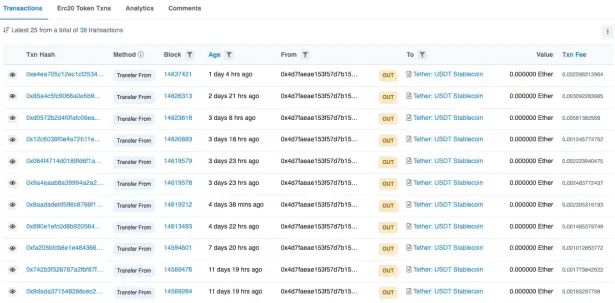
Meanwhile, over in Coinbase, things are a bit shaky today as blockchain security firm Peckshield recently detected a phishing scam targeting Coinbase users.
Some 38 users fell victim to the scam and lost more than $86,700.
Shiba Inu Developer Issues Spoof Warning
Over in the SHIB community, users were being warned in the past week to look out for scam tokens claiming to originate from "Shiba Inu: Deployer".
In a blog post posted in the Shiba Inu ecosystem on April 22nd, Kaal Dhairya stated, "When I saw an incoming transaction of the $WERSE token into "Shiba Inu: Deployer 2" I was pleasantly surprised but did not dig much into it because of being occupied by Shib The Metaverse land sale event. But upon looking deeper into the code I have found this is another scam... All honest tokens emit the correct information as events, with the correct sender and recipient addresses. This contract however, has crafted code specifically to emit malicious events (with arbitrary sender and recipient addresses), so that the token can associate itself with prominent wallets."
Lamenting that scammers make use of programming to fool investors and drain millions from their wallets, Dhairya said, "We see this every time and it breaks our heart as we can't do anything about it for them."
He urged users to only listen to official project channels for announcements.
Final Thoughts
Well, friends, it's certainly been a busy few days.
While reports of illegal activity in the cryptocurrency ecosystem is always cause for concern, I think we should take heart and be encouraged by positive news whenever it arises. This particular New York bill, barring further information, seems to be a step in the right direction, at least as a deterrent to the small group of developers looking for a quick cash grab at the expense of the less discerning investor. Of course, there may be details in the fine print of this proposed regulation that I do not yet understand and so I reserve the right to change my opinion on this should such information come to light.
I am taking care here to define the group of developers engaged in rug pull scams as a small group in the context of the overall cryptocurrency movement and basing this statement on the 2022 Chainalysis report which was also careful to note that legitimate cryptocurrency usage has far outpaced the growth of criminal usage in the past year.
Of course, as Chainalysis states, "Criminal abuse of cryptocurrency creates huge impediments for continued adoption, heightens the likelihood of restrictions being imposed by governments, and worst of all, victimizes innocent people around the world." In this regard, I look forward to hearing more about Senate Bill S8839 which may help to provide New York prosecutors with a clear legal framework in which to pursue scammers and rug pull developers.
But tell me, my friends, what are your thoughts on this latest development? Do you think that this proposed law is a step in the right direction or are you skeptical about any legislation in the New York Senate given other recent and seemingly unrelated moves by New York legislators to impose a three year moratorium on crypto mining in the state?
And what are your thoughts about the scam targeting Coinbase users with fraudsters pretending to be Coinbase Support? $86,000 is no money to sneeze at, I'd say. But I'd love to hear your thoughts.
Well, I'm off again in search of another story. Until we meet again, please remember to be safe.
Arrivederci!






