
What is Presearch?
Presearch is a search engine. That much you might have adjudged by now but it's where we'll begin chiefly because search is, as with many other conventions of internet computing we've come to assume or take for granted, up for a quite radical transformation through the introduction of decentralised blockchain frameworks.
I've not really thought about Search for quite a long time. I just do it. I type something into the search bar and I press Enter. Day in, day out. What search engine do I use? Google. Why? Arguably because it's the default search engine in Mozilla Firefox, Google Chrome and Apple's Safari. Arguably because it serves the best results.
Search History and Problems
Google grew to dominance in the search engine field (and beyond) by virtue of its secret PageRank algorithm that ranked web pages on the links and references to them from other websites. Google further offered companies the chance to buy search terms in order to achieve a higher page rank (Google AdWords). Those No-Evil-doers at Google effectively monetised web search.
With the monetising of web search and page ranking came the business of SEO (the process of increasing the quantity of web traffic to a website or web page from search engines). E-mail spamming, link farming and pay-per-click have come along with various other white hat (Google approves) and black hat (Google doesn't approve) techniques to trick Google's PageRank and other indexing algorithms.
Social media comes along with Facebook realising a highly sophisticated form of data-based content marketing. And here we are in 2021 with dangerous filter bubbles whereby an internet user's opinions and beliefs are reinforced by the adverts and customer-targeted "news" that they receive on the internet.

Shoshana Zuboff's slightly weighty The Age of Surveillance Capitalism doesn't shy away from locating much of the blame of what is wrong with the current internet at Google's door. Google's AdWords was, for Zuboff, the first widespread instance of using personal data to target potential customers.
The New Internet
Faced with the might of surveillance capitalism ("an economic system centred around the commodification of personal data with the core purpose of profit-making" - Wikipedia) the more conscious and tech-savvy internet user does have choices. We can use different browsers (a nod to Firefox which has always allowed you to easily change the search engine from the search box. Now there's something Firefox does that Google Chrome doesn't do), switch off targeted marketing, block ads, and we can use a different search engine.
It's probably a niche, or fairly select, user who is going to delve into the settings of their browser to amend the default search engine and, for now, a rare user who will seek out and use Presearch. But things change quickly in internet habits so we can be hopeful. Increased interest in crypto (the rising price of Bitcoin and numerous other tokens) encourages interest in more altruistic blockchain projects focused upon the potential for freedom and fairness offered by decentralized frameworks.
The Presearch Vision
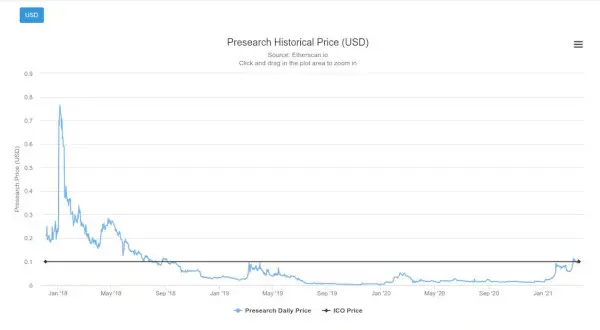
The Presearch Vision Paper is a very clear and informative document on the company's plans to "build out a blockchain-based, decentralized web search engine powered by the community". This well-written, extensive paper convinces me that (a) Presearch has some noble ambitions to be commended, and (b) is making some wise decisions and moving forward at a sensible pace. And, if judged by the price of PRE tokens, the market seems to agree:
Presearch differs from Google and more traditional search engines in three main ways. These are Presearch's unique selling points.
1. Data privacy
Full privacy is the default mode for Presearch. The user retains full control over what information is disclosed.
2. Payment to contributors
Users earn some amount of PRE for every search they make. That's a good asset for onboarding new users keen to earn some cryptocurrency. Users who run nodes can earn more PRE.
3. Decentralization
Presearch aims "to be decentralized to the maximum extent possible." For now, running a fully decentralized blockchain search engine seems unrealistic but it is encouraging that Presearch has this among its three principle directives.
The Web Search Bill of Rights
The paper states that "Presearch continues to be inspired by blekko’s Web Search Bill of Rights and its core tenets." Blekko was a search engine service that ran from 2010 to 2015. It sought to provide a richer dataset of information on websites than Google while adhering to the following set of principles. The intentions of Presearch seem similarly aligned so the Web Search Bill of Rights is worth considering here.
- Search shall be open
- Search results shall involve people
- Ranking data shall not be kept secret
- Web data shall be readily available
- There is no one-size-fits-all for search
- Advanced search shall be accessible
- Search engine tools shall be open to all
- Search and community go hand-in-hand
- Spam does not belong in search results
- Privacy of searchers shall not be violated
Ultimately Presearch, like any search engine, must compete with Google. Its long-term success may come down to the search results it returns and the project developers recognise this. It seeks to grow a community to develop a search platform that can rival Google in a number of ways but perhaps primarily in openness. While Google doesn't want you to use any search engine other than its own, the Presearch landing page offers you alternative search engines straight away in a beautifully designed page.
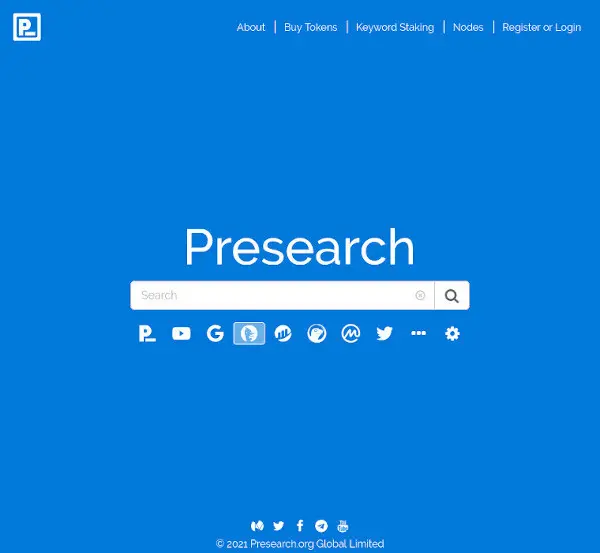
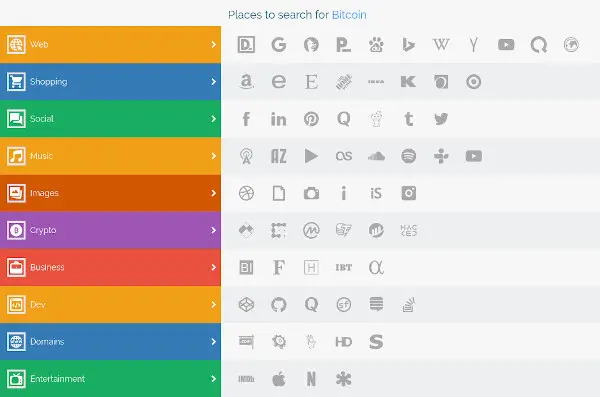
Further, if you click on the menu icon and choose to 'Search All Providers' extensive options for search are provided. Just in the first line under 'Web' there are 11 search engines you can immediately search with. This is a wonderful page, again exhibiting a highly professional GUI but also emphasising the open nature of the Presearch project. Presearch appears focused on exploring and emphasising the open nature of Search.
Search Options
There are many possibilities for searching the internet. There isn't solely one search box, one engine, one route and one standard list of results to be returned. Data-driven customer marketing has at least exposed this fact.
So I wonder what browser you use. Google Chrome? Microsoft Edge (that's Chrome)? Mozilla Firefox? Let's knuckle down and get into Settings to change the default search engine. But Presearch isn't listed there. That's because there's quite a trade to get listed. According to the Presearch paper, 'Google actually pays Apple more than $12 billion per year to be the default search engine in Safari'. So Presearch has sensibly decided to run with a browser extension option instead of having its name be listed in these browsers as an alternative search engine. Other options include setting your home and new tab pages to Presearch.org (which works nicely for me).
Keyword staking
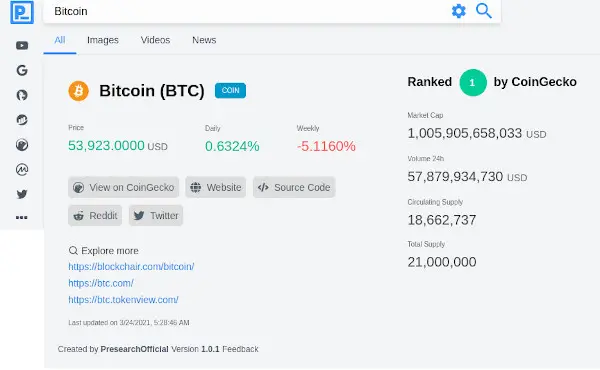
Keyword staking on Presearch is both an alternative model to traditional keyword ads and a highly optimised, unique method of staking cryptocurrency tokens. Advertisements are still triggered by keywords typed by users but the advertiser stakes PRE to show those ads. They can remove their PRE from the platform any time but will lose the ads. This is a great idea that encourages holders of PRE tokens both to provide relevant content and also to get involved in the Presearch community. Combined with custom packages of content that community users are creating to show on Presearch pages (for an example, see the screenshot below of searching for 'Bitcoin' on Presearch) we begin to envisage how a very different kind of search engine ecosystem might begin to grow.
I highly recommend reading or browsing the Presearch Vision Paper. It contains extensive documentation regarding nodes and node staking which I've not really touched on here. Nodes are a crucial component of decentralization. They will ultimately do the hard work running the searches of the Presearch engine. There is a lengthy write-up on the tokenomics of the project too. It's a very well written paper, clear enough that I can understand it (a rare thing since so many of these papers for crypto-tokens obfuscate and blind the reader with pseudo-science). This paper is refreshingly honest about the challenges Presearch faces. Building a decentralised search engine is a complex process.
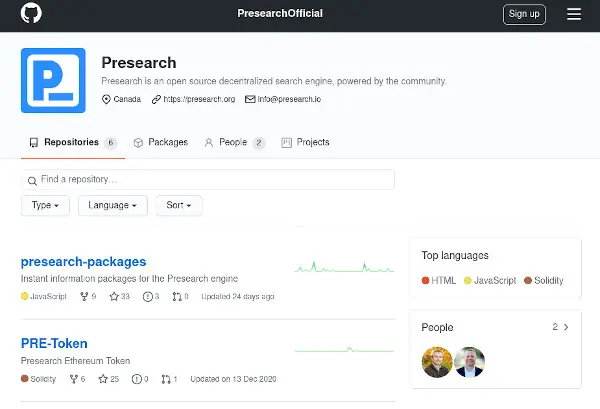
Tokenisation is never easy, either. 400 million PRE have been minted out of a maximum supply of 500 million. The paper is very open about the difficulties faced by any relatively immature cryptocurrency. The company running the project, Presearch.org Global Limited, based in Ontario, Canada, aims to transition to a not-for-profit, decentralised autonomous organisation in time. Packages of code are open-sourced and available on GitHub.
The organisation is currently focused on growing the number of active users and improving the search experience. Still, it already has some 2.5 million users and the search experience is very smooth. It is attempting to onboard users to its search engine by offering rewards in PRE. I'll be honest and would suggest that you're not going to get rich through your everyday searches (though you are going to accrue more income than you will with more traditional search engines). Your data is worth something. It is of interest to marketers what you are searching for. It's arguable that you should earn some tiny amount for providing that contribution to a search engine. You shouldn't lose your privacy and have that data directly linked to your online profile or search footprint. This has been the custom default of search engines for too long. It needs changing.
I genuinely think that the Presearch project is worthy of a little of your crypto research time. The concept of staking PRE to run keyword ads is a really unique proposition for tokenised investment that could really see Presearch and its community grow. The PRE token has seen steady accumulation in value in recent weeks. The search engine is already of real benefit to its users, by virtue of the extensive search options provided, enhanced data privacy, and the opportunity to earn PRE tokens.
Again I encourage you to take a look at the Presearch Vision Paper. Presearch is an exciting and ambitious project and the team directing its growth look to be making sensible decisions as to how best to progress and expand without endangering the ideals of the project. It needs to continue to encourage community use. Both in terms of content (community packages; open source code; keyword staking) and scope (the decentralised framework of nodes performing search operations), it is the community of Presearch users who will be able to make this a radical alternative to Google and other search engines. Everything about it so far looks really promising. A lot to like.






