
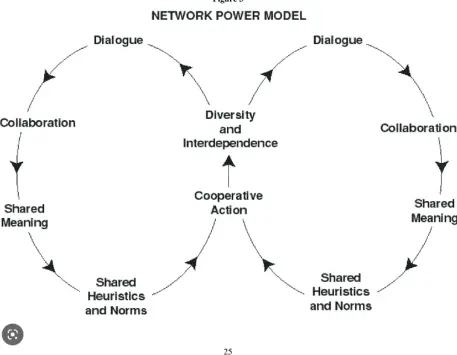
The so-called paradigm shift in planning theory refers to the move from a more technical and pragmatic approach to planning to consideration of theories of communication, empowerment, stakeholding and power. Communicative planning, sometimes called collaborative planning, has become a key model in schools of planning theory, roughly coalescing around the writings of Patsy Healey, Judith Innes and David E Booher, writers of some central texts in communicative or collaborative planning theory. Such works have often drawn on the critical theories of German philosopher and social theorist Jürgen Habermas, particularly his theories of communicative rationality. In their highly influential 2002 paper 'Network Power in Collaborative Planning,' Booher and Innes adapted Habermas' four validity claims (that must be realised in order to ensure a successful outcome for a communication process) to the context of town planning. Booher and Innes conceived of network power as a "flow of power in which participants all share."
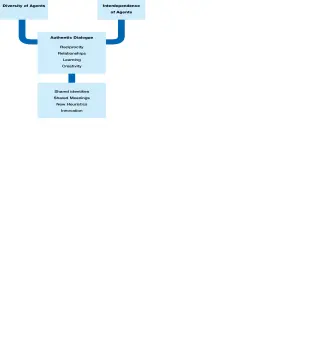
This power sharing is effective, argue the writers, when "three conditions govern the relationship of agents in a collaborative network: diversity, interdependence and authentic dialogue (DIAD)." This is not the only theory of communicative planning but it is one which is well regarded in some planning theory circles and is now old enough (2002) to have been well critiqued in years since and implemented in some real-world planning policies and frameworks. While this essay will examine or touch upon some other theories of communicative planning and other, perhaps older, non-communicative approaches, Booher and Innes' work 'Network Power in Collaborative Planning (2002)' is taken as a central point of origin for this study.
So how can communicative planning (when further referenced within this essay this term refers to theories of communicative or collaborative planning generally) develop less parochial approaches toward policy management? 'Parochial' is a tricky word to define. Synonyms include 'small-minded' and 'provincial'. Google's Oxford Languages dictionary gives 'parochial's first meaning as "relating to a Church parish." The planning context ("the parochial church council") is noted but in the context of this essay we will use the second definition of the word - to mean "having a limited or narrow outlook or scope." Wikipedia defines parochialism as "the state of mind, whereby one focuses on small sections of an issue rather than considering its wider context." Perhaps we'll throw all of this into the ballpark then. We are looking at collaborative planning and its whole approach is aimed at a widening inclusiveness, a more 'democratic' approach (although this term is nowadays fraught with quite loaded connotations). Wikipedia contrasts parochialism (narrow in scope) with cosmopolitanism. "Cosmopolitanism" or a cosmopolitan approach, for Wikipedia (the quote is from the Stanford Encyclopedia of Philosophy [1]), 'is both prescriptive and aspirational, believing humans can and should be "world citizens" in a "universal community".' If planning theory has made the jump to this kind of enlightened (?) world-view one might suggest planning procedure in the real world (policies; governmental and commercial barriers to implementation taken into account etc) has been dragging its feet. But we will examine the success or failure of communicative planning to widen the scope of planning policies, consultation and implementation of planning practices further in this essay.
What is policy management in the context of town and regional planning? The Ministry of Housing, Communities and Local Government "sets out the Government’s planning policies for England and how these should be applied" within the National Planning Policy Framework (NPPF) [2]. It provides a framework within which locally-prepared plans for housing and other development can be produced."
1 Kleingeld, Pauline; Brown, Eric (October 2019). "Cosmopolitanism". In Edward N. Zalta (ed.). Stanford Encyclopedia of Philosophy. Center for the Study of Language and Information. Archived from the original on 14 January 2020.
2 National Planning Policy Framework






