
I’ve been filming a course titled The Art of The Bubble to be released with Real Vision. It takes a refreshed look at the principles behind our work and explains them in 25 lessons.
For cryptocurrencies, I wanted to put together a model portfolio that would be easy to execute on and easy to understand. It’s also something we could improve with our algos but easy enough for a beginner.
The idea is to start with a lead indicator – Bitcoin. Now, that’s not an indicator that you’ll want to change as the sector matures, but as long as it has better than 40% market dominance, it’s probably ok.
We used the 200 day moving average (smoothed a bit) over BTC to assess industry health. Again, not a great indicator, but easy enough for a beginner.
Then we selected 5 coins and excluded obvious coins that would have skewed the basket with hindsight bias (e.g., Solana). We added weights to these coins given our confidence in them.
- BTC - 35%
- ETH - 25%
- BNB - 15%
- AVAX - 15%
- DOGE - 10%
We treated those weights as separate liquidity buckets. Out of a $100,000 portfolio, then, BTC would start with $35,000 and whatever it gained or earned would be taken from that one bucket. If it gained 10% on a trade, you now had $38,500. If it lost 5 after that, you now had $36,575. No wins or losses would affect the amount that was used for ETH, BNB, AVAX, or DOGE. The same holds for all those coins. Neither would there be any rebalancing.
The result is that you have 5 funds each trading 1 coin that combine to make your portfolio.
The reason for treating the coins this way was to isolate underperformers and facilitate ease of execution (never underestimate execution risk).
The signals for the coins are also relatively simple. For Bitcoin, if the price on a daily chart closed above the 200 day moving average buy and hold. If it closed below the average, then sell and stay in cash.
For the other coins, you have a simple nested conditional:
- If the closing price of BTC > 200 MA, (this is the lead indicator check)
- Then if the closing price of your coin > 200 MA,
- Then buy and hold,
- Else sell or hold cash.
I can think of a dozen ways to improve performance on this strategy, but this is good enough. The real magic derives not so much from the signal algorithm as the portfolio management. Here are the results displayed individually.
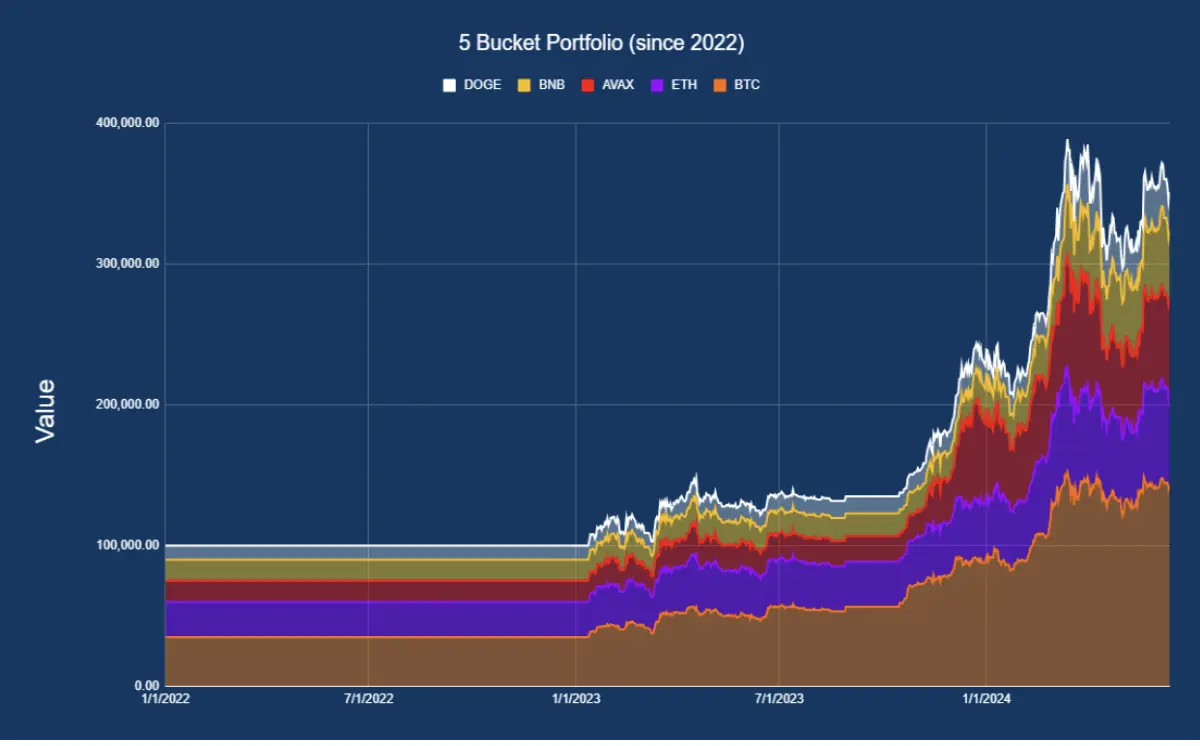
Each line adds value. So, BTC in orange started with $35,000 and rose over time. ETH, in purple started with $25,000 and rose over time but is added in the chart to BTC’s value. And so on. At the top is DOGE, in white, which started with $10,000 and rose in value over time also.
Since 2022, that portfolio would have returned 251% over your initial investment. It’s a bumpy ride, but it performs well.
Here’s how it would have performed relative to the benchmark of just buying and holding those coins starting in 2022 in the same proportions.
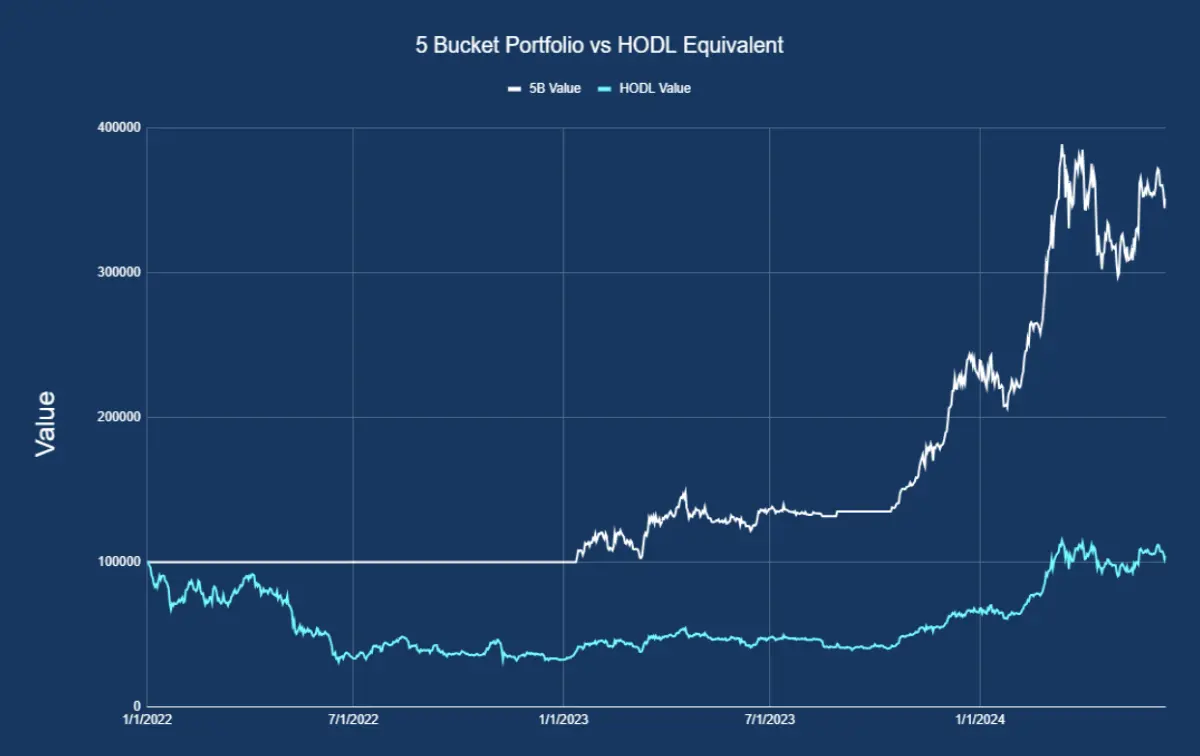
The benchmark portfolio would have made just 4.23% over your initial invested. That means the 5 Bucket provided about 250% alpha.
I think it’s still an incomplete strategy as you will need to rebalance at some point. Also, its bias towards BTC is something that pays well in the first part of a bull run but not after that (at least historically).
Still, we’ll be making regular updates in Discord about this and on my Twitter @lspurcell. At the very least, I hope you learned something from this little data experiment.
Happy Trading!
- Sebastian Purcell, PhD






