
Have you ever asked yourself or your loved ones if you are normal? We are so often trying to plot ourselves against the trends of society, and society is ever a moving target. When Steve started getting a mullet cut in the 80's he was staking his position in a trend that at the time was normal. Now 50 year old Steve is still rocking the mullet but he's lost his spot on the normal curve and is on the fringe. Not everyone is targeting normal, in fact some people go out of their way to make a statement about normal by seeking to place themselves outside it. There is always some trend particularly among young adults to change themselves or do something that makes them stand out rather than blend in, so they look at the prevalent normal and pick something so outside of that that they can't help but get attention in a crowd.
When we ask if something is normal we are really asking if it falls on the thick centre of the bell curve. Who we include in that bell curve may be a narrow group. A teen doesn't care about trends among their parents generation or among 6 year olds but perhaps a 3-5 year spread around their age are the people whom they want to measure themselves against.
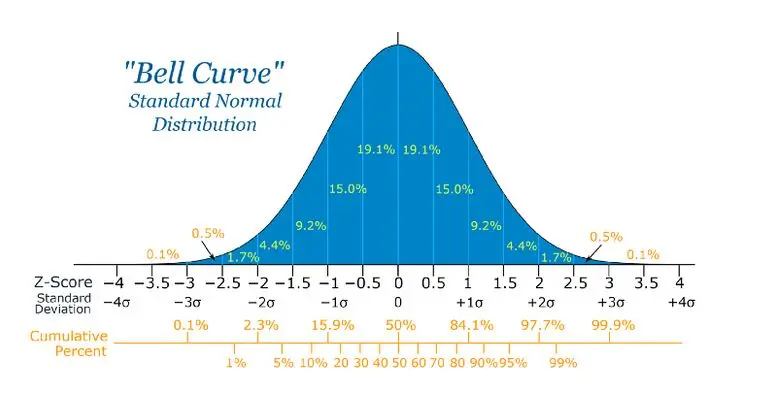
Over recent decades battles have been fought over various bell curves when we ask society what to accept as normal or not. Societies expectations are important because where we draw the lines determines where we decide to exclude or treat people as a problem to be solved. Some of the most public battlefields are in the realm of gender roles and LGBTQ identities. One could argue that in the 40's and 50's North American societies placed their measure of normalcy in what we would now consider a narrow band, dead centre on the bell curve. However if you asked them to draw those lines at the time they would probably think the bars only neglected a tiny minority at each end. If you stepped outside of that measure of normalcy you were in some cases a societal problem needing fixing. Understandably, in hindsight we know there seems to be a natural distribution of gender and sexual identity expression falling well outside that narrow band. The push to stretch societies definition of normal to include more outliers is a daily effort on many topics.
I've been fascinated with the bell curves on testosterone in particular because its levels have been repeatedly and definitively linked to both physical and behavioural variation in both men and women. Minorities of all sorts are aware they are such before knowing why, and often never really know why. Whether you are severely risk-averse or severely non-risk-averse significantly impacts the direction of your life and where you fall on the testosterone bell curve for your biological sex can give at least some insight as to why you are who you are. As with anything, there can be too much or too little as to threaten your health but there is also a wide range within the safety bars that indicates natural differences among people.
Ultimately the bell curve gives us a model to plot data on, and discuss or debate what is normal within the parameters of a particular demographic, as small as 6 month olds and as big as all of humanity (though the job of acquiring data on all possible human demographics would be staggering). Where we draw our lines matters. In some cases it is subjective, based on the values of those contributing. In other cases, it is objectively important to draw lines accurately. For example the size of certain parts of the brain indicate a persons capability for empathy and impulse control; drawing a line between a slightly insensitive person and a potential serial killer.
I believe the bell curve is one of the best tools for tracking variation in humanity, discussing and determining if and when intervention is warranted or public campaigns to educate people about the broader boundaries of normalcy. Truth needs to be rooted in data.






