
Despite much criticism against Segregated Witness (Segwit) since its implementation in 2017, the solution to scale Bitcoin continues to see an increase in the number of transactions over the years.
Data from Segwit.space, a platform that monitors the adoption of the technology, revealed that a new milestone has been reached, as the volume of transactions in the protocol now represents over 56% of all transactions in the Bitcoin network.
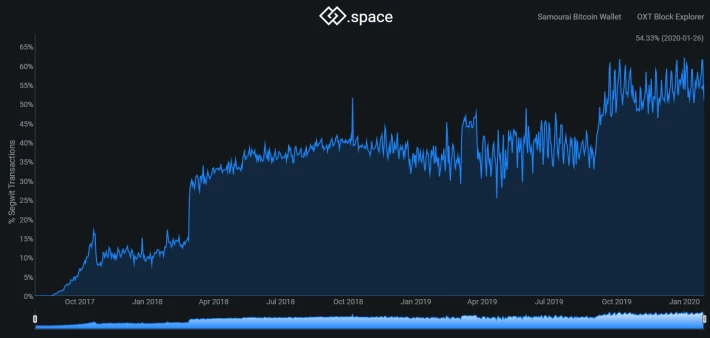
This is not the first time Segwit has recorded a significant increase in transaction volume. The data in the graph shows that the protocol underwent a major change from about 40% in September 2019 to almost 60% in the following month.
Segwit's adoption is quite commendable, considering that more than 35% of the total transaction volume in the network used it only one year after its implementation.
What Segwit does?
Because transaction confirmation time in the Bitcoin network is slow, Segwit helps increase the amount of transactions per block by removing the witness data from each block and encrypting it in the side chains.
More than 60% of each block is composed of witness data; therefore, developers believe that removing such information would increase the scalability of the Bitcoin network. That's where the name comes from - segregated witness.
Although it seems a very reasonable idea to scale Bitcoin and reduce transaction fees, Segwit still does not see a higher adoption because it is not a mandatory upgrade.
This gives miners, exchanges and portfolio providers an option of whether or not to adopt the change. There is also the argument that removing transaction data from the network is contrary to the Bitcoin principle and should therefore be discouraged.
In contrast, the data in the graph shows that the crypto companies are buying the Segwit idea and are implementing the change.
Two of the largest organizations currently using Segwit are Gemini and Bitmex. It is believed that if the entire network adopts the Segwit protocol, the block size could increase to about 1.7 mb.






