
DeFi got built on a paradox we all stopped noticing. To prove a smart contract is solvent, Ethereum and its successors require every user to publish their balances, collateral ratios, leverage positions, sometimes even their trading intent before it executes. Transparency, sold as an auditability guarantee, became crypto's number one privacy problem. Anyone, anytime, can reconstruct the full financial history of a wallet with a few queries on an explorer.
XELIS, the Layer-1 BlockDAG that has been running since 2024, took the opposite bet from genesis. Balances encrypted homomorphically. Confidential assets native to the chain. Zero-knowledge proofs to validate transfers without revealing amounts. Privacy is not an option bolted on after the fact, it is the default.
What was missing was a complete DeFi stack on top of it. That is what XELIS Vault just shipped. The testnet is open.
51 Silex contracts, a live testnet
XELIS Vault is a composable DeFi protocol written in Silex, the native language of XELIS. Under one roof: a CDP stablecoin (xUSD), a decentralized median oracle, an AMM, a PSM, a lending engine, a privacy mixer, an end-to-end encrypted chat, and on-chain governance. The code is open, audited, and there is a 700,000 VLT airdrop in progress.
As of writing, 35 of 37 core contracts are deployed on testnet. Addresses are tracked in docs/DEPLOYMENTS.md in the repo. The faucet is open to grab testnet XEL. The CLI works against the deployed contracts. 22 integration tests pass out of 25, and the 3 remaining failures are UTXO maturity and health factor tuning cases, not logic bugs.
Deployment follows DEPLOYMENT_GUIDE.md across 13 phases. Contract addresses, transaction hashes, configuration values, all of it is in DEPLOYMENTS.md. No black box.
An architecture in six layers
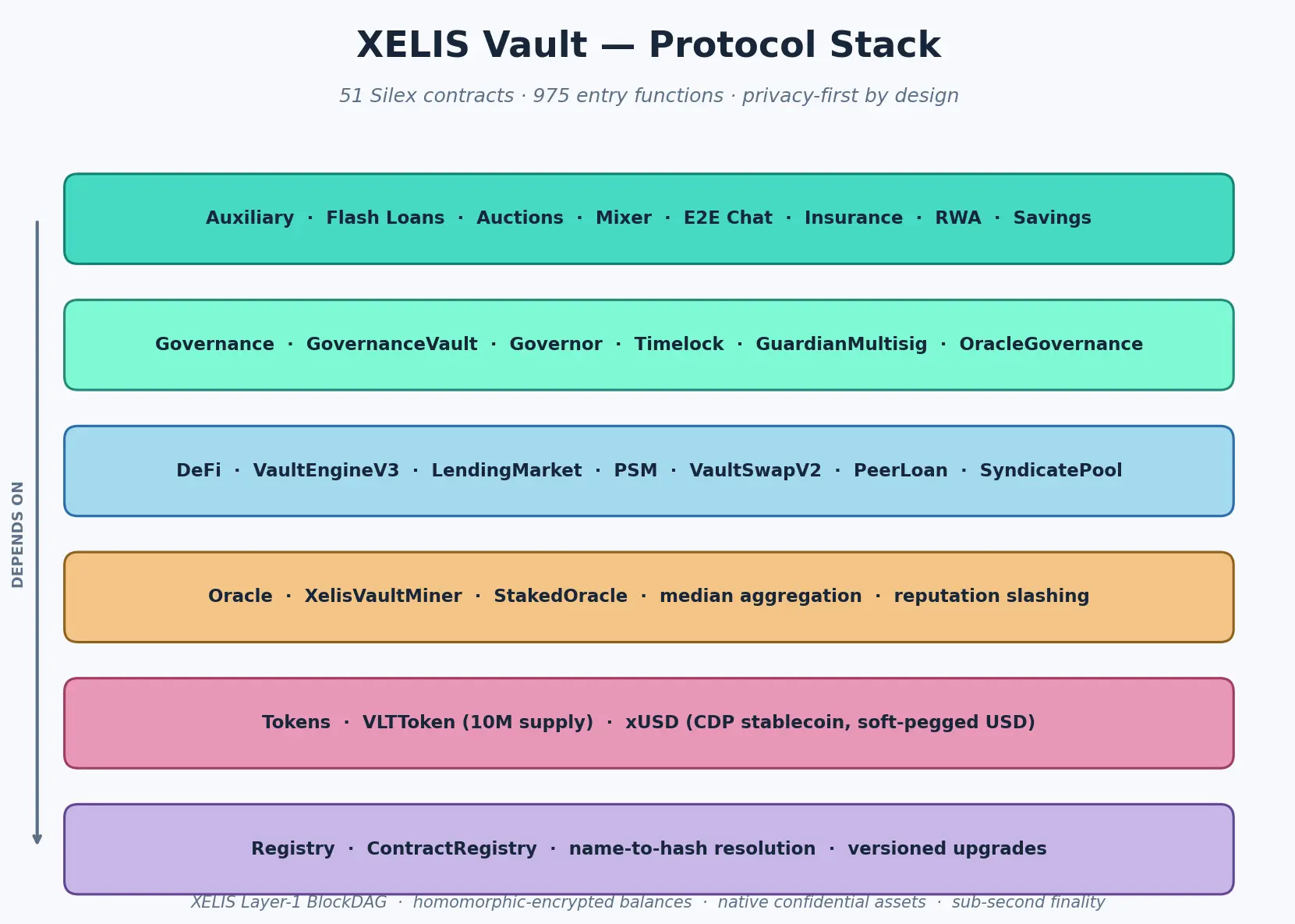
The architecture is organized in six layers, with each layer depending only on the ones below. That is what keeps the dependency graph acyclic and deployment deterministic. Bottom up: Registry (name to hash resolution, versioned upgrades with cooldown, rollback), Tokens (VLT and xUSD), Oracle (XelisVaultMiner for the miner registry and slashing, StakedOracle for median with circuit breaker), DeFi (VaultEngineV3, LendingMarket, PSM, VaultSwapV2, PeerLoan, SyndicatePool), Governance (GovernanceVault, Governor, Timelock, GuardianMultisig, OracleGovernance), and the Auxiliary layer which bundles FlashLoan, SealedBidAuction, PrivacyMixer, VaultChat, InsurancePool, AssetVault, TreasuryVault, RevenueShare, SavingsRate, Payroll, FaucetContract, ComplianceModule, MinerDelegation, FlashCallback.
In total, 975 entry functions exposed to the user. The full source is on GitHub: github.com/XelisVault/xelis-vault.
The audit report is public
No confidential PDF buried somewhere. The v11.5 remediation report published on August 21 documents the re-application of 18 findings from a controlled disclosure audit (2 critical, 5 high, 8 medium, 3 low). It is all in docs/AUDIT_v11.5_REMEDIATION.md in the repo.
You read for example that AirdropClaim.emergency_withdraw_unclaimed never transferred any funds: a // In production: comment in place of an actual function call. That FlashLoan.flash_loan was calling the wrong chunk ID and sending the principal to the EOA instead of the callback contract. That the access-control guards in four contracts (RevenueShareDelegation, FeeDistributor, AnalyticsCollector, CreditScore) accepted any contract caller instead of an explicit allow-list.
It is detailed, it is dated, it is signed. The full changelog is public. The transparency choice is deliberate.
700,000 VLT on the table
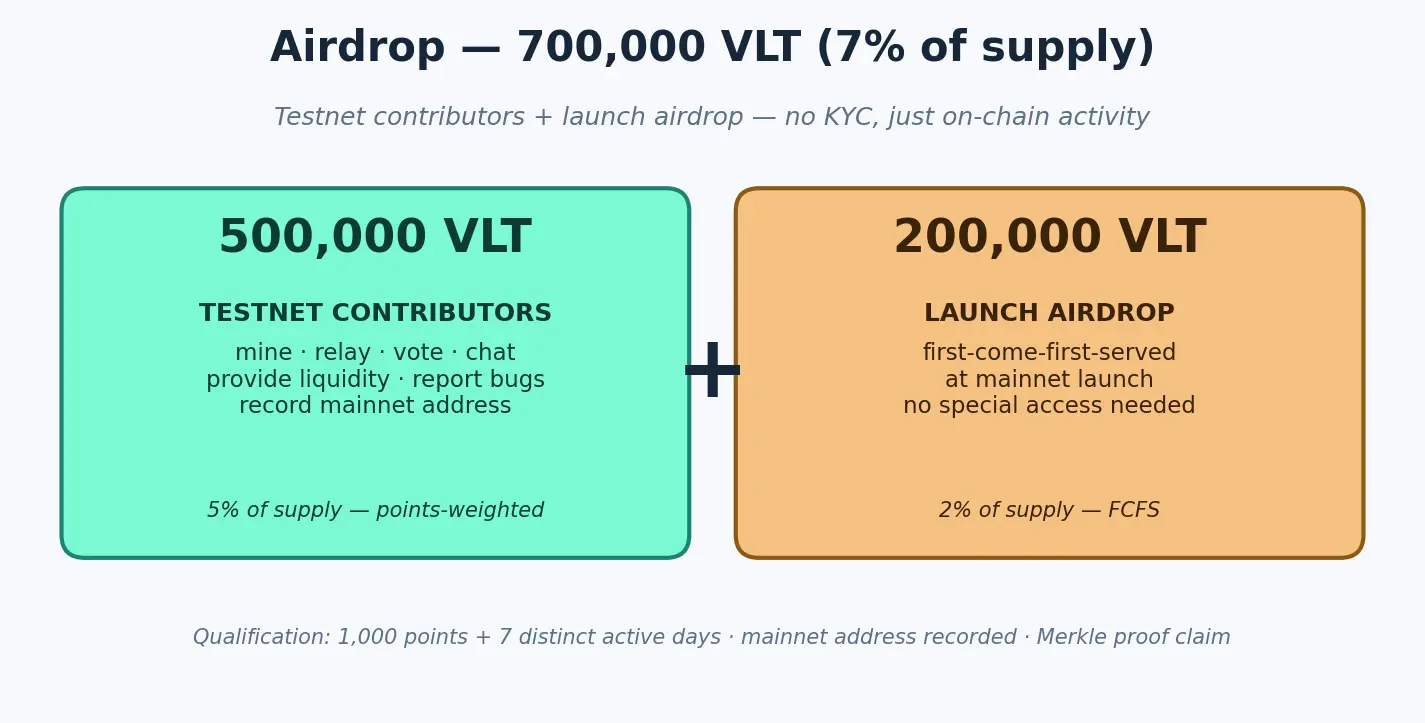
The airdrop has two envelopes.
The first one, 500,000 VLT, which is 5% of supply, goes to testnet contributors. No snapshot, no whitelist: we are talking about points accumulated on-chain by actual usage. The AirdropTracker.slx contract tracks every action. Mining (valid submissions, uptime), relayer (anchors, uptime), governance (votes, proposals), chat (messages, groups), liquidity (deposits, LP), bug bounty. The admin can also attribute points manually via record_manual_attribution_batch, up to 50 users per batch, with a configurable cap (50,000 points per call by default). That is designed to reward Discord helpers, mods, community leaders. The admin can also disqualify a cheater, or force-qualify a valuable contributor who did not hit the 7 active days requirement.
The second envelope, 200,000 VLT (2% of supply), is the launch airdrop at mainnet. First-come-first-served. No special access, no insider deal. Just be there at the right moment.
To qualify on testnet: 1,000 points minimum, 7 distinct active days, mainnet address registered. Distribution is proportional to points, with a multi-role bonus (3 active categories give +25%) and a custom multiplier possible for community leaders. At the end, a Merkle root is published on-chain on AirdropClaim.slx and each user claims with their proof.
10 million VLT, distributed over 10 years
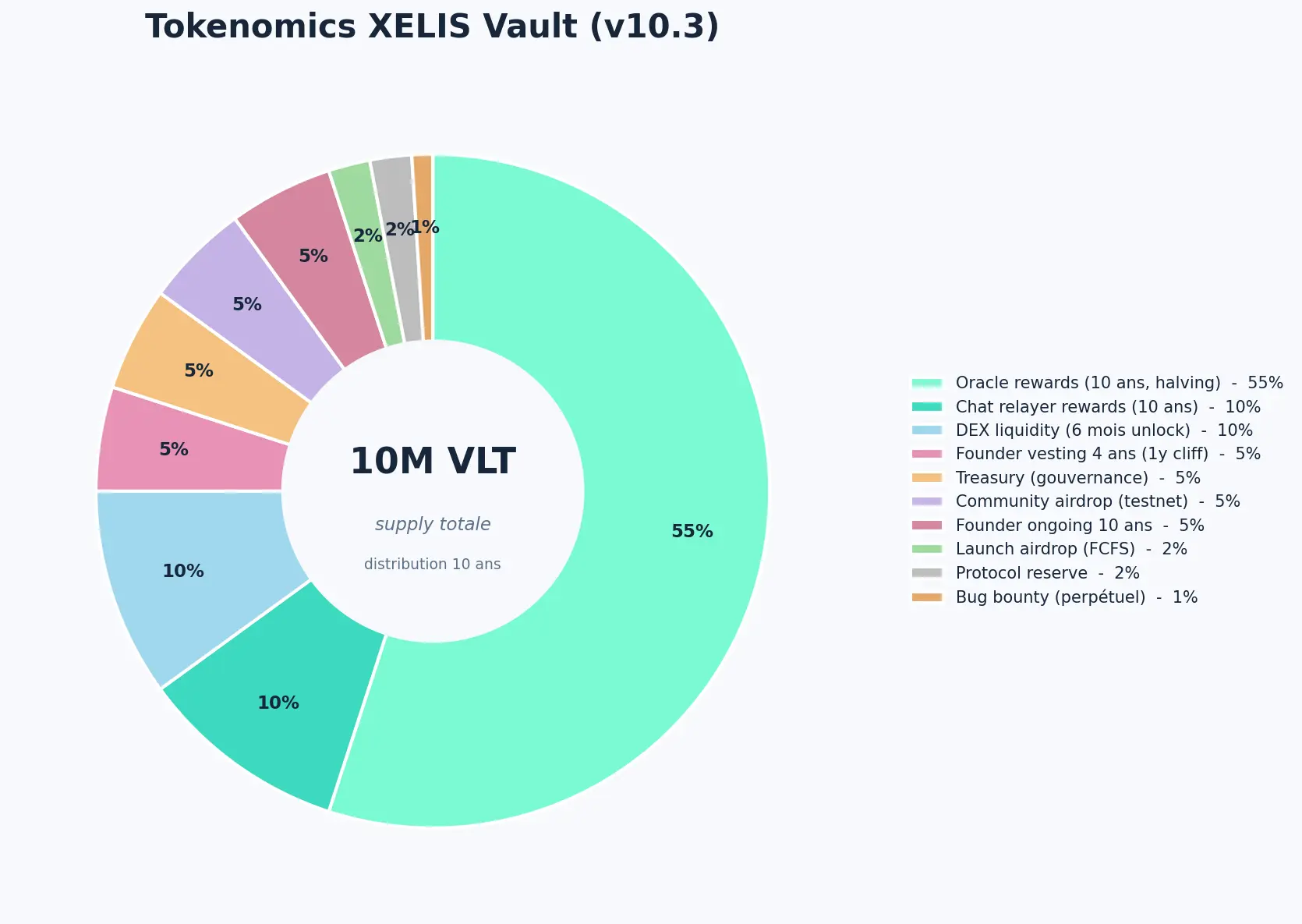
The full breakdown is in docs/TOKENOMICS_v10.3.md in the repo. 55% to oracle rewards (10 years, dynamic budget with Bitcoin-style halving, interval of 6,307,200 blocks which is one year), 10% to chat relayers (10 years, 100k per year), 10% to DEX liquidity (6-month linear unlock), 5% founder vesting over 4 years with a 1-year cliff, 5% treasury under governance, 5% community airdrop (the 500k from testnet), 2% launch airdrop (the 200k FCFS), 2% protocol reserve, 1% perpetual bug bounty, 5% founder ongoing over 10 years at 50k per year.
What is interesting in the economic model: no per-transaction founder fee. The founder gets 10% of the protocol's existing fees, via FeeDistributor which splits 50% burn / 40% treasury / 10% founder. No new tax on users. Founder compensation is aligned with volume success, not with a casino rake. That is a choice documented explicitly, after rejecting several proposals that would have created regulatory red flags (Howey test, rake perception, double taxation). The v10.3 tokenomics explains why those proposals were turned down.
The encrypted chat, and why it is harder than it looks
VaultChat deserves a pause. An end-to-end encrypted on-chain chat is not just storing encrypted blobs in storage. It is an entire system of relayers that anchor hashes into XELIS blocks, that validate Ed25519 signatures without ever seeing the content, that are subject to a 50 VLT slashable stake, with diminishing returns on rewards for anti-spam and a P2P dispute mechanism between relayers.
Ten anti-abuse layers are documented in docs/CHAT_GUIDE.md. Rate limit of 300 blocks between anchors per relayer. Maximum 50 anchors per day. Minimum 5 messages per anchor, minimum 2 unique senders. Daily cap of 100 VLT in rewards per relayer. Diminishing returns decreasing from 100% to 20% over the day. Reputation multiplier (Excellent 1.5x, Good 1.2x, Warning 0.8x, Critical 0.5x). Slashable stake. P2P consensus between relayers. Dispute mechanism.
Over 10 years, that is 1 million VLT split between active relayers, around 10k VLT per year per relayer with 10 relayers running in parallel. An optional user subscription (95% to relayer, 5% to protocol) covers server costs. The economic details are in docs/MINER_ECONOMICS.md.
How to join, concretely
Several roles are possible, and the barrier to entry is deliberately low.
To mine: install the CLI, have the minimum stake (1,000 VLT by default, it was 100 VLT before v10.7, raised for anti-Sybil), start the daemon. Rewards are stake-weighted with a reputation multiplier (Excellent = 1.5x, Good = 1.2x, Warning = 0.8x, Critical = 0.5x). xvault-miner is an interactive TUI dashboard that shows reputation in real time, stake, rewards, submissions, budget, and the XEL/USD price. To start mining immediately: xvault-miner --miner.
To run a chat relayer: install xvault-relayer, stake 50 VLT as a slashable bond, run the daemon. It is the most accessible role technically, and the one that pays the most as a percentage of stake.
For a community member: install xvault. Wallet, vaults, swaps, governance, mixer, chat. No stake required.
For a Discord helper or mod: the admin can attribute points manually via record_manual_attribution_batch. Community contributions count for airdrop points, just like any on-chain activity.
All the tooling installs in one command:
curl -fsSL https://xelisvault.github.io/xelis-vault/install | bashOrirm https://xelisvault.github.io/xelis-vault/install.ps1 | iexon Windows. No telemetry, no phone-home, everything stays local. The installer detects the OS, clones the repo into~/.xelis-vault/src, creates the Python venv, installs the three launchersxvault,xvault-miner,xvault-relayer, generates config with testnet defaults. No data leaves the machine.
For price providers
price_provider.py is the daemon that polls sources (CoinEx, MEXC, XELIS daemon, custom HTTP source, external command source), computes the median with 5% outlier rejection and 30-second staleness rejection, and submits the price to StakedOracle via the submit_price entry. The custom_sources.example.json file documents 7 source templates: CoinEx built-in, MEXC built-in, XELIS daemon, generic HTTP with bearer auth, simple HTTP, shell command, Python command.
aggregation_keeper.py runs in parallel, triggers the aggregate_now entry every 25 seconds for each configured feed, and monitors stuck cycles (alerts if no progress for 5 minutes). These two daemons are designed to run on distinct servers, by independent operators. That is what makes the oracle decentralized in practice, not just in theory.
The Discord and the rest
That is where to go for questions, support, phase announcements, testnet rollouts, bug bounties. The server is open, no invite needed: discord.gg/EjyvHFakY9.
On X (Twitter), the @XelisVault account posts phase updates. The official XELIS account @xelis_crypto covers the Layer-1.
For video, the official XELIS channel publishes technical content on the BlockDAG and privacy by design: youtube.com/@xelis_blockchain. Testnet deployments are livestreamed and announced on Discord, with replays usually uploaded to the channel.
What is testable now
Live on testnet: PSM mint/redeem, VaultEngine deposit/borrow/repay/withdraw, VaultSwap create_pool/add_liquidity/swap, GovernanceVault stake/claim, Faucet distribute, VaultChat register_session/anchor, InsurancePool stake/unstake, SavingsRate deposit/withdraw, Mining with heartbeat, stake, register_service.
Not yet testable live: AirdropTracker finalize (the freeze phase is manual, triggered at the end of testnet), AirdropClaim (triggers at mainnet), Governor execute_proposal (the Timelock has a 34,560-block delay, around 24 hours).
The full roadmap is in docs/ROADMAP.md. Q3 2026 (testnet) and Q1 2027 (mainnet) are the next two milestones.
Why get in now
This is a testnet, not a mainnet. Anything can break, anything can be redeployed, anything can be reverted. That is exactly the point of joining early: every bug found is worth points, every hour of mining is worth points, every chat anchor is worth points. The 500,000 VLT community envelope is distributed proportionally to that activity. The earlier you get in, the more you contribute, the bigger the share.
No financial advice in this article. No price projection, no "guaranteed 100x". A protocol building in public, an open testnet, a transparent airdrop distribution. Up to everyone to judge whether the topic is worth paying attention to early.
USEFUL LINKS
- github.com/XelisVault/xelis-vault full source code
- discord.gg/EjyvHFakY9 official Discord server
- x.com/XelisVault protocol X account
- x.com/xelis_crypto XELIS Layer-1 X account
- testnet-explorer.xelis.io testnet explorer
- xelis.io official XELIS site
- docs.xelis.io XELIS documentation
- youtube.com/@xelis_blockchain XELIS YouTube channel
- XELIS Vault whitepaper technical documentation
- Airdrop plan qualification and distribution
- Tokenomics v10.3 full 10M VLT breakdown
- Audit report v11.5 18 findings fixed in public






