
Prediction markets are often celebrated as the ultimate "global truth machine" a decentralized ecosystem where the collective wisdom of the crowd filters out noise and distorts bias into cold, hard probabilities. But what happens when the mechanism tasked with resolving multi-billion dollar disputes isn’t controlled by a decentralized crowd, but rather by a single-digit group of anonymous operators?
A groundbreaking investigation has exposed a profound structural flaw at the heart of the world's largest prediction platform, shaking the foundations of decentralized governance.
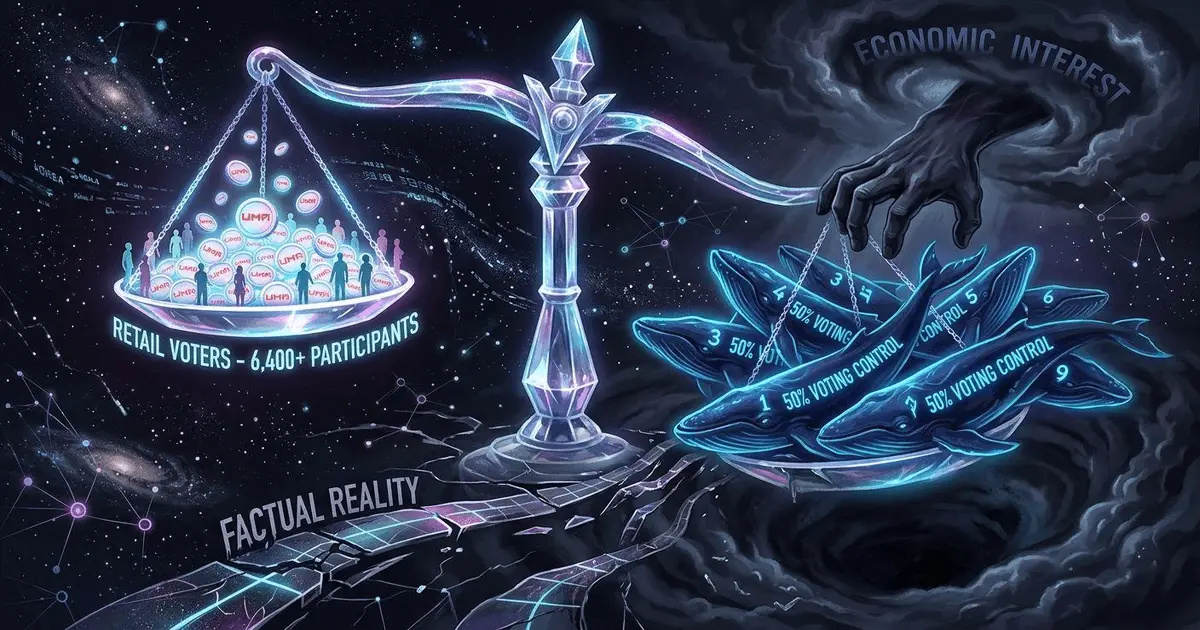
A broken equilibrium: The UMA token voting structure allows just nine anonymous whale wallets to tilt the scales of factual reality in high-volume prediction markets.
Quick Takeaway
A recent Bloomberg analysis reveals that out of more than 6,400 wallets participating over the last three years, just nine anonymous UMA whale wallets control approximately 50% of all voting power in Polymarket dispute resolutions. This heavy concentration of power introduces a severe economic conflict of interest, where massive financial incentives can drive reality-defining verdicts rather than objective truth.
The Core Breakdown: How 9 Wallets Outvote Thousands
When a highly contested market closes on Polymarket whether it is a high-stakes geopolitical outcome or a tight election race and traders cannot agree on the final result, the contract enters a formal dispute process. Instead of relying on a centralized judge, Polymarket routes these claims through UMA’s Optimistic Oracle.
UMA token holders are then called to vote on-chain to determine the factual reality of the event. The system was designed to reward voters who align with the majority consensus and penalize those who do not.
However, the raw data paints a radically different picture of how this works in practice:
Metric System Distribution Data Total Voting Participants (3-Year Span) 6,400+ Independent Addresses Dominant Core Control Group 9 Anonymous Whale Wallets Concentration of Voting Power ~50% of Total Voting Influence April 2026 High-Volume Disputed Contracts 230+ Contracts (Exceeding $1 Billion to $10 Billion in collective volume) Whale Success Rate Aligned with the winning outcome in nearly 100% of cases
This extreme concentration means that no matter how many thousands of retail participants review evidence, analyze terms, and cast their votes, the final truth is effectively dictated by less than ten entities.
The UMA Token Voting Architecture: Incentivizing Strategy Over Truth
To understand why this happens, we have to look closely at the underlying mechanics of UMA token voting. The network uses an economic game-theory model: if you vote with the majority, you earn more tokens as a reward. If you vote with the minority, your stake can be penalized or diluted.
In theory, this should force everyone to vote for the objective truth. In reality, it forces participants to play a game of prediction within a prediction: "How will the biggest whales vote?"
(Contested Market Outcome) --> (Dispute Process Triggered)
|
▼
(UMA Token Game-Theory Incentives)
👥 Whales: Vote for maximum economic self-interest
👤 Retail: Forced to guess & follow the Whale trend
|
▼
(Reality Verdict Formed by 9 Wallets)
Because these nine crypto whales carry massive weight, smaller voters are economically incentivized to simply copy the whales' movements to secure a payout, rather than researching the actual real-world facts of the dispute. This creates a dangerous loop where the whales have absolute, de facto control over the final verdict.
The Danger of "Fact-Determining Power" Driven by Economic Interest
This structural asymmetry completely redefines the risks for retail traders. When trading volumes climb, the rate of Polymarket disputes naturally rises alongside them. High-stakes geopolitical contracts such as localized military strikes or complex legal rulings frequently hang on precise phrasing and semantic interpretations.
If a whale holding millions of dollars in UMA tokens also happens to have a massive open trading position on a disputed Polymarket bet, they face a staggering conflict of interest. They possess the direct financial leverage to twist the oracle’s decision in favor of their personal trading portfolio.
Critics and prominent high-volume traders have voiced escalating frustration. Initiatives like UMA.rocks attempted to pool community voting power to challenge this dominance, yet even these collective pools have faced criticism for acting as centralized voting blocks themselves. Meanwhile, systemic upgrades originally promised by project teams to decentralize the process have been put on hold, leaving retail users exposed to an uneven playing field.
Decentralized Governance at a Crossroads
The ongoing dispute dilemma reveals that decentralized prediction markets have an architectural single point of failure: the oracle layer. True decentralization cannot coexist with a system where nine private keys hold the power to define historical reality for a global user base.
As rumors circulate about platforms exploring native token alternatives to bypass third-party liabilities, the wider industry faces a crucial test. If Web3 platforms cannot engineer a genuinely unbiased, manipulation-resistant method to resolve disputes, the promise of a decentralized "global truth machine" will remain nothing more than an illusion.
Verified Research Sources
-
Bloomberg Analysis: Data compiled across 6,400+ voting addresses over a 3-year historical timeline.
-
Market Activity Logs: April 2026 internal tracking of 230 contested contracts across scaling transaction volumes.
-
On-Chain Governance Records: Public ledgers detailing UMA token distribution, voting history, and consensus weightings.
Disclaimer: This post is for educational and research purposes only and does not constitute financial advice. Always do your own research (DYOR).
⚡ Never miss an urgent market shift: I post daily real-time crypto setups, micro-analyses, and exclusive charts. Follow My Daily Updates Here
🎮 Want to turn your gaming time into passive income?






