
Historically, Wall Street held a monopoly over retail investors. When a multi-trillion-dollar behemoth prepared for an initial public offering (IPO), retail traders were left with crumbs. They had to wait for institutional investors, hedge funds, and accredited players to buy in at a fixed bookbuilt price before getting access to the secondary market at a massive premium.
On June 12, 2026, Elon Musk’s SpaceX fundamentally disrupted this dynamic by debuting on the Nasdaq (Ticker: SPCX) at an IPO price of $135, raising an unprecedented $75 billion and instantly soaring past a $2 trillion valuation.
However, the real historical anomaly did not happen on the floor of the Nasdaq or Nasdaq Texas. It happened on crypto rails.
Through Pre-IPO perpetual futures and tokenized synthetic stocks (SPCXX and SPCXB) hosted by decentralized protocols like Hyperliquid and centralized giants like Binance and Bybit, global retail traders circumvented traditional brokerages entirely. This shift highlights a deeper structural trend: the rapid fusion of Real-World Assets (RWA) and Traditional Finance (TradFi) into crypto liquidity pools.
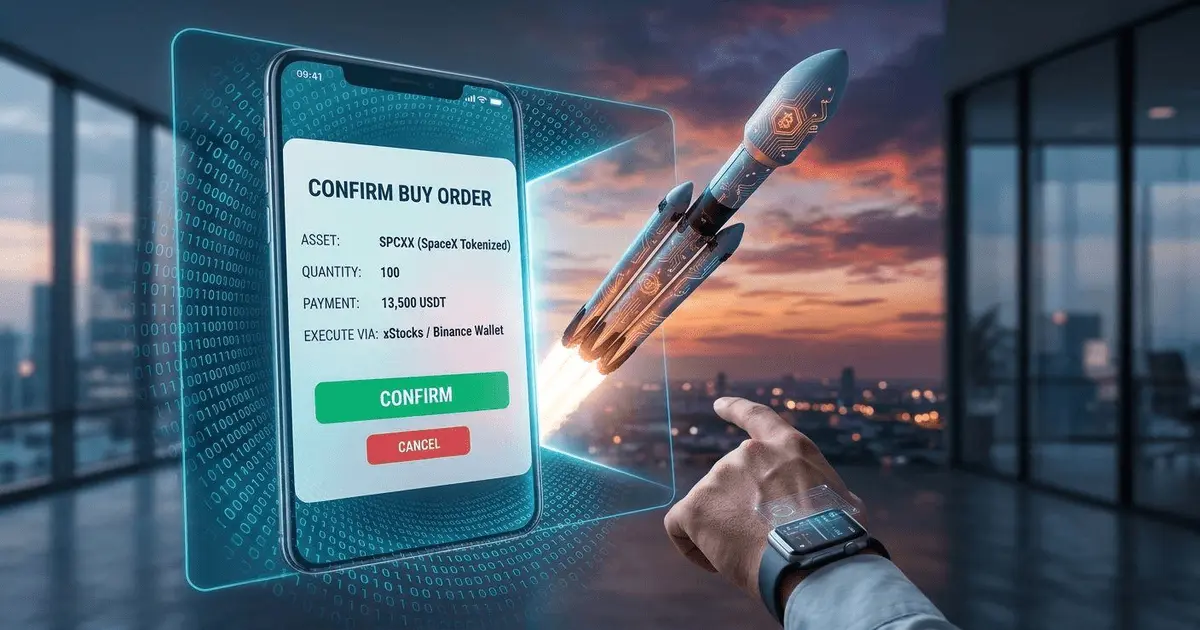
Global retail traders accessing tokenized SpaceX equity via secure Web3 crypto wallets.
Quick Takeaways:
-
The SpaceX Phenomenon: SpaceX went public on June 12, 2026, at $135/share, closing its first day above $166 (a $2+ trillion valuation).
-
Crypto's Shadow Market: Weeks before the listing, crypto platforms like Hyperliquid, Binance, and OKX traded over $2.2 billion in cumulative volume via SpaceX perpetual futures, acting as a highly accurate decentralized price discovery engine.
-
The New RWA Era: Backed tokenized shares (SPCXX via Binance Wallet/xStocks) let non-US retail investors buy fractional, on-chain exposure to Wall Street’s largest IPO without needing a US brokerage account.
-
The Regulatory & Liquidity Risk: These synthetic instruments do not represent direct stock ownership, carrying heavy counterparty risks, liquidation leverage traps, and intense regulatory scrutiny.
1. The Pre-IPO Pricing Engine: How Crypto Out-Smarted Wall Street
Before SpaceX ever rang the opening bell on the Nasdaq, crypto traders had already established its market value.
Through Pre-IPO perpetual contracts synthetic derivatives that track the expected listing price of an equity asset without an expiration date platforms like Hyperliquid, OKX, and Bitget built a multi-million dollar "when-issued" market.
While Wall Street underwriters fixed the official bookbuilding price at $135, SpaceX perpetuals (SPCX-PERP) were aggressively traded between $162 and $180, signaling a clear 20% to 35% premium driven by global retail demand.
When the stock opened on June 12 and immediately jumped to $150, eventually climbing to $166 in its first sessions, it validated the crypto futures market. The aggregate Volume-Weighted Average Price (VWAP) on crypto exchanges proved to be a highly accurate, real-time indicator of public market sentiment.
Traditional finance relies on closed-door roadshows to gauge demand. Crypto relies on 24/7 global order books. The implications for future mega-cap listings such as upcoming filings from OpenAI or Anthropic are profound: crypto rails are becoming the primary infrastructure for global price discovery.
2. Tokenized Assets and Centralized Exchange Volume Metrics
The momentum didn't stop with futures. Centralized exchanges (CEXs) recognized the massive overflow of retail demand that traditional brokerages couldn't absorb due to geographical constraints and strict accredited-investor rules.
The Backed Assets Integration
On June 11, 2026, just 24 hours prior to the official Nasdaq launch, Binance Wallet rolled out its SPCXX IPO Campaign via xStocks (underwritten by Backed). This allowed eligible web3 users to lock up USDC to subscribe to tokenized versions of SpaceX securities at the indicative price of $135.
Simultaneously, spot pairs like PCXB/USDC emerged on centralized spot markets to satisfy secondary market demand.
Traditional vs. Crypto Venues: Key Highlights:
-
Opening Price: The initial asset price on both platforms was $135.00 (on crypto venues, this was an indicative price based on the subscription).
-
Day 1 Peak: During the first day of trading, the price peaked at $166.00 on the Traditional Exchange (Nasdaq), while it reached a high of $171.08 via the SPCXB Synthetic Token on Crypto Derivative Venues (such as Binance, Bybit, and Hyperliquid).
-
Pre-IPO Trading Volume: Traditional markets saw zero Pre-IPO trading ($0.00), whereas Pre-IPO volume on Crypto venues crossed a massive $2.2 Billion.
-
Open Interest: During peak trading (June 9-12), Open Interest on Crypto platforms was recorded at over $250 Million a metric that is non-existent (N/A) for traditional venues.
-
Trading Hours: Nasdaq operates on limited trading hours (9:30 AM - 4:00 PM EST), whereas Crypto venues offer non-stop 24/7/365 trading.
The sheer velocity of capital moving through Binance and Bybit highlights a massive structural shift. Millions of retail traders in regions like Asia, Latin America, and the Middle East, who are traditionally locked out of US equity brokerages, utilized stablecoins to participate directly in the largest IPO in corporate history.
3. The Convergence of TradFi and RWA: Why This Matters
The SpaceX tokenization craze is not an isolated trend; it represents the ultimate proof-of-concept for Real-World Asset (RWA) Tokenization.
Historically, RWA protocols focused on low-volatility assets like US Treasury bills (e.g., BlackRock’s BUIDL fund) or gold tokens. The SpaceX launch proves that high-beta, highly anticipated equities can be wrapped, fractionalized, and distributed via blockchain infrastructure seamlessly.
How SpaceX Stock is Tokenized into Crypto:
-
The Origin (The Real Asset): It starts with actual SpaceX shares ($SPCX$) listed on the traditional Nasdaq stock exchange.
-
The Secure Bridge (The Wrapper): These real shares are backed, secured, and underwritten through a regulated custodian to create a collateralized asset wrapper (like Backed or xStocks).
-
The Crypto Token (On-Chain Minting): This backed asset is then minted as a blockchain-based token (ERC-20 standard).
-
The End Market (Crypto Trading): Finally, these newly created tokens ($SPCXX$ / $SPCXB$) are listed on centralized crypto exchanges (CEXs) for public trading in liquidity pools.
This structural shift introduces key benefits to global markets:
-
Fractionalization: A retail user does not need to buy a full share of an expensive stock; they can deploy as little as $10 USDC into an equity-tracked token.
-
Instant Settlements: Eliminating the traditional T+1 settlement cycles, on-chain equity tokens settle in seconds across blockchain networks.
-
Collateral Efficiency: In the near future, these tokenized tech stocks will likely be usable as collateral inside Decentralized Finance (DeFi) lending protocols, allowing traders to borrow stablecoins against their equity holdings without selling their underlying positions.
4. The Hidden Risks: Why Crypto Equity Tokens Are a Double-Edged Sword
While the capability to trade a $2 trillion aerospace giant using a Web3 wallet is an engineering milestone, it exposes retail participants to structural vulnerabilities unique to the crypto ecosystem.
Counterparty and Structural Separation
Tokenized shares like SPCXX do not represent direct equity ownership in SpaceX. Holders do not possess voting rights, they do not receive direct corporate distributions from Nasdaq, and they cannot demand physical delivery of stock certificates from SpaceX's transfer agent.
Instead, investors are exposed to the structural integrity of the issuer (e.g., Backed/xStocks). If the issuing entity faces insolvency, regulatory asset freezes, or smart contract exploits, the tokenized asset can decouple severely from the actual Nasdaq price.
Leverage Traps and Order-Book Illiquidity
Pre-IPO perpetuals are highly speculative instruments. Because they are not inherently tied to underlying shares during the pre-listing phase, prices are driven purely by sentiment and order-book depth.
Before June 12, hourly median spreads on decentralized venues spiked significantly, causing sharp flash crashes and aggressive liquidations for over-leveraged traders utilizing 3x to 5x leverage.
The Regulatory Loom
Regulatory authorities, particularly the US Securities and Exchange Commission (SEC) and European MiFID frameworks, closely monitor synthetic equities. If an exchange offers tokenized derivatives to restricted jurisdictions without proper securities licensing, sudden delistings and trading halts can happen with little warning, locking up user liquidity indefinitely.
Conclusion:
The SpaceX listing will be remembered by Wall Street as a record-breaking $75 billion capital raise. But for the global digital asset ecosystem, it marks the exact moment that crypto rails proved they could handle the scale, volume, and complexity of a multi-trillion-dollar equity launch.
Centralized exchanges are no longer just speculative digital casinos for meme coins; they are evolving into global, parallel financial systems capable of executing borderless, 24/7 price discovery for the world's most valuable corporations. The line between TradFi and Crypto didn't just blur this week—it was completely redrawn.
Verifiable Research Sources:
-
Official Nasdaq IPO Press Release: SpaceX (SPCX): Rocket Company Launches Historic IPO (Executed June 12, 2026, opening at $150/share against a $135 reference). Nasdaq Newsroom
-
On-Chain Product Issuance Framework: Binance Support Announcement: xStocks' SpaceX Token (SPCXX) IPO Campaign and Allocation Parameters. Binance Support Document Archive
-
Derivatives Volume & Open Interest Analytics: Talos State of the Network: Pre-IPO Price Discovery and Spreads Analysis on Global Crypto Rails for SPCX-PERP (Data tracking $2.2B cumulative pre-listing volume)
Disclaimer: This post is for educational and research purposes only and does not constitute financial advice. Always do your own research (DYOR).
⚡ Never miss an urgent market shift: I post daily real-time crypto setups, micro-analyses, and exclusive charts. Follow My Daily Updates Here
🎮 Want to turn your gaming time into passive income?
👉 Start Your Crypto Mining Journey Now






