
The crypto market in mid-2026 is sending shockwaves through portfolios, and the loudest alarms are ringing from the Ethereum camp. While Bitcoin continues to command institutional capital, Ethereum (ETH) has taken a massive beating.
The ETH/BTC ratio has collapsed to a 10-month low of ~0.027, a level not seen since the local bottoms of yesteryear. Year-to-date, Ethereum has plummeted by roughly 32%, while Bitcoin has managed a shallow 11% decline.
This staggering divergence begs a brutal question: Is Ethereum structurally dying, losing its throne to faster L1s and its own scaling solutions, or are we looking at the ultimate contrarian buy of 2026? Let’s look at the data.
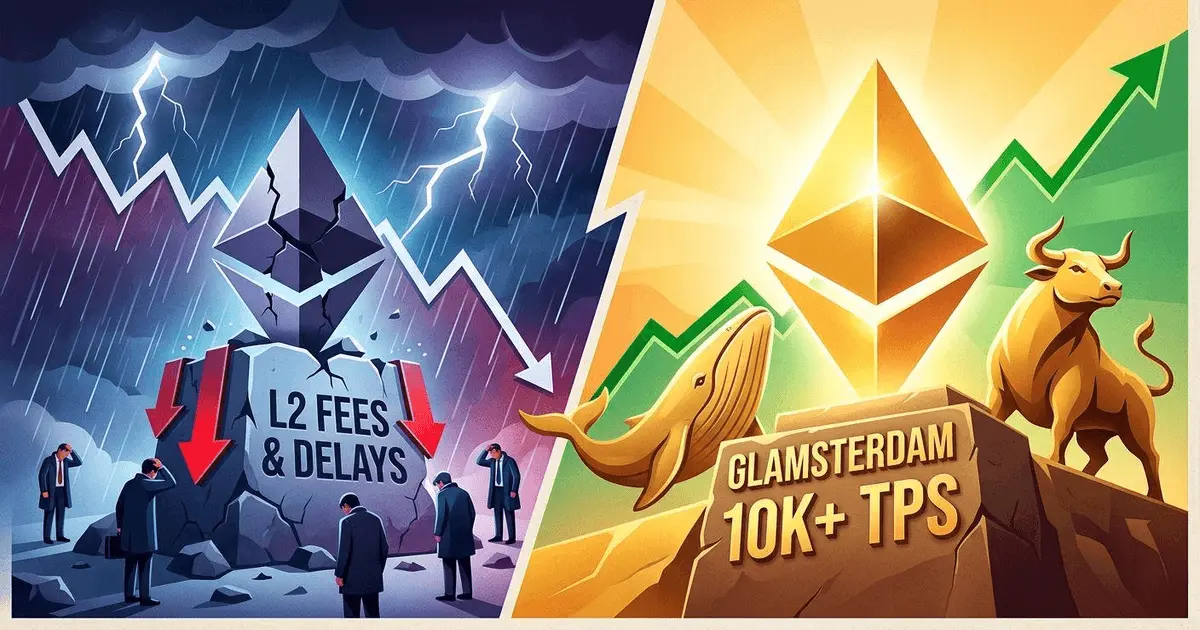
Ethereum’s current market split: Navigating short-term L2 revenue delays vs. the upcoming Glamsterdam upgrade.
Quick Takeaway:
-
The Problem: ETH is bleeding against BTC due to continuous Layer 2 fee cannibalization (dropping mainnet revenue) and the sudden delay of the massive Glamsterdam upgrade from June to Q3 2026.
-
The Counter-Trend: Retail is panicking, but on-chain data shows massive whale accumulation. Over 475,000 to 510,000 ETH have been pulled off exchanges into private custody in June alone.
-
The Verdict: Ethereum isn’t dying; it is undergoing a structural transition. The Glamsterdam delay has extended the boring consolidation phase, creating a prime accumulation window before the network unlocks 10,000+ TPS capabilities later this quarter.
1. The L2 Dilemma: Revenue Cannibalization
Ethereum’s biggest strength has historically been its massive network revenue driven by gas fees. However, the success of Layer 2 networks like Arbitrum, Optimism, and Base has triggered an unexpected crisis: L1 Revenue Cannibalism.
-
User Transactions: Moving directly to Layer 2 networks.
-
90% Lower Fees: Layer 2 scales processing, cutting user transaction costs drastically.
-
Tiny Fractional Payouts: Only a small percentage of fees are paid back to the Ethereum L1 Mainnet.
-
Ethereum Revenue Drop: Lower Mainnet fee collections lead to a drop in overall L1 revenue.
-
Temporary Sell Pressure: Reduced revenue creates short-term downward price pressure on ETH.
By pushing user activity off the main network to ultra-cheap L2s, the Ethereum mainnet is collecting significantly fewer transaction fees. Without high fees to burn ETH via EIP-1559, the token supply has seen temporary inflationary spikes, eroding its "sound money" narrative and pushing casual investors toward alternative assets.
2. The Glamsterdam Delay: Extension of the Pain
The single biggest fundamental catalyst for Ethereum in 2026 was supposed to be the Glamsterdam Upgrade, originally slated for activation this June.
The Ethereum Foundation recently confirmed that Glamsterdam has been pushed back to late Q3 2026 (August/September). The scale of this hard fork is immense, introducing Enshrined Proposer-Builder Separation (ePBS) via EIP-7732 and fundamentally restructuring block execution.
Why Glamsterdam is a Game-Changer:
-
Throughput Expansion: It targets a jaw-dropping 200-million gas limit floor, up from the current 60-million limit.
-
Massive Scalability: The upgrade aims to push Ethereum's L1 capability toward 10,000+ TPS, while simultaneously cutting remaining L2 data storage costs by up to 78%.
The delay means Ethereum must endure a few more months of low-revenue vulnerability and negative market sentiment. For short-term traders, this was a signal to rotate capital back into Bitcoin or stablecoins, triggering the steep decline in the ETH/BTC ratio.
3. What the Smart Money is Doing: Massive Whale Accumulation
While retail platforms and panic-sellers are calling Ethereum a "dead chain," on-chain analytics tell a completely different story. The smart money is buying the fear.
According to blockchain data, a massive divergence has formed between price action and whale behavior. Between June 4 and June 7, over 475,000 ETH exited major exchanges.
This trend has continued through mid-June, with wallets holding between 10,000 and 100,000 ETH accumulating an additional 510,000 ETH as prices tested localized support zones between $1,500 and $1,700.
-
475,000+ ETH removed from exchanges (June 4 -7)
-
510,000+ ETH bought by large investors (Since June 5)
-
200 Million gas limit floor achieved post upgrade
When supply on exchanges drops rapidly while prices fall or consolidate, it usually signals that institutional desks and large entities are quietly building long-term positions, anticipating a supply shock once the macroeconomic or protocol environment shifts.
Technical Trading Perspective: Maximizing the Range
From a pure trading standpoint, the market is range-bound. With ETH struggling to reclaim key moving averages, the most effective short-term approach is range scalping using the RSI (Relative Strength Index) and MACD on daily charts to identify local oversold territories.
Maintaining a strict 1:2 Risk-to-Reward ratio allows traders to capitalize on these macro-driven sweeps without getting caught if the market decides to flush weaker longs one final time before Q3.
Conclusion:
Ethereum isn't dying; it is lagging due to an unaligned timeline between its scaling architecture and its technical upgrades. The revenue loss to L2s is a temporary design feature, not a structural flaw.
Once the Glamsterdam upgrade goes live in late Q3, the narrative around L1 throughput and transaction capabilities will completely reverse. The current drop to a 0.027 ETH/BTC ratio isn't the end of Ethereum it's highly likely the ultimate "sell the rumor, buy the delay" accumulation window of 2026.
Research & Verification Sources:
-
ETH/BTC Ratio and Market Performance: Data retrieved via IG Market Intelligence & CoinDesk Market Indices (June 2026).
-
Whale Accumulation Tracking: On-chain transaction data monitored via OnchainLens, KuCoin Flash Alerts, and FxStreet Blockchain Analytics (Data current as of June 16–19, 2026).
-
Glamsterdam Protocol Specifics: Ethereum Foundation Official Protocol Cluster Update, Developer Interop Archives (Svalbard, Norway), and EIP-7732 Documentation via CoinMarketCap Academy.
Disclaimer: This post is for educational and research purposes only and does not constitute financial advice. Always do your own research (DYOR).
⚡ Never miss an urgent market shift: I post daily real-time crypto setups, micro-analyses, and exclusive charts. Follow My Daily Updates Here
🎮 Want to turn your gaming time into passive income?
👉 Start Your Crypto Mining Journey Now






