Hello everyone,
First, we will look at how the Romans proceeded in the manufacture of their coinage. Then, we will move on to explanations about the piece illustrated.
Step 1:
Like all coinage, they needed metals. Here, it is a coin made of pure silver. To extract silver, among other metals, they used a great number of slaves of various origins to dig tunnel-like galleries that could extend for several kilometers and reach remarkable depths. Working conditions were extremely harsh, and unfortunately, in addition to living without rights, these individuals had a very short life expectancy.
This type of extraction nevertheless allowed them to produce large quantities of raw materials, particularly because the expansion of their territory was often driven first and foremost by the presence of other peoples’ mines, in addition to the plundering of precious objects already manufactured locally.
Yes, you understand: an army was needed to conquer, coinage was needed to pay the army, so this expansionist system was bound to run in a loop. The war machine had to be profitable to endure.
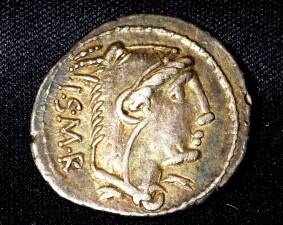
This coin dates from the late Roman Republic, specifically from 106 BC.
At that time, the value of a coin was mainly linked to the value of the metal itself.
As in more recent periods of history, people placed value on what was tangible, unlike, for example, a bank balance which for several decades has no longer been guaranteed by a gold reserve held by the bank.
Step 2:
Transporting the extracted materials, often in the immediate vicinity of the quarries.
Step 3:
Separating the metals from the rock. This was done using very high-temperature furnaces that liquefied the rock. Since metals have a different density, a kind of lump would form and, after cooling, it could be separated from the rest of the melted mass. Remains of melted rock (slag) can still be found scattered on the ground in many places, evidence of an industry spread across Europe and of the movement and reuse of land over the centuries.
Step 4:
Transporting the precious metals to a secure location, notably a large city, after having shaped them into ingots, of course. This is where the coins would later be sealed before distribution.
Step 5:
Next, the motifs had to be chosen and two dies produced, one for the obverse and one for the reverse. A die is a type of mold that imprints its design onto the metal. The imagery often served as propaganda, depicting a leader or a deity (useful when converting a population), but also indicating the origin of the coin and thus serving as a guarantee of the metal’s quality.
The die also acted as a calibration tool, resulting in coins of relatively uniform shape and weight, at least for the period and for mass production.
Step 6:
Cutting the ingots, hammering them into sheets, then cutting them to obtain blanks (pre-calibrated pieces). The blanks were heated to make them more malleable and placed between two dies. A smith would then strike the metal with a hammer so that the dies would imprint the coin. We are speaking here of the earliest method of coin production in history, known as hammer striking, which appeared in the 6th century BC under the reign of Croesus.
Of course, I have summarized the steps. For the manufacture, as well as the controls and tests required to meet specifications before modern coins are put into circulation, there are more than 120 different stages, and often many more depending on the institution commissioning the production.
Explanations :
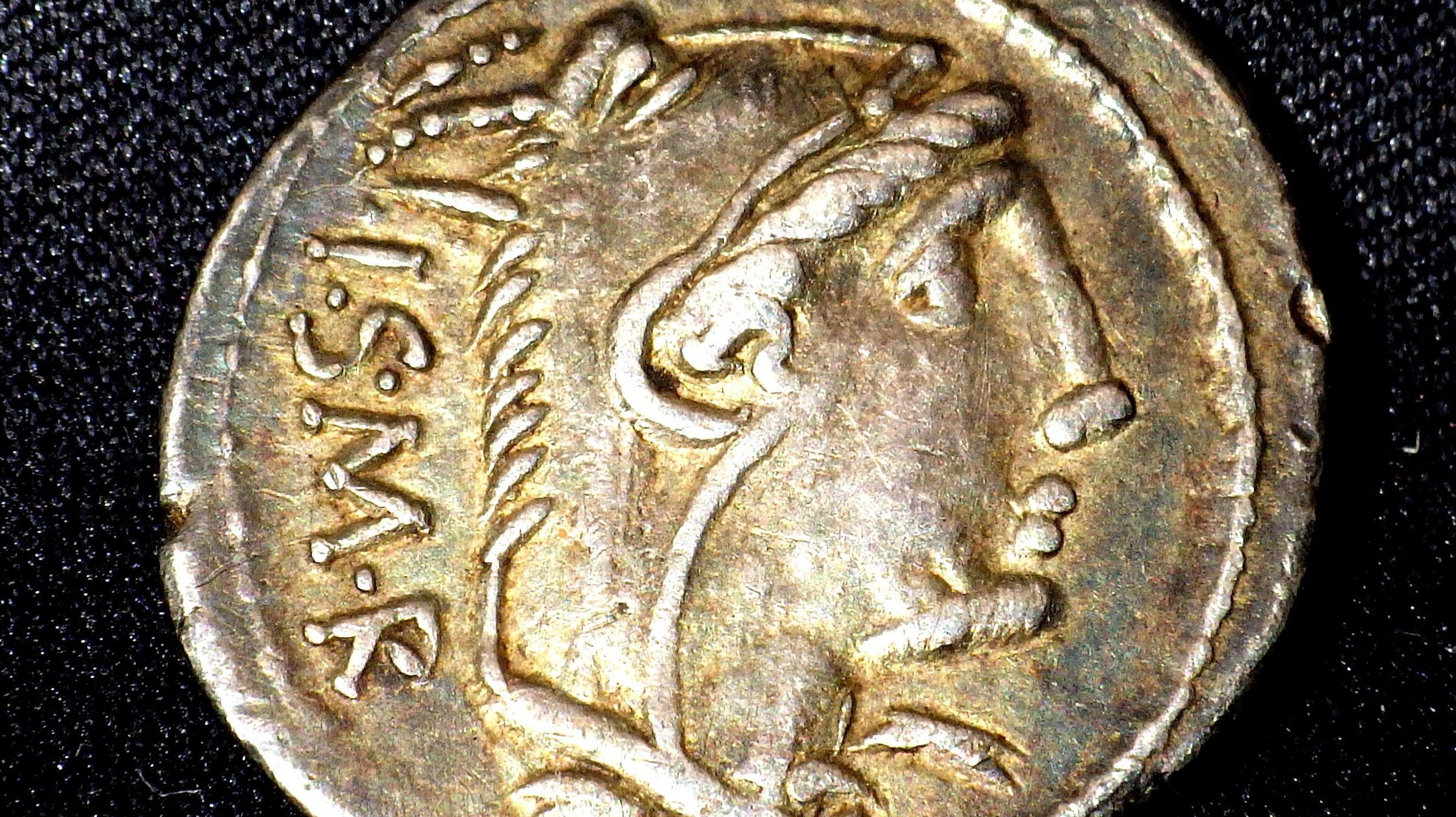
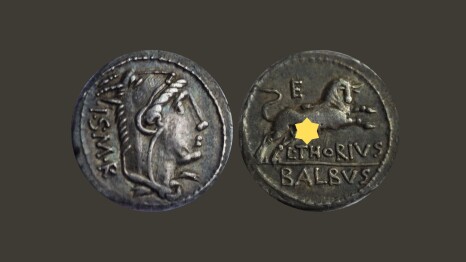
Now, let’s speak about this coin. It originated in Rome. The figure depicted is Juno Sospita wearing a goatskin headdress. She was the divine protector of the ancient city and of women. She also symbolized royalty, fecundity, and fertility. Fertility is echoed in the depiction of the bull (the vigorous image partially hidden by the star). Defense is also represented by the bull, a notably bold animal shown in a charging stance.
You may notice the letter “E”; this refers to the die used. Following the alphabet, the dies were marked in this way to track total production. Since a die would gradually wear out with repeated strikes until it became unusable, it was possible to estimate the number of coins struck based on the number of dies produced.
ISMR: Iuno Sospita Mater Regina, which translates as Juno Sospita, Queen of Motherhood.
Lucius Thorius Balbus, also known as Thorianus, was a Roman military leader who commanded the army and was originally from Lanuvium, like the deity Juno before she was integrated into the beliefs of the capital. He was therefore the issuer of this coin, which likely served to pay his legionaries. According to Cicero, this leader fought alongside his troops—troops who may at times have carried the portrait of their commander in their pocket.
The symbolism is strong, and each element echoes the others with the aim of protecting the prosperity of the people and, let’s say, encouraging the troops.
Metal: 95% silver
Diameter: 20 millimeters
Weight: 3.90 grams
Thank you for taking the time to read.