Mechatronics is the discipline that studies how three sub-disciplines interact - mechanics, electronics and computer science - in order to automate production systems to simplify and replace human work.
Mechatronics arises from the need to create know-how in the field of modeling, simulation and prototyping of control systems, focusing mainly on motion control systems, defined as Motion Control. The main fields of application are robotics, industrial automation, biomechatronics, avionics, automatic mechanical systems for motor vehicles.
The mechatronic engineer or the sector expert mainly deals with the design and implementation of automatic control systems using both development software such as MATLAB / Simulink as well as electronic control units for the implementation of the real system and the verification of operation in real time.
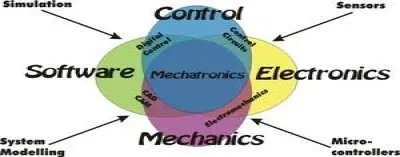
Euler diagram made by the Rensselaer Polytechnic Institute which explains what mechatronics is
The classic mechatronic control system can be represented by a closed loop, feedback (feedback), and consists of several main blocks: the system to be controlled (e.g. an electric motor), the system actuator (e.g. electronics power), the system controller, designed in a simulation environment and implemented on a control unit (DSP - Digital Signal Processor), and finally the sensor, which measures a state of the system (e.g. the speed of rotation of the engine).
In physics the term mechanics indicates any theory that deals with the movement of bodies. Based on the physical characteristics of the matter studied, mechanical theories are mainly divided into:
classical mechanics
statistical mechanics
relativistic mechanics
quantum mechanics
Classical mechanics describes substantially accurately most of the mechanical phenomena observable directly in our daily life. Some of its main branches of application are celestial mechanics, sound mechanics, but the most relevant one, from which also the mechanics of solids and the mechanics of fluids descend, is undoubtedly the continuum mechanics, based on the hypothesis of continuous body, whose field of validity is defined by the Knudsen number. If this hypothesis cannot be applied, the principles of statistical mechanics, of which thermodynamics is part, can be used.
Instead, there is a considerable discrepancy between the predictions of classical mechanics and the experiments both for systems in which the speeds involved are comparable with the speed of light and for systems with spatial dimensions comparable to atomic or molecular ones, for which the constant fundamental to deal with is the Planck constant. In these cases classical mechanics are replaced respectively by relativistic mechanics and by quantum mechanics.

Electronics is the science and technique relating to the emission and propagation of electrons in vacuum or matter. As a science electronics is a branch of physics, in particular of electrology. Born as a branch of electrical engineering, it is now understood as a discipline in itself, and can be defined as "weak and high frequency current technique" differing from electrical engineering which is instead "the technique of strong and low frequency currents".
More specifically, electronics is the set of theoretical and practical knowledge and methodologies used for the design and construction of systems and hardware devices capable of processing physical quantities in the form of signals containing information, for various types of applications. The electronic realizations are therefore electronic processing circuits made up of electronic components, active and passive, connected by means of conductive wires or traces, generally metallic, through which electric currents circulate. Electronic engineering deals with this area.
Computer science is the science that deals with the treatment of information through automated procedures. In particular, it has as its object the study of the theoretical foundations of information, its computation at the logical level and practical techniques for its implementation and application in automated electronic systems, therefore called computer systems. As such it is a discipline strongly connected with mathematical logic, automation, electronics and also electromechanics.
It accompanies and integrates or supports all scientific disciplines and not, and as technology it pervades almost any "medium" or "tool" of common and daily use, so much so that (almost) we are all in some way users of IT services . The value of information technology in socio-economic terms has climbed Anthony's pyramid in a few years, going from operational (to replace or support simple and repetitive tasks), to tactics (to support planning or short-term management), to strategic. In this context, information technology has become so strategic in the economic and social development of populations that not being able to exploit it, a status renamed with the expression digital divide, is a problem of global interest.
Together with electronics and telecommunications unified together under the denomination Information and communication technologies (ICT), it represents that discipline and at the same time that economic sector that gave birth and development to the third industrial revolution through what is commonly known as digital revolution. IT evolves above all in the field of telephony.