
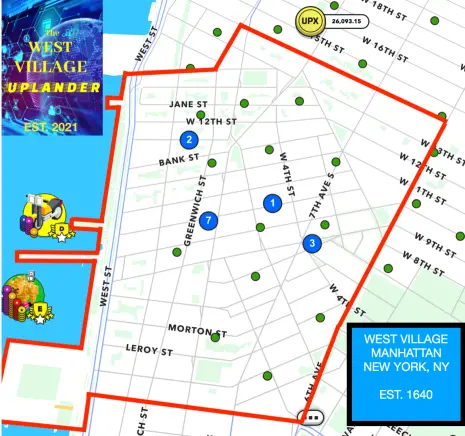
I feel I should say something about how just off the ship I feel here in the West Village but that seems wildly inappropriate given that I haven't even left my house. As unoriginal as that immigrant image might be how else to describe watching my block explorer drifting across Upland's West Village of Manhattan like a toddler wondering off the screen amidst these undeveloped streets. It's an odd thing to start a city with a map, parcel off the property lots, and then wait for the people and businesses to arrive confident that they will arrive. Here we are in the latest iteration of Manhattan's West Village and I'm wondering if the current occupants of the West Village will feel anything like the native residents of Sapponckanican ("land where tobacco grows") felt in 1640 when Europe's cast of rogues and outcast began to populate this neck of the woods. What relation, if any, will the West Village of Upland metaverse have to the physical world beyond sharing street names. A place develops an identity over time, it's character coming from lives lived within the space but what of a place in the that shares a name and a map?
"A well-known cliché during its twentieth-century heyday was that Greenwich Village wasn't a place but a state of mind. For decades it wasn't even called Greenwich Village; it was known by it's political divisions, the Ninth and Fifteenth Wards."-John Strausbaugh, The Village: A History of Greenwich Village.
I initially bought an NFT parcel of, of what? blockchain code? I initially bought an NFT in Upland's West Village because my nephew is planing a trip to NYC this summer and my wife and I plan to meet up with him. I've been thinking we might meet up at the Whitney Museum and then explore the village a bit but who knows. In real estate I hear the maxim that one shouldn't fall in love with bricks-and-mortar how much more so is this true in the metaverse. Don't fall in love with NFTs. And yet there is a pull of place that reaches through the code, through the map, through the place name.
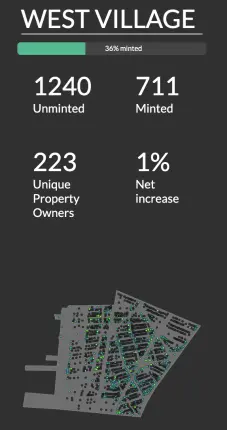
(Data courtesy of Uplanddata.com)
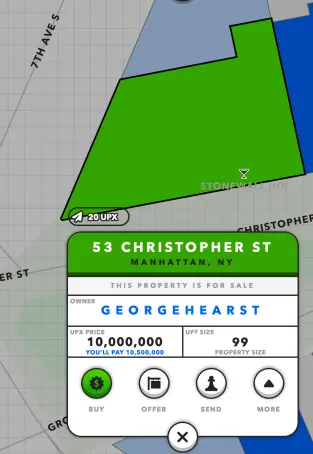
There's undeniable history in the West Village and one can feel the pull of place names in Upland as the collections created reference famous place names and players discuss on the Discord channel the advantages of purchasing NFTs on Park Ave. or Avenue of the Americas. In the West Village the NFTs are currently at 36% minted according to Uplanddata.com. One of the early minted properties is the address location of the historic Stonewall Inn.
(Screenshot from Upland)
Did the player known as Georgehearst buy the property with the idea that someone would pay a premium for this historic location? Seems likely given that it is currently listed at $10M UPX for a markup of 6475% from the minted price of $154,540 UPX according to upx.world when a 3 - 4X seems the most common markup for those wanting to flip a property quickly.
Initially I bought several NFT props in Upland's West Village thinking it's an up and coming neighborhood with a pedigree. However, the excitement over the Brooklyn opening, then the Brooklyn Burn, and now the week long Brooklyn pause has given me some time to think about my NFT prop strategy. What is my strategy? Am I buying props to develop? What is the timeline for development in NYC? During the Brooklyn pause I returned to Manhattan and again gravitated to the West Village minting a few more props. Now I have 13 props with a total of 530 UP2 yielding $9311 UPX/month which ranks me as 5th in terms of the current property owners.
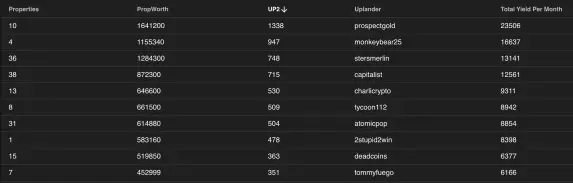
(Leaderboard courtesy of UPX.World)
There are currently 224 unique property owners in West Village who own an average of 3 properties, with an average total investment of $97,929.06 UPX, for an average total UP2 of 75.27, and an average monthly yield of $1324.51. UPX.
I'm not sure it's a very good strategy to concentrate on any one neighborhood as the liquidity might vary greatly and one might be holding property for a bit. Uplanddata.com indicates that there was a 1% increase in minted properties yesterday. That gives some indication of the rate of growth currently when only a little more than one third of the properties in this neighborhood have been sold. I'll monitor that to see how it changes over time. One reason for me to start the West Village Uplander blog is to focus on the experience in one neighborhood and see how this one neighborhood develops over time and how that experience compares.
I also started West Village Uplander as a place to reflect a bit more philosophically on this mainstreaming of NFTs in general and within a gaming environment in particular. There is a part of me that sees a game like Upland as the ultimate company town. This time around individuals have some of the advantages of a property owner but how much voice do they have in the governance and how much of the rewards for the overall increase iin value is shared by the players of the game. What have we learned from Web2 that will make Web3 better for players in the metaverse? At the recent CGC|NFT virtual conference panel on "Nerfing Pay-to-Play" there was talk about being able to take NFTs from one game environment to another and of course Upland is currently testing being able to cash out their UPX tokens for fiat currency and cryptocurrencies. Both of which are good things to hear. What seems missing in Upland though is any talk of the other advantages of blockchain that are being experienced with the cryptocurrencies. I'm currently bouncing back and forth between Upland and Cardano in terms of learning more about each. With Cardano one of the things which fascinates me is the manner in which the governance is set up. How will governance and ownership of the gaming environment evolve from Web2 to Web3? Will we see blockchain games that develop sophisticated governance like Cardano? Will players expect to have the same time of ownership that they are experiencing in decentralized autonomous organizations (DAO)? For me at present these are unanswered but important questions. How will people who develop businesses in the metaverse have a voice in issues which affect their businesses? How will issues like zoning affect development of neighborhoods?
In future posts I'll continue to explore these issues as well as meet some of the property owners in West Village to get their take on why they chose to invest in West Village. Until then let me know in the comments if you've purchase a property in the West Village or what you think about the development of metaverse gaming environments as we transition into Web3.






