Grass is transforming the internet by building a user-owned map of the web, and Stage 2 is here to push that vision even further. And contrary to what others are saying, this isn’t just another fleeting AI/Web3 craze; it’s a project that puts power back in the hands of the users, and I’ve seen this unfold over the past few months.
Looking back at Stage 1, the impact has been nothing short of remarkable: 2.8 million users across 190 countries, the largest airdrop ever on Solana, and a staggering 100TB of web data scraped daily. These milestones are a testament to the power of a strong, global community working toward a common goal.
If you missed the first stage, there’s no better time to join. Stage 2 opens the door to even greater rewards and opportunities, and more advanced releases. Let’s dive into what makes this moment so pivotal for Web3 and the internet as a whole, and why you shouldn’t wait to join the action.
1.) Grass Project’s Outstanding Development
At present, with 2.5 million daily active users, Grass has already amassed sufficient data to train GPT-3.5 from the ground up. This is a significant achievement, but it is only the beginning. Should Grass expand by a factor of 10 to 20, it would possess the capacity to systematically crawl the entire web on a daily basis. Such an expansion would not merely be a quantitative increase, but would fundamentally alter the scale and scope of data collection, opening new avenues for the application of AI and providing a more intricate understanding of the digital landscape. It is, in essence, the potential for a shift in the very way we engage with information and technology.
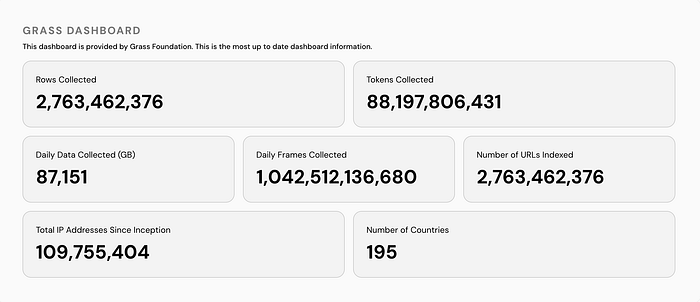
Source: https://grassfoundation.io/network/stats
2.) Challenging the Web Crawling Monopoly
The capacity to crawl the entire web is monopolized by just two companies, which have constructed multi-trillion-dollar empires based on this extraordinary power. Grass, however, is positioning itself to disrupt this concentration of control. Through a decentralized and user-driven model, Grass seeks to democratize access to this critical capability, fundamentally challenging the monopolistic grip these entities hold over the digital landscape. This shift could significantly alter the dynamics of how information is accessed and controlled on the web.
3.) Live-Context Retrieval (LCR)
Grass presents a distinct, impartial solution for live context retrieval (LCR), surpassing its competitors by providing real-time, accurate data without infringing upon the interests of AI labs. As language models converge in their capabilities, the critical factor that sets them apart is their access to up-to-date, relevant information. Unlike existing systems, which are constrained by ad-driven monetization models, Grass is purposefully designed for AI and free from these limitations. With the growing emphasis on enhancing model intelligence through reinforcement learning, Grass offers a forward-thinking means for language models to connect to the internet, facilitating better training and reasoning processes.
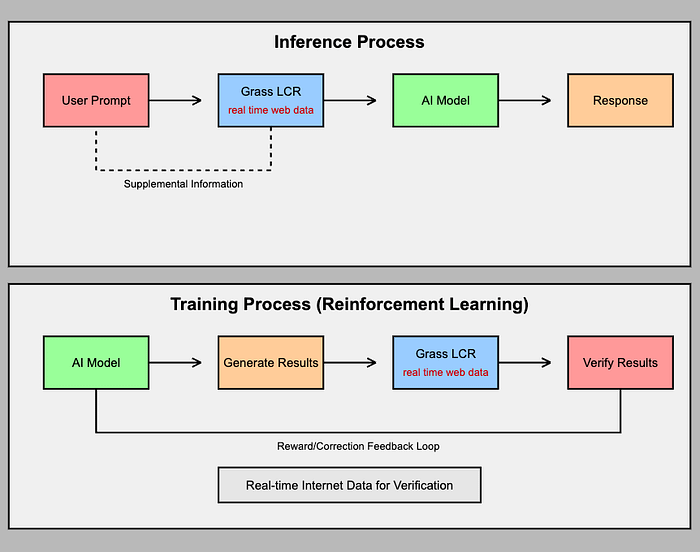
Source: Aylo’s Interview with Grass Founder Drej
4.) $Grass Tokenomics
In recent days, the Grass token has experienced a remarkable series of all-time highs, distinguishing itself as one of the few tokens to see such a significant price surge following its airdrop. Recognized for having the most widely distributed airdrop on Solana, the token’s bullish trajectory is largely attributed to its future role in Live Context Retrieval (LCR). When bandwidth is allocated to power LCR, Grass tokens act as the essential medium, akin to gas, for facilitating the transaction. Thus, regardless of whether clients settle their payments in fiat or cryptocurrency, the value must ultimately be converted into Grass tokens to enable the transaction.
5.) Great Demand for Grass
The Grass network is presently being leveraged by leading AI labs, and in recent weeks, several prominent Fortune 500 companies have reached out to the Grass foundation, reflecting a growing recognition of its potential. Yet, the demand for this network has become so pronounced that scaling it has emerged as a formidable challenge. On any given day, the volume of incoming requests far exceeds the capacity of available nodes, revealing a critical gap between the network’s current infrastructure and the rapidly expanding demand. This situation highlights both the tremendous promise of the network and the considerable difficulty in maintaining the infrastructure necessary to meet such demand.
Conclusion
Decentralization, particularly in the realms of AI and crypto, is often implemented without sufficient consideration or purpose. Many companies adopt decentralization as a trend, without critically examining the fundamental issues they aim to address. In contrast, Grass approached this challenge from the very beginning with a clear understanding that crypto and decentralization were indispensable tools to solve specific problems: chiefly, to ensure user control, trust, and transparency. For Grass, decentralization is not about merely optimizing for performance, but about promoting fairness and empowering users. Their infrastructure is intentionally designed to return control to the users, underscoring the necessity of decentralization as a solution. This approach is garnering considerable attention, not only due to its technological merit but also because it aligns with a growing demand from companies for ethical alternatives. There is a clear recognition that Grass provides a genuine opportunity to not just to revolutionize web scarping, but also to advance ethical practices in the AI domain.
Ready to take back the internet and get paid for it? Join Grass today!
🌱 getgrass.io🌱
Grass’ Links and Other Resources
If you enjoy my articles, please consider following me here and on Medium!
I am also open for partnerships and collaborations. For inquiries, feel free to reach out to me at [email protected] or on Telegram, https://t.me/annmargolis.





