
IBM Quantum Pay-As-You-Go is a usage-based plan that charges you only for the quantum-computer access time your circuits consume, billed by the second at an advertised starting rate of $96 per minute, or $1.60 per billable runtime second, according to IBM's 2026 Quantum products page. It has a one-second minimum purchase and no annual commitment, so you calculate cost with a simple formula: billable QPU runtime seconds multiplied by the per-second rate. What you are paying for is QPU execution time, not the time your job spends waiting in the queue or the time you spend waiting for results.
Key takeaways
-
IBM Quantum Pay-As-You-Go starts at $96 per minute, equal to $1.60 per billable runtime second (IBM Quantum products page, 2026).
-
The minimum purchase is one second, but every billable second still costs the applicable rate: a one-second minimum is not a one-second cap.
-
Billing counts QPU execution time only. Queue delays and result-waiting time are excluded.
-
Runtime seconds multiply with shot counts, circuit depth, error-mitigation variants, dynamic circuits, and default repetition settings.
-
If you expect to need 400 minutes or more per year, IBM says to consider the Flex Plan, which starts at $72 per minute.
-
The free Open Plan gives up to 10 minutes per 28-day rolling window.
How IBM Quantum Pay-As-You-Go billing works
IBM bills Pay-As-You-Go by QPU execution time, the seconds a quantum processor actively runs your workload. The meter starts when your job occupies the processor and stops when it releases it. Time in the scheduling queue and time spent returning results to you do not count.
The mechanism runs in three steps.
-
You submit a workload through Qiskit Runtime to a chosen QPU on the IBM Quantum Platform.
-
The job waits in a queue (unbilled), then executes on the processor.
-
IBM measures the QPU execution seconds and charges them at the per-second rate, rounded to the billable second, with a one-second minimum.
The cost formula is:
Estimated cost = billable QPU runtime seconds × per-second rate
At IBM's advertised starting rate, that is runtime seconds × $1.60.
Callout
The number to optimize is QPU occupancy, not queue time. Two workloads with identical wait times can cost very different amounts if one occupies the processor for 10 seconds and the other for 90. Queue delays are free; processor seconds are not.
How much does IBM Quantum Pay-As-You-Go cost?
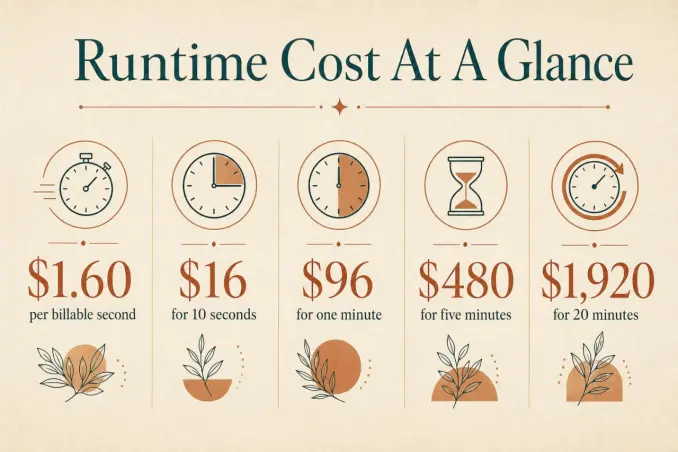
At IBM's advertised starting rate of $1.60 per second, cost scales linearly with runtime. One second costs $1.60; a full minute costs $96. IBM labels this a starting rate, and actual prices can vary by QPU and account terms, so treat these as the baseline.
Worked cost examples at the starting rate:
Billable runtime
Cost (USD)
Approx. cost (INR at ₹88/$)
1 second
$1.60
₹141
10 seconds
$16
₹1,408
30 seconds
$48
₹4,224
1 minute
$96
₹8,448
5 minutes
$480
₹42,240
10 minutes
$960
₹84,480
20 minutes
$1,920
₹168,960
These figures are calculated from IBM Quantum's 2026 starting rate. Currency conversion is illustrative and moves with the USD/INR exchange rate, so confirm the live rate at billing time.
What makes billable runtime go up?
Runtime seconds are driven by how much work the processor does, not by how the circuit looks on screen. A short-looking circuit can burn long QPU time. Several factors multiply the billable seconds:
-
Shot count: more repetitions per circuit means more processor time.
-
Circuit depth and gate operations: deeper circuits and more gates extend execution.
-
Error-mitigation variants: techniques that run multiple circuit variants multiply the executions billed.
-
Dynamic and hybrid circuits: mid-circuit measurement and feedback add processor occupancy.
-
Default repetition and delay settings: the reset time between shots directly inflates runtime.
That last factor is easy to miss. IBM reported a temporary 4-millisecond default repetition time on certain Nighthawk exploratory systems, versus 250 microseconds previously, per the IBM Quantum Compute Service changelog (2026). A 16x longer reset between shots means far more billable seconds for the same circuit, even though the circuit itself is unchanged.
Newer processors cut both ways on cost. IBM claims its Nighthawk r2 processor, with 120 programmable qubits, can deliver up to 25 times higher throughput than Heron at comparable fidelity, which can shorten runtime. But processor-specific settings like a longer default repetition time can raise QPU consumption. Check the active repetition time before running large batches.
When should you use Pay-As-You-Go instead of Flex or Premium?
Use Pay-As-You-Go for irregular or exploratory workloads under roughly 400 minutes a year. IBM says users who expect to need at least 400 minutes annually should generally consider the Flex Plan instead, because Flex starts at $72 per minute, a lower rate than Pay-As-You-Go's $96.
The break-even is about commitment, not just rate. Flex has a 400-minute annual minimum purchase, so you commit to that capacity up front. Pay-As-You-Go has no annual floor beyond its one-second minimum per job, which suits bursty usage you cannot forecast.
Plan
Starting rate
Minimum purchase
Best for
Open
Free
None
Learning, experimentation (up to 10 min / 28-day rolling window)
Pay-As-You-Go
$96 / min ($1.60/sec)
1 second
Irregular, low-volume workloads
Flex
$72 / min
400 minutes / year
Predictable mid-volume usage
Premium
$48 / min
5,200 minutes / year
High-volume, sustained research
On-Prem
See site
See site
Dedicated on-premises deployment
Rates and minimums are from IBM Quantum's 2026 products page and documentation. Premium's 5,200-minute annual minimum at $48 per minute suits sustained research programs, not occasional experiments.
Is there a free IBM Quantum option?
Yes. The Open Plan is free and intended for learning and experimentation. It includes up to 10 minutes of QPU time per 28-day rolling window, according to IBM Quantum documentation (2026). The rolling window matters: it is not a calendar-month reset, so your available time refills as older usage ages past 28 days.
IBM has also offered targeted bonuses. Eligible Open Plan users who logged 20 minutes during a prior 12-month period could receive a one-time additional 180 minutes for the following 12 months (IBM Quantum, 2026). Terms like this change, so confirm current eligibility in your account.
The Open Plan is the practical starting point before you spend anything. Prototype circuits, measure their runtime, then estimate the Pay-As-You-Go cost with the formula before scaling up.
How do you control Pay-As-You-Go costs?
Set a cost limit on your instance and monitor usage in the IBM Quantum Platform and IBM Cloud billing views. A cost limit caps spending: when billable usage reaches the limit, further workloads on that instance stop rather than run up an open-ended bill. Review your instance, workload, and account usage regularly so estimates match reality.
Beyond limits, the levers that cut billable runtime are technical:
-
Reduce shot counts to the minimum your statistics require.
-
Limit error-mitigation circuit variants where accuracy allows.
-
Shorten circuit depth and remove redundant gate operations.
-
Check and reduce default repetition or delay times on the target QPU.
-
Choose higher-throughput processors when they shorten execution.
For teams tracking quantum pricing alongside broader AI and cloud-cost moves, a daily digest like Verityadaily's The Daily Brief newsletter helps you catch changes to plans and rates as they publish.
Worked example: estimating a real workload
Suppose you run an error-mitigated circuit with 4,000 shots that occupies a Heron-class QPU for 45 seconds of execution time, then a second batch that runs 80 seconds.
-
Batch 1: 45 seconds × $1.60 = $72
-
Batch 2: 80 seconds × $1.60 = $128
-
Total billable: 125 seconds × $1.60 = $200
The queue time before each batch, however long, adds nothing. If you cut the shot count in half and it halves execution time to roughly 62 seconds total, the bill falls to about $99. That is the direct link between circuit design and dollars: fewer processor seconds, lower cost.
For a broader view of what quantum cloud access costs across providers, see our guide to quantum computing cloud pricing in 2026 and our breakdown of AWS Braket pricing
Related concepts
-
QPU execution time: the seconds a quantum processor actively runs your workload. This is what Pay-As-You-Go bills.
-
Wall-clock time: total elapsed time from submission to result, including queue and result-waiting. Not billed under Pay-As-You-Go.
-
Shots: the number of times a circuit is repeated to build measurement statistics. More shots mean more runtime.
-
Error mitigation: techniques that reduce noise, often by running extra circuit variants that add billable seconds.
-
Dynamic circuits: circuits with mid-execution measurement and conditional logic, which can increase processor occupancy.
-
CLOPS: circuit layer operations per second, a throughput metric. IBM reported best CLOPS above 330,000 across seven QPUs (IBM Quantum Q1 update, 2026).
-
EPLG: error per layered gate, a fidelity metric. IBM reported a best EPLG of 0.19% on ibm_boston (IBM Quantum Q1 update, 2026).
For context on IBM's quantum hardware direction, see our explainer on Microsoft's quantum chip and new state of matter and Elon Musk's reaction to it.





