A silly question that any beginner must ask
In my last article, I showed my film camera, but later on, I realised that maybe I went a bit too deep into terminology without explaining first. So, I’m taking a step back today.
What are the parts of a camera?
Essentially, a camera is just a light-tight box with a hole where one attaches a lens. It can’t have any other holes, or light will be leaking in and destroying the frames. A camera needs a lens in order to condense light onto the sensor or the film.
There is one exception. One can make a tiny pinhole into aluminum foil, place it in front of the camera where the lens goes, and an image gets formed even though there’s no glass!
If that sounds like a mystery, check out this article where I briefly mention camera obscura.
So far, everything sounds good, we are able to direct light onto the sensor, but we have to control how much light enters. If we let in too much light, the sensor or film will reach its maximum light-gathering capacity, and there won’t be anything in the photo, just a pure white frame.
There are two options. One is that we physically limit the amount of light entering the camera. This is the lens aperture. Check out this article for more advanced details.
The other option is that we let it light inside the camera for a short while — a timer. We connect a button to it so that we can take choose when to let light in, and then it closes the opening between the lens and the camera body. This is called the shutter, controlled by the shutter button.
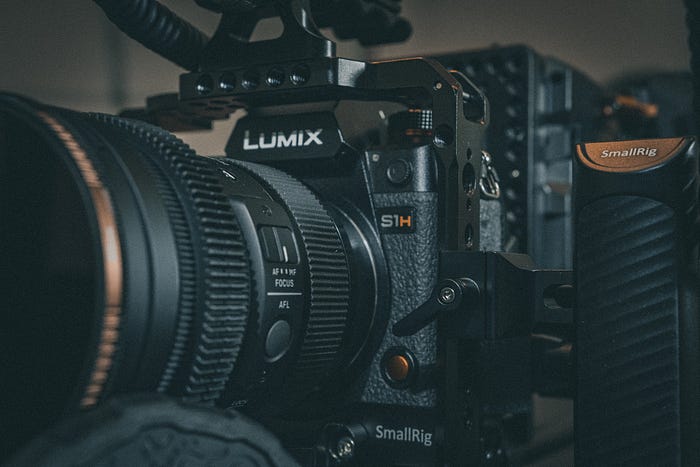
The physics behind photography is very exciting. Everyone would benefit if they know at least a bit of how it works. (Picture: Unsplash)
Camera lenses
There are so many different types of lenses and properties to compare that it’s worth discussing in a separate article or even better, a series of articles.
In really basic terms, a lens consists of multiple optical elements, typically glass. Some of the lenses are with convex surfaces — just like a magnifying glass. Others are concave, i.e., the centre of the optical element goes inwards in contrast to the outward bulging convex surface.
A lens is acting like a pipe through which light passes. It can be handy to control the flow, how much water goes through the pipe. This is done by placing a set of metal blades that ideally form a circle. Often, their number is limited to save costs.
You can see the hexagonal shape inside my lens in the picture further down. This is called an aperture. On the body of the lens, there is a ring which allows the photographer to change the distance between the blades, essentially allowing different amounts of light to pass through the lens.
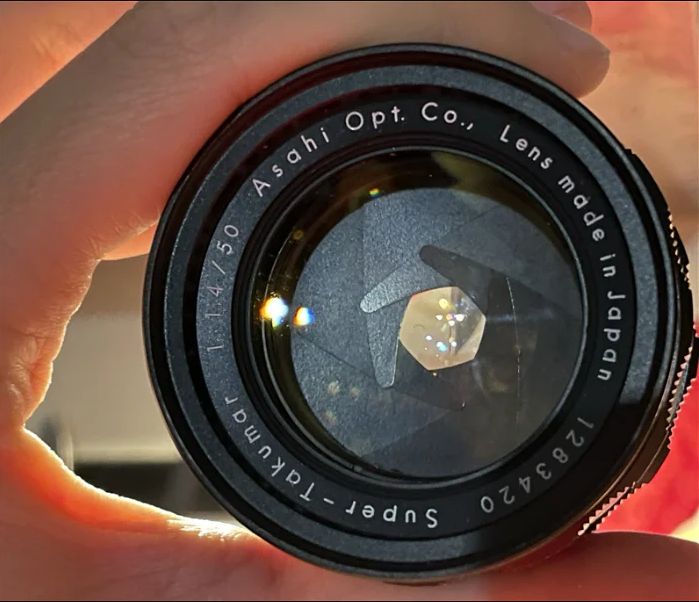
The Takumar 50mm F/1.4 has six aperture blades forming a hexagonal aperture (Picture by the author).
The shutter
The camera shutter allows light to pass from the lens to the sensor or the film. The time during which the film is exposed to light is called shutter speed or just exposure time.
There are several types of shutters. Older cameras have fully mechanical shutters. There are two black cloths that move, triggered by springs. Later on, shutter timings were controlled electronically, but the shutter curtains move mechanically. Nowadays (and in some newer film cameras), there is an electronic shutter. There are metal blades that move when the shutter button is pressed.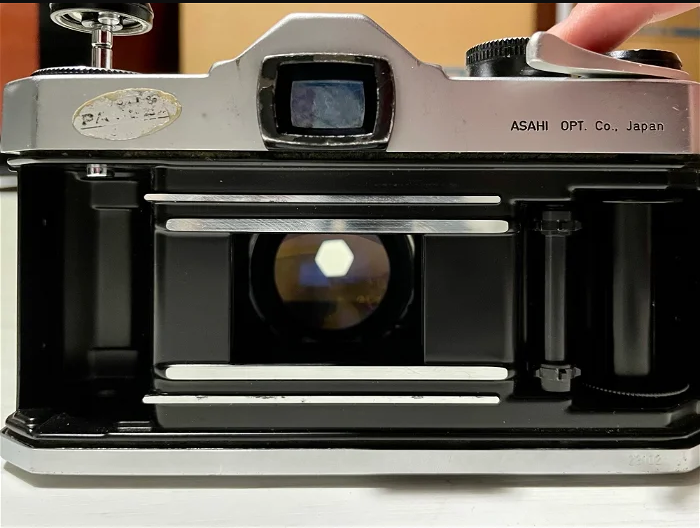
The shutter curtains on this camera are the smallest black rectangle in the middle of the camera body. In bulb mode, the shutter curtains move to the side, leaving a rectangular opening (Picture by the author).
Light gatherers
Light gatherers is not a real term in photography, but it covers both digital sensors and films. I chose to use it since, essentially, the idea is just to collect light and turn it into data, be it in a digital form or in the amount, size, shape and density of silver crystals on the film base.
If the lens is a water pipe, the light gatherer is the bucket that water goes to. As I hinted earlier, the bucket has a limited volume. If you fill it to the rim, it can’t take any more water, and the image is just pure white. Conversely, if the bucket is empty, it means that the image is uniformly black.
Exposure
The plumbing analogy continues. If we want to fill a bucket, we could either use a huge pipe which fills it quickly or drip the water slowly from a tiny hose. In either case, we can fill the bucket with the same amount of water.
Translating back to photographic terms, a photo can be exposed equally well by using a lens with a wide aperture and setting a fast shutter speed or by choosing a small aperture but a long shutter speed.
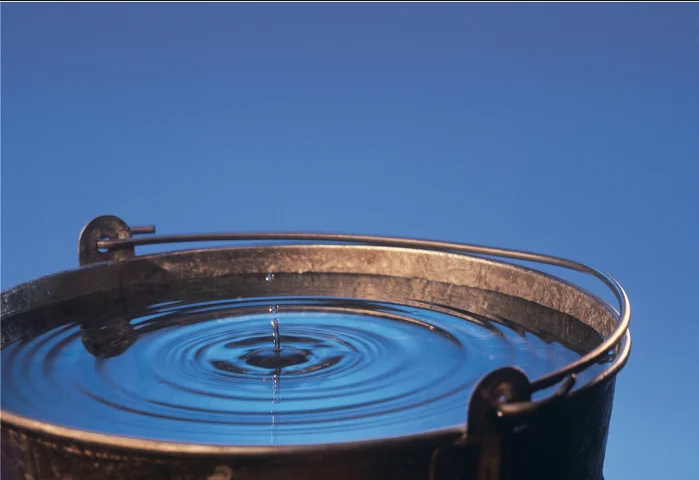
Filling a bucket with water is surprisingly similar to how cameras work. (picture: Canva Pro)
One last thing that remains to be mentioned is that the size of the bucket is another parameter to tweak. A small bucket can take a small amount of water. So if the “light-holding capacity” of the sensor is small, it can’t be used both with a big aperture and a slow shutter speed.
The sensor or film is described by its ISO value, i.e., how sensitive it is to light. The larger the value, the more sensitive the device (so it acts like a small bucket). If I were to set a high ISO value and a lens with a wide aperture, then I’m forced to use fast shutter speeds, or I will fill my small bucket to the rim.
Conclusion
I hope that I have convinced you that silly questions should be asked every time they arise. The more you delve into the basics of a matter, the better understanding you get, and this builds a solid foundation for advanced knowledge.
I hope you remember the take-home message of this article that cameras are like buckets that we fill with water. I believe this will enrich your knowledge about the technical side of photography. It doesn’t need to be intimidating, but it will make a massive difference in your skills.

This article is (or will be) reposted on my other blogging and social profiles.
https://linktr.ee/neurodivergent_ai
You can find me on [affiliate links]:
| Medium | Vocal | Simily | read.cash | noise.app| Publish0x | Steemit |
| Hive | Appics | Instagram | Twitter |
Check out more of my artworks in my community on Ko-Fi.
https://ko-fi.com/neurodivergent_ai
Join Medium with my referral link - Neurodivergent AI
https://medium.com/@neurodivergent_ai/membership






