
If you are a regular Publish0x user, you will know that the site pays out tips in three currencies - one of which is AMPL. But did you know that withdrawing your AMPL at the right moment could significantly increase its value in the short and long term?
AMPL is an interesting cryptocurrency because supply is elastic - that is, it changes daily in response to demand. As the Ampleforth.org website says:
The AMPL protocol automatically adjusts supply in response to demand. When price is high, wallet balances increase. When price is low, wallet balances decrease.
But while the price of your AMPL can change, and the amount of AMPL in your wallet can change as a result, what doesn't change is your percentage ownership of the network. If your wallet contains 1% of the network, it will continue to hold 1% no matter what happens to AMPL price or supply. That's why market cap (rather than just price or just supply) is usually the key metric when thinking about AMPL.
Publish0x is different
All of that applies to AMPL you hold in your wallet (on chain), but - and this is the key part - it doesn't apply to AMPL you hold on Publish0x. Here, the price will fluctuate in line with market rates but the amount is fixed. If you have 10 AMPL on Publish0x, you will continue to have 10 AMPL until you withdraw it (or earn more).
However, if price can change but the amount you hold is fixed, this means that your percentage ownership of the network isn't fixed. And if it isn't fixed, you should withdraw your AMPL at the moment that gives you the highest possible percentage ownership. The biggest slice of the pie, if you like.

Delicious AMPL pie
So when is this? Simply put, it's when supply is low. Ideally, you also want to move when price is high, so you can:
- be confident that supply isn't going to drop further after the withdrawal (meaning you could have had a bigger slice of the pie if only you had waited a little longer)
- ride the wave of positive rebases (daily increases in supply). This gives you the opportunity to then sell your AMPL at maximum possible value when market cap is at its peak
The best tool for picking your moment is probably the official Ampleforth dashboard. This shows both price and supply over time, as well as market cap.
We've already seen that supply will change in response to price (ie price is the leading indicator). Looking at the dashboard, you will also see that price is much more volatile - moving suddenly, with dramatic spikes - whereas supply tends to follow a much smoother curve.
So my advice is to wait for supply to reach the bottom of its curve, then request a withdrawal as soon as you are confident that price is spiking upwards - or at least consistently above the dotted yellow 'expansion threshold' line which indicates an upcoming positive rebase. Take a look at this example (click to make it bigger):
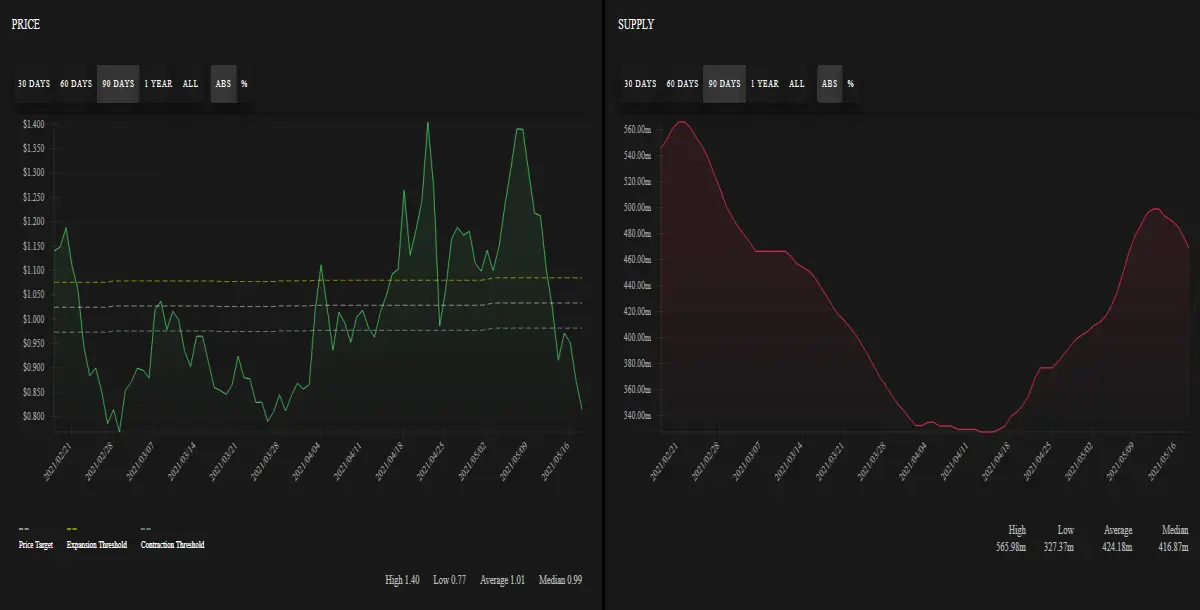
Here you can see that supply (the graph on the right) reached the bottom of its curve in early April and stayed there for around three weeks. Price (the graph on the left) started to spike around 18 April. So that would have been a sensible time to request a withdrawal. You could have waited for the later spice in price around 7 May, but by then supply (and as a result, market cap) had increased significantly - so you would be getting a smaller slice of pie. In my opinion, it's more important to move when supply is low than worry overly about prices.
Of course it's not an exact science, because of the delay between requesting a withdrawal on Publish0x and receiving the funds in your wallet. If you're paying out to KuCoin, the deadline for making a request is Sunday 6PM UTC; the AMPL will then be in your account "between Monday and Wednesday, or on rare occasions by Thursday". Although supply won't have changed greatly in those few days, it's ample time - excuse the pun - for price to shoot all over the place.
I hope this helps you. And I'd like to leave you with this quote from British critic AA Gill:
So much of life is not about whether you're good or bad, or right or wrong, or can afford or not afford - it's just about timing.






