The CFD market has grown considerably over the past two decades, with millions of traders now using leveraged products to speculate on forex, shares, indices, commodities and other financial markets.
Hundreds of CFD brokers operate globally, but a relatively small group has built substantial international businesses. Size does not automatically make a broker better, of course. However, a large client base, established regulatory presence and long operating history can provide useful indications when comparing providers.
Source: IndependentInvestor.com, Reddit.com, ForexFactory.com
Here are five of the biggest names in CFD trading:
1. IG
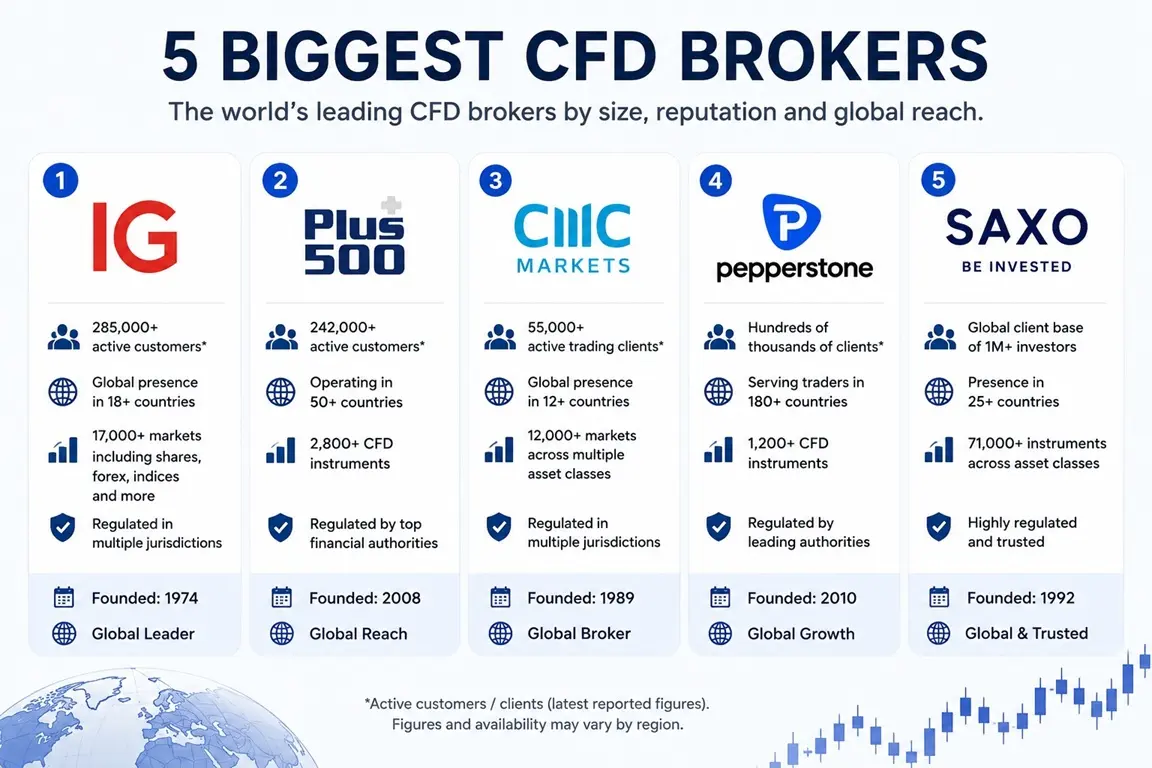
IG is one of the oldest and largest leveraged trading providers in the industry. The company was founded in 1974 and has since developed into an international trading group with operations across Europe, Asia Pacific, Africa, the Middle East and North America.
Its scale is considerable. IG reported around 285,000 active organic customers for the seven months to December 2025, while its wider product offering includes CFDs, spread betting, share dealing and exchange traded derivatives. CFD traders also get access to a very large selection of financial markets. This includes shares, forex, indices and commodities.
Why IG stands out:
-
More than 50 years in the industry
-
Large international client base
-
Extensive selection of markets
-
Strong proprietary trading platform
-
Regulated across multiple jurisdictions
IG is difficult to ignore when discussing the largest CFD providers. Its size, history and market coverage put it firmly among the industry's major players.
2. Plus500
Plus500 is another major name in retail CFD trading.
Founded in 2008, the company grew rapidly through its proprietary trading platform and relatively simple approach to leveraged trading. It has since expanded beyond CFDs into other areas, including futures and options in the United States.
The numbers demonstrate its scale. Plus500 reported 242,440 active customers during 2025 and revenue of $792.4 million. One of Plus500's biggest attractions is simplicity. Its proprietary platform is considerably easier to understand than some professional trading systems.
Why Plus500 stands out:
-
More than 240,000 active customers in 2025
-
Large international presence
-
Simple proprietary platform
-
Wide selection of CFD markets
-
Publicly listed company
More experienced traders may prefer brokers offering greater platform choice, but Plus500 remains one of the largest dedicated CFD names.
3. CMC Markets
CMC Markets has been operating since 1989 and has developed into another substantial global trading business.
The company offers CFDs alongside investing products and has built a particularly strong reputation for its proprietary trading technology and extensive market coverage.
CMC reported 55,081 active trading clients for its 2026 financial year. Its investing business was considerably larger, with more than 281,000 active investing clients. Its CFD platform provides access to a substantial number of markets, making CMC particularly interesting for traders who want to go beyond the most popular forex pairs and indices.
Why CMC Markets stands out:
-
Established in 1989
-
Large international operation
-
Extensive CFD market selection
-
Advanced proprietary platform
-
Strong charting and research tools
CMC can feel slightly more complicated than some simpler CFD platforms, particularly for beginners. For experienced traders, however, that additional functionality can be an advantage.
4. Pepperstone
Pepperstone is younger than IG and CMC Markets but has grown rapidly since being established in Australia in 2010.
The broker has expanded internationally and developed a particularly strong following among forex and CFD traders.
One reason is platform choice.
Pepperstone supports several popular third party trading platforms rather than forcing every trader onto a single proprietary system. This makes it attractive to traders who already have an established setup and do not want to change the way they analyse or execute trades.
Why Pepperstone stands out:
-
Major international forex and CFD broker
-
Strong regulatory presence
-
Excellent platform selection
-
Competitive trading costs
-
Popular with active traders
-
Pepperstone may not have the history of IG or CMC, but it has become one of the most recognisable CFD brokers globally.
5. Saxo
Saxo takes a somewhat different approach from many retail CFD brokers. Founded in Denmark in 1992, the company positions itself towards more experienced and higher value traders. CFDs form part of a much broader trading and investment offering covering shares, forex, ETFs, bonds, futures and options.
Its platforms are another major selling point. SaxoTraderGO provides a relatively accessible trading environment, while SaxoTraderPRO is aimed at traders who require more advanced functionality.
Why Saxo stands out:
-
More than three decades of operating history
-
Broad international presence
-
Large selection of financial instruments
-
Professional quality trading platforms
-
CFDs available alongside traditional investments
-
Saxo may not be the obvious choice for someone simply looking for a basic CFD account. For experienced traders wanting several asset classes under one provider, however, it deserves consideration.
Conclusion - What CFD Broker to Trade With
IG, Plus500, CMC Markets, Pepperstone and Saxo are among the biggest and most established names in global CFD trading.
They have reached that position in different ways. IG combines enormous market coverage with more than 50 years of experience. Plus500 has built a large international client base around a simpler proprietary platform. CMC Markets offers extensive market coverage and advanced trading tools, while Pepperstone has become particularly popular with active forex and CFD traders. Saxo sits towards the more sophisticated end of the market.
Size should never be the only reason for choosing a CFD broker.
Regulation, spreads, commissions, overnight charges, platform quality and market coverage still need to be compared. A huge broker can be completely unsuitable for a particular trader, while a smaller regulated provider might offer exactly what they need.
The biggest name is not necessarily the best broker. It is simply a sensible place to start your research.






