
1. Python
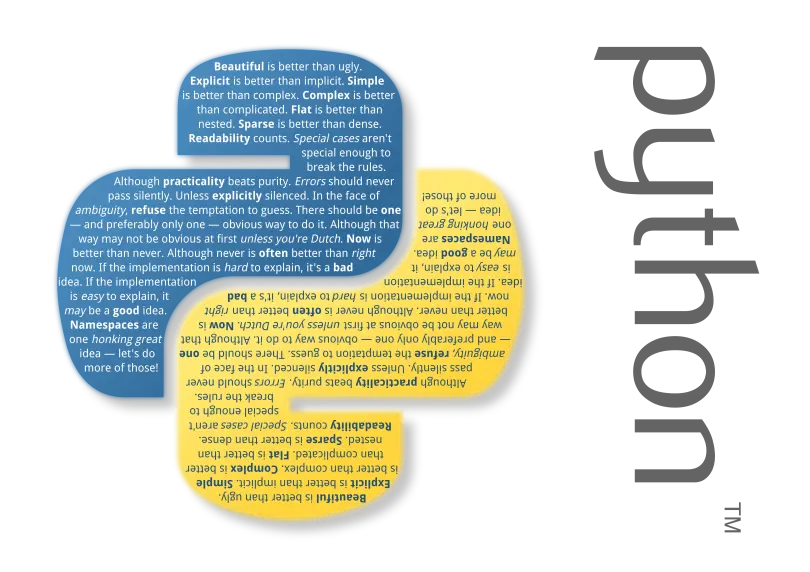
Python is an interpreted high-level general-purpose programming language. Its design philosophy emphasizes code readability with its use of significant indentation. Its language constructs as well as its object-oriented approach aim to help programmers write clear, logical code for small and large-scale projects.
It is created by Guido van Rossum in 1991 as Python 0.9.0.
Python consistently ranks as one of the most popular programming languages. According to these
- TIOBE index
- "index | TIOBE - The Software Quality Company"
- "Stack Overflow Developer Survey 2020"
- "The State of Developer Ecosystem in 2020 Infographic"
- "PYPL PopularitY of Programming Language index"
Its a very easy language and simple normal English like language. It is also written in the language's core philosophy is summarized in the document The Zen of Python (PEP 20), which includes aphorisms such as:
- Beautiful is better than ugly.
- Explicit is better than implicit.
- Simple is better than complex.
- Complex is better than complicated.
- Readability counts.
It is a beautifully written language and does not need to compile when you want to run it.
2. Java
Java is a high-level, class-based, object-oriented programming language that is designed to have as few implementation dependencies as possible. It is a general-purpose programming language intended to let application developers write once, run anywhere (WORA), meaning that compiled Java code can run on all platforms that support Java without the need for recompilation. Java applications are typically compiled to bytecode that can run on any Java virtual machine (JVM) regardless of the underlying computer architecture. The syntax of Java is similar to C and C++, but has fewer low-level facilities than either of them. The Java runtime provides dynamic capabilities (such as reflection and runtime code modification) that are typically not available in traditional compiled languages. As of 2019, Java was one of the most popular programming languages in use according to GitHub, particularly for client-server web applications, with a reported 9 million developers.
As of March 2021, the latest version is Java 16, with Java 11, a currently supported long-term support (LTS) version, released on September 25, 2018. Oracle released the last zero-cost public update for the legacy version Java 8 LTS in January 2019 for commercial use, although it will otherwise still support Java 8 with public updates for personal use indefinitely. Other vendors have begun to offer zero-cost builds of OpenJDK 8 and 11 that are still receiving security and other upgrades.
3. JavaScript
Java is a high-level, class-based, object-oriented programming language that is designed to have as few implementation dependencies as possible. It is a general-purpose programming language intended to let application developers write once, run anywhere (WORA), meaning that compiled Java code can run on all platforms that support Java without the need for recompilation. Java applications are typically compiled to bytecode that can run on any Java virtual machine (JVM) regardless of the underlying computer architecture. The syntax of Java is similar to C and C++, but has fewer low-level facilities than either of them. The Java runtime provides dynamic capabilities (such as reflection and runtime code modification) that are typically not available in traditional compiled languages. As of 2019, Java was one of the most popular programming languages in use according to GitHub, particularly for client-server web applications, with a reported 9 million developers, which is Great.
As of March 2021, the latest version is Java 16, with Java 11, a currently supported long-term support (LTS) version, released on September 25, 2018. Oracle released the last zero-cost public update for the legacy version Java 8 LTS in January 2019 for commercial use, although it will otherwise still support Java 8 with public updates for personal use indefinitely. Other vendors have begun to offer zero-cost builds of OpenJDK 8 and 11 that are still receiving security and other upgrades.
4. C#
C# is a general-purpose, multi-paradigm programming language. C# encompasses static typing, strong typing, lexically scoped, imperative, declarative, functional, generic, object-oriented (class-based), and component-oriented programming disciplines.
C# was developed around 2000 by Microsoft as part of its .NET initiative and later approved as an international standard by Ecma (ECMA-334) in 2002 and ISO (ISO/IEC 23270) in 2003. It was designed by Anders Hejlsberg, and its development team is currently led by Mads Torgersen, being one of the programming languages designed for the Common Language Infrastructure (CLI). The most recent version is 9.0, which was released in 2020 in .NET 5.0 and included in Visual Studio 2019 version 16.8 .
So, as soon as you can learn learn a programming language . In my opinion i have learned the language which i need to learn to complete my Goal. For Example when i need to make a neural network for Image classification than i learned Python, and when i have to make a game for me in unity I learned C# same as if the game was to be made in unreal engine than in will learn C++ . That's why not any of the following language is bad learn only the language which you need to learn.
Todays Joke:
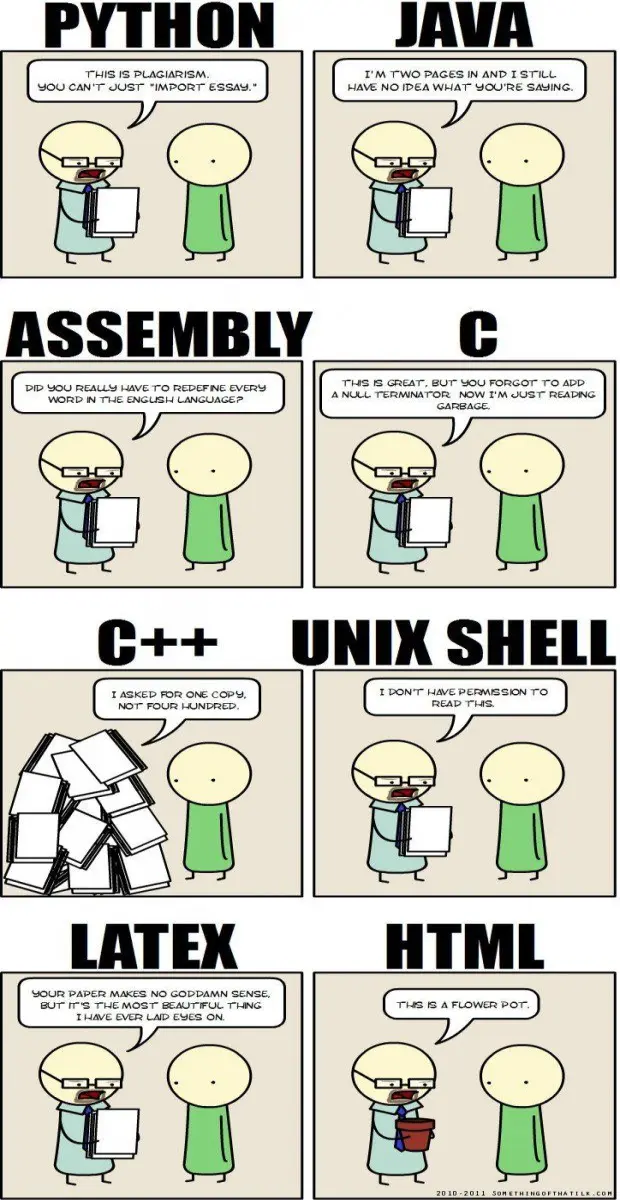
And that's the END
Thanks for reading.






