
With today’s digital gadgetry practically ubiquitous with daily life, it’s hard to imagine the practicality of going backwards to film photography, especially given the advantages of modern digital cameras and the latest advances with the mirror less choices. However, the film camera still has a lot to teach a serious photographer, especially about image composition, manual control, light control and post-processing.
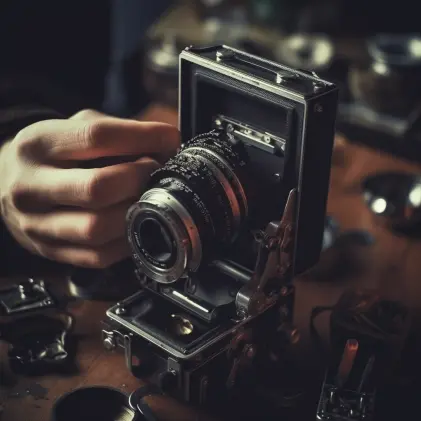
(even AI doesn't quite know what to do with film cameras. Here we have some sort of visual mush of a top-down viewer camera, maybe sourced from the image of a Bronica, but the computer didn't have enough to work with so instead we get a lens in a box it can't fit, a viewer on the bottom under the lens, and no camera body per se. Go figure).
Framing and Composition
Digital cameras easily spoil us. They remove the guesswork that was a natural challenge with film cameras. While most folks were happy enough with just pointing and shooting, and if the photograph that came back from the corner store processor looked correct, dedicated photographers had to work with techniques in bracketing. The common expectation was that for every roll of 24 and 36 exposures of film, 2-3 three really good photographs was a good day.
In fact, many bad shots were taken on purpose to narrow the good one, better known as “bracketing” from military logic. One would typically go through at least three shots, with a setting for less light, middle range, and more light to hopefully get one good image out of three. And this already assumed the photographer knew what he was doing with image framing, choice of lens equipment, and skill.
The truth of image would not be known until the photographer got to the darkroom and ran test prints, or he waited for a processor to produce a negative strip set to make choices on what to print out. And because of this educated guesswork, only those who stayed disciplined and dedicated to f-stops, light meters, and experience learned how to use their cameras well.
Today, we take the above for granted. If a shot comes out bad, we delete it from the camera on the spot via the viewer, and then take 5 more. The work involved in minimal and extremely forgiving. Even phones enhance images with their amazing autofocus ability, removing any challenge one would have otherwise had controlling focus such as on an SLR unit or medium format manual model.
Storage Differences
The fragility of film once exposed became even more of a task after the 9-11 task. All over the country and world airports overnight beefed up security, and magnetometers and x-ray screeners became the photographer’s bane. Anything over 400 ISO was at serious risk of damage in these machines, and for traveling photographers that mean having to get even better and managing light and film speed with lower ISOs for reliable film storage and transport.
Again, once digital cameras came into vogue, this issue disappeared, but the film photographer really had their hands full having to carry anti-x-ray film bags and similar to protect their work on travel status. And even if not getting on a plane, a general lack of attention could easily lose a role of film or it could get crushed and damaged if not protected, especially with older film styles. No surprise, the 35mm film and its canister became the standard because at least the hard canister that kept the film rolled up offered some decent protection. Now, one can just upload their shots to the cloud as soon as they are saved, protected in the Ethernet-sphere in seconds or minutes.
Post-Processing Basics
Probably the most powerful aspect of digital photography, or at least what comes to mind the fastest, is how easy it is to repair, enhance, duplicate and add to digital images once they are taken. With the utilization of post-processing software like Photoshop, GIMP, and even the basic Apple iOS tools that come standard with phones now, the ability to fix all sort of mistakes as well as produce images of different formats and quality are possible in seconds.
The above said, the principles for all these software tools, believe it or not, come from the darkroom. Terms like “dodge” and “burn” weren’t invented as cute names for programs. They were technical procedures used to control exposure and fix flaws in film choices as the user worked the camera manually.
…But it All Made a Better Photographer
However, despite all the above challenges, some of the best photographer so far still remains those shots generated by film. While there have been many good examples produced in digital, the principles of critical photography continue to be based on the product of film shots.
So, if you want to get really good at using you digital camera, spend some time with a film version and in the darkroom. You don’t have to do it forever, but the few weeks or months that you stay dedicated to the older art will pay dividends in your photography overall.





