
As new projects and new players appear in the Crypto ecosystem, new cybercrime formats appear, and new needs when putting together a portfolio. No one doubts that you have to have Bitcoin and Ether, and probably also Avax and Sol, and more probably some stablecoin such as USDT to take advantage of dips. But everything ends there? There are about 20,000 projects with interesting tokens, but it does not seem logical and rational to buy a little of each. It seems necessary to study the spectrum of projects and do some critical thinking before investing. The crazy ecosystem of the Memecoins is like a monkey with a razor. The risk is very high, however, it is a very important part of the culture of the new generations that are more interested in being part of a cultural tribe than in a business project. In this regard, here I leave an impressive video (terrifying?) On what could come in the Memecoins industry.
My exVC smell makes me think that to invest rationally, you have to think about “industries” and only later, see what alternatives are in those industries. I remember my epochs as the private plane pilot, when the instructor placed special emphasis on driving the plane for "attitudes." Once the plane's nose was well-oriented, we could think about the tactics to be used to get to a destination. It seems to me that in cryptocurrency investment issues, the example of the plane can be useful.
In this sense, an orientation or “attitude” for investing in cryptocurrencies that I find interesting to explore, is the insurance industry. There will be others and I think they are going to be objects of future posts.
Disclaimer. I am not a financial advisor or intend to be. Therefore, nothing I say must be interpreted as an investment recommendation. All I write is just for information and as a result of my research of the projects I mention, but in no way can it replace the research of each reader.
What is the insurance industry?
In ancient times and the Middle Ages, they were made “contracts” of insurance through the storage of cereals in temples or lords' grains, since one of the social functions that these surpluses fulfilled was their distribution or sale in times of bad harvests. In the Dark Ages, there were mutual relief brotherhoods in case of diseases, disabilities, or deaths. The first assurance system itself is the maritime insurance that appeared in the Mediterranean during the Middle Ages as a result of the development of maritime trade.
Insurance is a contract called an “insurance policy”, through which, an insurance company, the insurer, is committed by charging a premium to an insured, in the case of the event whose risk object occurs, to compensate the damage produced to the insured. In a contract intervenes 1) the insurer, which is the entity responsible for coverage in case of incident; 2) the insured, owner of the insurance policy and responsible for the payment of the corresponding premium; and 3) the beneficiary, who is the person who will charge the corresponding compensation in case of incident. These three figures are not always to be the same person, being able to be all different. There may also be one more figure, 4) the insurance agent, who is the person who intermediates between the insured and the insurer, and other figures such as 5) insurance comparators which are usually Internet platforms that allow an estimate of what insurance prices could be.
What is the Crypto insurance industry?
As can be seen, the centralizing capitalist fabric has achieved a system in which there is a place for several holes in which several parasites can be introduced to the party. The nature of the risks of the Crypto ecosystem makes certain differences and difficulties in assembling a credible and sustainable insurance system for a future insured. Crypto insurance allows exchanges and investors to claim a portion of their losses in case of theft or protocol failures by human error. The product itself arises as a need for an uncertain and speculator subsystem called DeFi based mainly on the Ethereum blockchain. Therefore, Crypto insurance should be essence to be decentralized as well as DeFi. DeFi space is the most modern hunting preserve of pirates and cybercriminals. While cryptocurrency theft is generally decreasing, the DeFi ecosystem has an episode of hacking every day that causes large losses to investors and companies.
Decentralized Crypto insurance covers, in general, the vulnerabilities of a Smart Contract, and the loss of value of a token. It does so for a certain period, and a certain amount. The truth is that there are several difficulties in creating a Crypto insurance industry, mainly due to the lack of regulations, and the lack of history of the Crypto ecosystem, that is, because of its relative youth. However, there have been some decentralized platforms that allow investors to buy insurance plans, and I will show two of them.
Nexus Mutual
An entrepreneur called Hugh Karp created Mutual Nexus in 2017. As can be seen in his LinkedIn profile, he has more than 15 years of experience in the traditional insurance industry. This allowed him to detect what are the main problems that arise in a decentralized and novel environment such as the DeFi ecosystem. Karp raised that Blockchain technology could allow people to manage collectively decentralized, eliminating the need for a centralized intermediary.
The concept of insurance as a "cooperative approach" laid the basis of Nexus Mutual, a platform that allows people to collaborate to share and manage risks, guaranteeing that all are protected in a transparent and decentralized way. Nexus Mutual began using Chainlink Price Feeds in March 2020 to offer high-quality market data and manipulation proof for its capital fund. Nexus Mutual is also associated with a heavyweight of DeFi such as Yearn.finance, to offer insurance coverage for DeFi tokens.
Nexus mutual does not cover the losses directly, but they are covered thanks to the funds deposited by all its members when buying an insurance policy. When there is a problem that must be covered with the funds of the Nexus community, this platform follows a democratic and decentralized system to decide what claims are valid by public voting through the blockchain.
To be a member of the community, the token NXM must be taken in the portfolio, which grants the power of governance for the assessment of claims and allows the purchase of coverage. The NXM Token can only be purchased and sold from the application of Mutual Nexus and transferred only between members of the Community. It can never be bought or sold in an exchange. Being a member of the community you can acquire an insurance policy. The minimum coverage term is 30 days and a maximum of 365 days. When a claim needs to be processed, the member must bet on 5% of his NMX tokens blocked for the purchase of his/her bail, to avoid fraudulent claims. The other members of the community must reach a democratic consensus of at least 70% in favor of the claim. In addition, these members must bet tokens NMX for their vote, and the total of the entire group must be at least 5 times greater than the coverage to claim. The insured must provide evidence and details of the attack and it will be necessary to wait 72 hours for community members to vote if the claim must be processed and approve the reimbursement of lost funds.

A curious fact that exemplifies the nature of the risks to be covered in the Crypto ecosystem. The founder himself was hacked, losing 8 million dollars! 370,000 NXM tokens of the Karp wallet were stolen. Karp, who, knightly offered a reward to the cybercriminal through a Twitt. The pirate obtained remote access to the Karp computer and modified its Metamask extension.

Analyzing the operation in Etherscan, it is observed that the pirate has already negotiated part of the NXM stolen by ETH through the 1inch Exchange. However, officially, Nexus Mutual says that project pools are safe and that only the Karp address was affected in this directed attack, and that the mutual cooperative is not affected, being the reserve of funds and all the systems safe .
Sure
SURE has a scheme similar to Mutual Nexus. To ensure its portfolio, the investor needs to acquire Sure Tokens, in this case, in several enabled exchanges. Then you must enable your coverage in the company's Internet site dashboard. To buy coverage, the investor needs to create a proposal from his/her personal wallet. SURE tokens should not accumulate in centralized exchanges, but they can be staked in DEXs, contributing to the Liquidity Pools.
Examples of SURE coverage are the following.
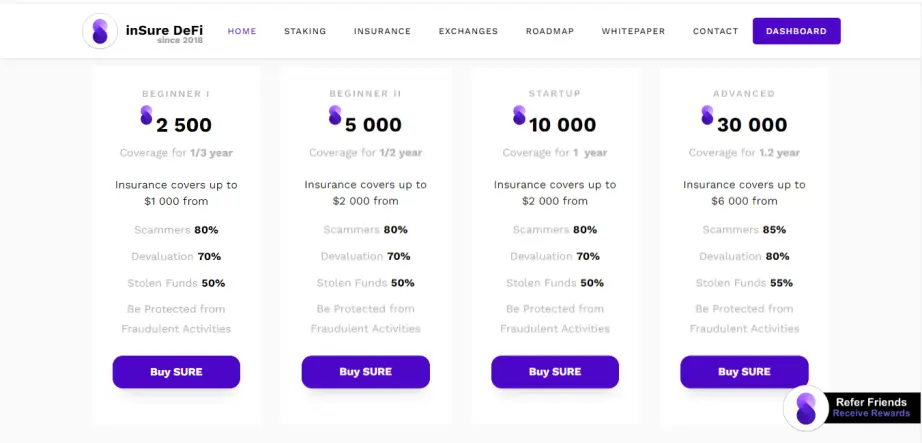
SURE uses a Dynamic Pricing Model to calculate the cover premiums, and a Liquidity Pools scheme in DEXs that encourages members to put their tokens and provide liquidity to increase ecosystem stability. For a complete understanding of how these mechanisms work, the very clear and concise White Paper can be seen here.
SURE tokens are supported by all EVM wallets and can be converted into the main DEXs and CEXS.
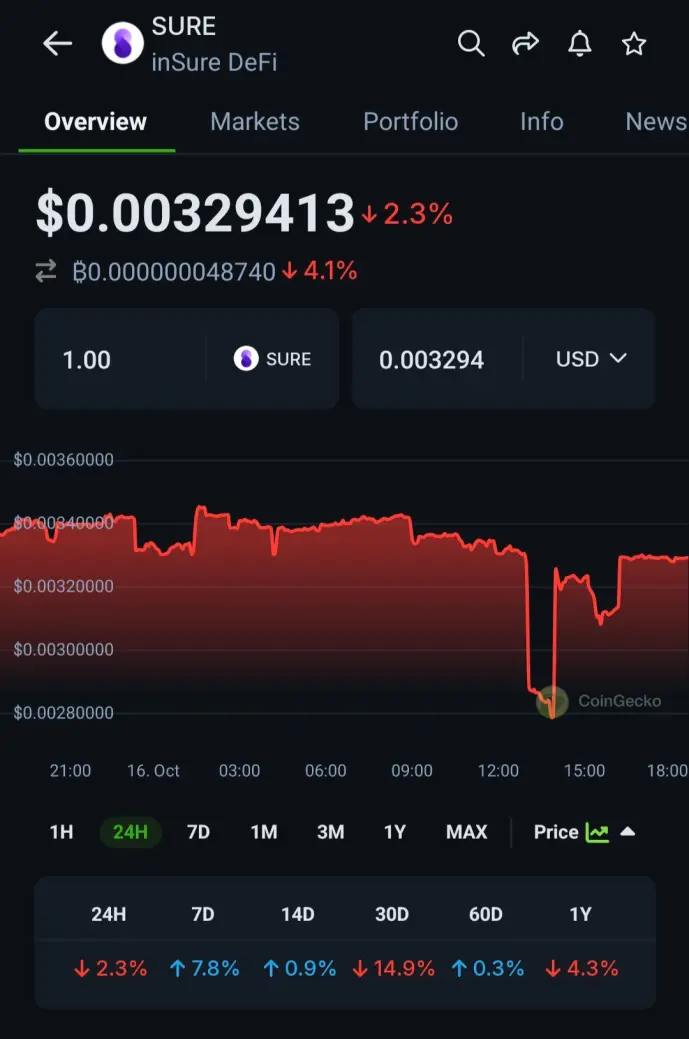
inSURE is a decentralized ecosystem of totally transparent insurance. All its members can verify the On-Chain Treasury funds, and create new development proposals. All requirements are processed transparently and voted by the community in a 24/7 base.
Conclusion
It is almost totally universally accepted that cybercrime will increase pari pasu with the development of blockchain technology, which, incidentally, is in its first babbling. It does not seem crazy then to bet on some tokens of the Crypto insurance industry, whose main function is to serve as a liquidity to cover possible losses in the portfolio, due to pirates, due to human errors in the code, or due to the vertiginous fluctuations of the prices of certain DeFi assets.
I remember that my teacher once told me "there is always one more smarter than you." Over the years I checked it, sometimes very bitterly. That is why I always secured all my assets, with large coverage, to prevent future problems that will surely be presented. Those things that the experience has, in the face of the intrepidity of youth facing risks as if they did not exist. From my point of view, the projects of the Crypto insurance industry has a great perspective for the next decades, and surely new projects will appear that make it increasingly sure to operate with cryptocurrencies, which, incidentally, will be the most way frequent exchange of new generations.
Thank you for visiting!






