
After episode 15, a little (nothing major) stir broke out about the so-called “cashless society”.
It is logical to think that very conservative individuals are not convinced of the uselessness of the banks of the next decades. Less than 1% of the world's people use some type of cryptocurrency and/or related services. The remaining 99% do not yet know what it is about. And those who know something is because they read or listened to or saw a TV program in which they spoke (usually very badly) about cryptocurrencies. With which, it is perfectly logical to think that a conservative individual thinks that all this is things of nerds and cypherpunks isolated from the system and that soon some corporation is going to take control of all this crap and the corporate banking system’s glorious days are going to return everything to normal.

Image of press 👍 and ⭐ in Pixabay
That is why someone may think that most people "do not see as a threat" the much-publicized (by banks and financial corporations such as credit cards) "cashless society", and on the contrary, that they see it as a great innovation, mainly to prevent cash theft.
Theft? And what do banks do?
Of course, part of the campaign is to make people "not realize" so that then "they do not see it as a threat."
That's why in the commercials there are young people ecstatic with happiness looking at their cell phones while operating with their trusted bank.

Image of Anastasia Gepp in Pixabay
Let's say it with all the letters. In a P2P world there is not even the slightest space for a bank or a credit card. Much less for traditional insurance companies or one of the hundreds of monstrosities that the international financial corporation invented to create debt in the population and have it for life paying the fees corresponding to that debt.
Even if the crypto-sphere is not yet ready to avoid the whale games, it is still preferable to the dictatorial centralization of the banking industry, backed by an institution created by centralized governments like the Central Bank and controlled by an executive branch that uses the whole system to regulate the value of the local currency and relative prices through inflation that favors its friends and impoverishes the population. (Do not forget that the Central Bank was proposed by Marx in his Manifesto to control the entire economy, from a system that called itself "the dictatorship of the proletariat") The word dictatorship gives an anarchist like me goosebumps.
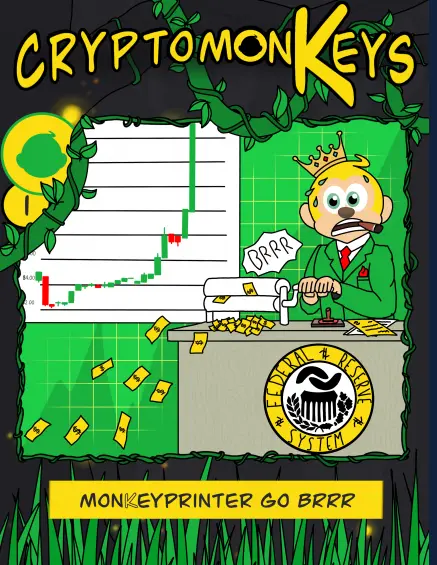
As bankers and politicians realize that this is so, all they think about is to see how they are going to regulate all this mess. But, since they also know that they do not have many alternatives, then what we are going to see in the near future is a gigantic worldwide campaign to exacerbate the cashless society to misinform people around the world and keep them tied to the traditional banking system.
This campaign will not only consist of commercials, but they will also use all kinds of strategies such as the creation of applications for phones that deceive the user, the creation of corporations that "say themselves within decentralization" (¿Libra?), the incredibly ridiculous issuance of cryptocurrencies by central banks, and many other aberrations that, by having the mass media controlled, will have no problem in achieving a very high rate of adoption.
What can we do? I think the best thing is to increase our P2P actions.
The fundamental targets of this macro campaign of massive disinformation in favor of the cashless society will be the centralized exchanges, where many coiners buy and sell their coins. So we should expect the regulations will drop there soon. Anyway, everything they do is going to be temporary, until mass adoption and the total elimination of fiat money arrive.
Naive? Ridiculous? Dreamer? Anarchist? Subversive? Not any of that, only a reality analyst who works on the basis of critical thinking.
Someday everyone will understand that the equilibrium was interrupted in 2009 and that we are just learning to think about our lives in a decentralized way.

Imagen of Gerd Altmann in Pixabay
With that said, let's go to today's two tokens.
HBAR
CoinGecko Rank #65
Hedera Hashgraph (HBAR) is a distributed decentralized database. It is a potential project and brings together a group of leaders, including important men in the world economy.
Data is recorded on the DAG (Directed Acyclic Graph), rather than on-chain like current popular Blockchain platforms. In a previous post, I referred to DAG.
In DAGs, the network participants act as nodes. These nodes cross-authenticate each other's transactions. As a result, the speed of the transaction is faster because there is no need to mine the block and reach a consensus earlier.
The main characteristic of its algorithm is speed. Hashgraph has higher throughput and low consensus latency. Get 250,000 transactions per second. Transactions on the platform only need 3 to 5 seconds to process, and initial performance is limited to 10,000 TPS. The founders think that when the network becomes "mature", the number of TPS will increase.
To make sure it is safe it uses a Byzantine fault-tolerant asynchronous system. In this way, even if one of its nodes stops working or does not show adequate behavior, it could continue to function without problems. With 2/3 of the network, a transaction is already validated. The transactions are validated in order, so you cannot choose the order in which the transactions are processed. In networks such as Bitcoin, miners prioritize those with the highest transaction fees to receive a greater profit. This does not happen on this network.
Mathematically Hashgraph is essentially a graph. A chart that is held together by simple hashes. Using the Gossip protocol, its nodes are constantly “gossiping”, sharing with each other every information they know about the up-to-date state of the network and its history. This network does not seek that all the nodes agree that a certain transaction took place. A node involved in a hashgraph transaction randomly selects another node to report on the transaction (and everything else it knows about). Then the process continues, and both nodes will select others to transmit the information to. The process is repeated until all the nodes know what has happened. Although in the short term this system makes the nodes have different information, with a time frame they all have the same information.
To know the true state of the network, the network itself examines these hashes. This way, you get to know which node knew what information and at what time.
The consensus is inferred through "voteless voting": the vote of a node must not contradict the information available on the status of the Hashgraph network. There is no need to talk to anyone, mathematics gives the guarantees of perfect consensus. The hashgraph consensus mechanism is extremely practical compared to the well-known Proof-of-work (PoW) and Proof-of-Stake (PoS).
Leemon Baird is the face of Hedera Hashgraph as Founder & Chief Scientist. He has a Ph.D. in Computer Science, several patents, and is the author of numerous publications in academic journals.
HBAR is Hashgraph's native cryptocurrency and grants token holders access to applications distributed on the platform, making it a utility token. HBAR can also be used to run a node.
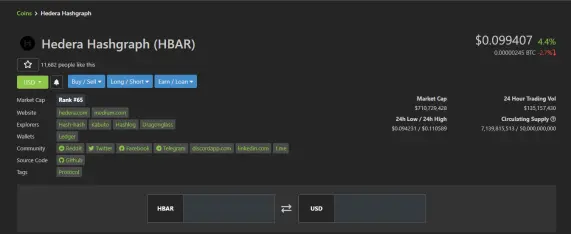
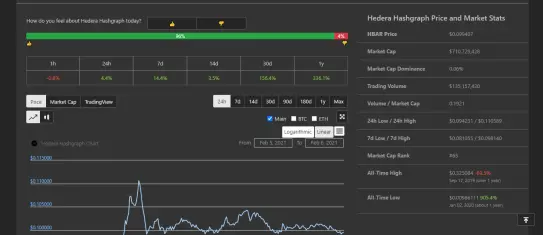
One very special thing about the Hedera project is that there is a board of 39 leading organizations and companies in the financial world. So far, this council has attracted participation from a number of big players, including Boeing, Google, Deutsche Telekom, IBM, Swisscom Blockchain, and Tata Communications. The board members are committed to modifying software changes while providing stability and continued decentralization to the platform. Each member of the board has one vote. This is to prevent "power" from becoming too focused on one entity. Also, the council members will change after a few years. Specifically, each member will have a maximum of 2 terms of three consecutive years. Many questions have been raised about this governance model. The most important question is whether 39 board members are truly independent. Can't this turn into a clumsy battle of power-sick giants?

Image of Willgard Krause in Pixabay
Conclusion. The idea of decentralization hand in hand with speed and security is always very attractive to the crypto-sphere. The HBAR project is very promising because it is backed by leading scientists. What we will have to investigate in depth, according to what the facts show, is how gigantic corporations behave when sharing a project. A priori, the presence and support of important and consolidated companies that clearly understand the decentralization process would be an encouraging figure. But we always have the suspicion of the unlimited power of some of those corporations. If everything works well and the governance of the project proves to be successful, then we are facing a project with a very good prognosis, because scientific support and financial availability seem to be first line.
0x
CoinGecko Rank #51
0x is a protocol run on the Ethereum blockchain that allows decentralized exchanges to conduct off-chain transactions, reducing gas costs and relieving blockchains from loading unnecessary data.
The off-chain transactions are guarded by the so-called “relayers”, nodes in charge of announcing the buy and sale orders through all the accounting books and that act as an exchange house. However, they do not take any position, since their role is that of an intermediary between the Makers (brokers that provide liquidity to the network, negotiating and offering buy and sell prices) and the Takers (buyers).
Thus, relayers facilitate currency trading by transmitting the best maker prices to takers. For the services provided, they receive a commission in local currency for each transaction.
On-chain operations are only transmitted to the blockchain when the two parties, makers and takers, have finally agreed to close the contract (that is, to carry out the transaction).
The native token of 0x is ZRX, an ERC-20 token, which allows transactions to be carried out within the protocol and serves to pay economic incentives within the platform.
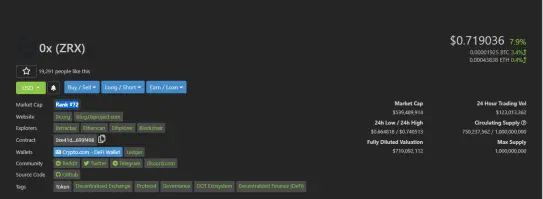
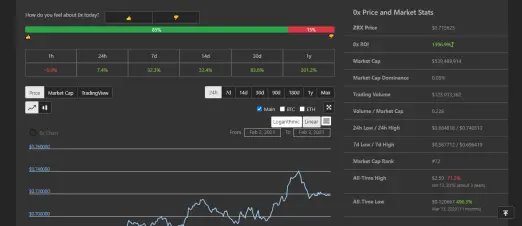
0x has a maximum number of coins of 1,000,000,000. Currently, there are approximately 517,000,000 in circulation. Being a free open-source platform, it applies very low fees and only to small deposits of less than 1,000 USD.
0x was created with the purpose of promoting interoperability between decentralized applications that incorporate exchange functionalities (DEX). To achieve this, 0x allows operations to be executed by an Ethereum smart contract system. These smart contracts are publicly accessible, free to use and any DApp can use them.
0x specializes in providing the necessary protocol to improve the functioning of decentralized exchanges and reduce gas costs and commissions. Unlike other exchange houses, it is not a proprietary system but rather an open and free-to-use digital infrastructure that is financed by users. Although its protocol was initially heavily criticized for its code flaws and for trying to put an overly decentralized model to work, developers of 0x have continued work on the code and prompted numerous innovations.
The 0x project began when Will Warren and Amir Bandeali co-founded 0x in October 2016. Since then, 0x has undergone changes to accommodate the growing needs of decentralized exchanges. On August 17, 2017, 0x ended its ICO with the sale of 1 billion tokens and a raise of $ 24 million. With these initial funds, the program grew internally and proved itself, the team realized that opening the application process to the public was the next big step. From then on, the evolution of 0x has allowed it to position itself as one of the best options for handling DEX.
0x is completely decentralized and open. This means that anyone can use it. This creates a reliable standardization in the Ethereum system, public, and enhanced through community consensus rather than relying on a centralized authority.
The ownership of tokens is always under the control of whoever owns it. 0x is capable of performing off-chain transactions and on-chain agreements. Orders are cryptographically signed by the token owner to ensure security. However, these are not transmitted to the blockchain until all the changes have been finalized. This makes it possible to avoid saturating the blockchain because it only transmits the final result of the transaction to the blockchain.
0x allows fast, secure, and free exchanges between all ERC 20 and ERC 721 tokens, both built on Ethereum. ERC 721 is an Ethereum protocol for designing NFT crypto assets.
Another product developed that works with this protocol is 0x Instant, a payment platform that allows, with a few lines of code, that an application or web page accept payments in all cryptocurrencies that 0x support, again at cost 0 and so fast and safe.
The main criticism made of 0x is the little use of the token itself, ZRX. Although it is used at all times by the protocol, this is done in a transparent way, without it being clear what use it would be for someone to have a large amount of ZRX, other than as a possible investment. The only practical utility that the token has is to be able to participate in the future development of the product, with the development decisions taken after voting in which each ZRX owned gives a vote.
Conclusion. The developers of 0x do not rule out inserting centralizing measures in the platform to prevent the capitalization of shares by a few users. They have also shown that their software is not susceptible to forking, for the simple reason that it is not profitable to do so. Ox has shown so far that the technology of conventional exchange houses and decentralized exchanges can be combined without sacrificing security and with lower costs and data load for blockchains. In this way, there are numerous important projects that are based on its protocol, both other cryptocurrencies and DEXs, among which Augur and Maker stand out. I have no doubt that this is a winning project in the long term and that the ZRX token will be of fundamental importance in future decisions in the crypto sphere.
As usual, none of the things written in this post are financial advice and are not intended to replace personal research.
I am interested in showing in this blog the fundamentals of crypto-sphere projects that may mean a paradigm shift in the near and not so near future. This approach may be different and complementary to the posts of other talented colleagues at Publish0x that show shorter-term variables and which I follow with great interest, since I, of course, am also interested in the short term and in putting together a solid portfolio.
Thank you for reading!
You can follow my blog Tokenomics here
You can follow my blog SirGerardThe1st Grimoire here
Publish0x is a great idea. Consider signing up with my link
Hey you guys who speak Spanish, you can follow me on my Linkedin group "Relax Financiero"
If you have any questions or comments, please feel free to leave them down below
You can also contact me at [email protected]
You can also follow me on
- Telegram https://t.me/whytokenomics
- Twitter https://twitter.com/SirGerardThe1st
- LinkedIn https://www.linkedin.com/in/gerardosaporosi/






