

Introduction
As AI tools like ChatGPT, Claude, and Gemini become embedded in everyday life, a once-niche skill is now essential: prompt engineering. It has rapidly become necessary for developers, educators, creators, and even casual users.
This article explores how prompt engineering is evolving in 2025, outlines practical techniques for better prompts, highlights new tools, and examines the emerging frontiers of this fast-changing field.
1. What is Prompt Engineering?
Prompt engineering is the process of crafting effective inputs (prompts) to large language models (LLMs) in order to get accurate, creative, or context-aware outputs. It’s both a technical practice and a communication skill.
Why It Matters
-
Maximizes Model Performance: Better prompts = better results.
-
Bridges Human-AI Interaction: Prompts act as the main interface between people and AI systems.
-
Drives Real-World Use Cases: From writing assistants to data analysis, prompt design powers a wide range of applications.
2. Core Techniques in Prompt Engineering
2.1 Basic Techniques
-
Zero-Shot Prompting
No examples given.
Example: “Summarize the following article in three sentences.” -
Few-Shot Prompting
Provides a few examples to guide the response.
Example:
“Translate the following to French:-
Hello, how are you? → Bonjour, comment ça va ?
-
What is your name? → Quel est votre nom ?”
-
-
Role Prompting
Assigns a role or persona to influence tone or behavior.
Example: “You are a helpful customer support agent. Respond to this query…”
2.2 More Advanced Techniques
-
Chain-of-Thought Prompting
Encourages the model to show its reasoning process.
Example: “Explain your steps before giving the final answer.” -
Output Constraints
Guides formatting and structure.
Example: “Summarize in 10 bullet points.” -
Self-Consistency & Self-Checking
Run multiple responses and pick the most consistent (self-consistency), or have the model critique its own output (self-checking). -
Template Prompting
Use structured templates for repeatable tasks, like report generation or summaries.
2.3 Emerging Areas
-
Multimodal Prompting
Combination of text, images, video, or sound to get richer results.
Example: “Create a 10-second video of a cat chasing a laser in a living room.” -
Emotionally Intelligent Prompting
Prompts designed to evoke empathetic, context-sensitive responses.
Useful in mental health apps and support services. -
Recursive Prompting and Meta-Prompting
Refining prompts over multiple rounds or using prompts to generate better prompts.
2.4 Practical Tips for Personal Use
People benefit from using well designed prompts, even while focusing on simple tasks such as brainstorming, writing and summarising.
-
Be Clear and Specific
Example: “Provide a basic overview of the article in two sentences.” -
Provide Context
Example: “List three habits that might help you based on what you wrote in your journal.” -
Use Instructional Verbs
Example: “Provide five ideas for dinners that cost little to make.” -
Set Output Constraints
Example: “Write no more than 15 words for your motivational quote.” -
Break Complex Tasks into Steps
Example:-
“Summarize this blog post.”
-
“Suggest three follow-up questions.”
-
-
Iterate and Refine
If a response isn’t ideal, rework your prompt and try again. -
Use Self-Checking
Example: “Write a summary, then review it for clarity.” -
Avoid Overloading
One clear request is better than many mixed ones.
3. Tools and Platforms
Several tools now support structured prompt engineering:
-
LangChain – Build chains of prompts and tools for complex workflows.
-
PromptLayer – Track, version, and analyze prompt performance.
-
OpenAI Playground / Anthropic Console / Google Vertex AI – Visual interfaces for quick testing.
-
PromptBase – A marketplace for buying and selling prompt templates.
-
Orq.ai – Supports multimodal input, versioning, and team collaboration.
-
Mirascope – Offers real-time feedback and optimization.
4. Emerging Frontiers and Future Trends
4.1 What’s New and Underexplored
-
Multimodal and Non-Text Prompting
Expands prompting to visuals, audio, and sensor data. -
Prompt Security and Robustness
Techniques like context isolation and input validation are being used to prevent injection attacks or unwanted behavior. -
Customization and Personalization
AI prompts adapt based on previous interactions or user profiles. -
Automated Prompt Optimization
AI now helps write better prompts, evaluate their quality, and optimize them automatically. -
Human-AI Co-Creation
AI can suggest drafts while humans guide or refine them, creating a loop of collaboration. -
Domain-Specific Prompting
Different industries (medicine, law, science) require field-aware prompt strategies. -
Low-Code / No-Code Tools
Platforms are simplifying prompt creation for non-technical users. -
Multi-Turn and Long-Form Prompting
Managing long conversations or tasks involving memory and nuance is a growing area. -
Reverse Engineering Prompts
Analyzing successful prompts to understand what works and why.
4.2 What’s Ahead
-
Generative AI-Assisted Prompting
Tools that suggest better prompts on the fly. -
Adaptive, Interactive Prompts
Dynamic prompts that evolve during a conversation. -
Ethical and Fair Prompting
Increasing focus on reducing bias and improving transparency. -
Industry Standards and Best Practices
Emerging frameworks to guide consistent, safe prompt engineering.
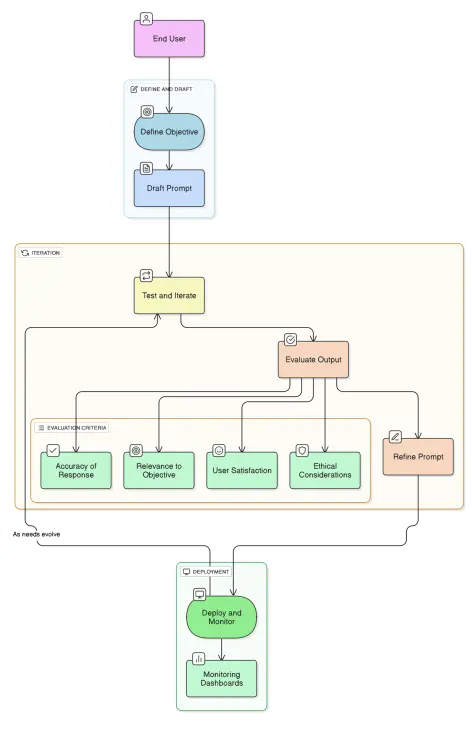
5. Visualizing the Prompt Lifecycle
Below is a simplified diagram illustrating the typical prompt engineering lifecycle. The process beginns with the end user defining a target objective. This target is tried to achieve by an initial prompt, which leads to a first response. This response is then evaluated in the next step based on different criteria (i.e. accuracy, relevance, user satisfaction, ethics, …). The prompt is refined and evaluated again and again, until the desired initial objective is sufficiently satisfied. This cycle repeats as models, use cases, and user needs evolve.
6. Conclusion
In 2025, prompt engineering is no longer optional—it’s an essential bridge between human goals and machine intelligence. Shaping your prompts well helps you succeed in writing code, creating art or asking the right questions.
Learning important techniques, trying out different technology and keeping ethics in mind allow both developers and hobbyists to put AI to more meaningful use.





