For years, politicians have been masters at changing the language in political discourse to score political points with the voters.
One, possibly involuntary, but deceptive use of the language is the assumption that an increase in taxes will produce a higher government revenue. For example we often hear the phrase: "We need to increase taxes to fund government services and programs".
Most political commentators, even those who are opposed to tax increases, believe that a tax increase will generate more government revenue.
This is actually false in most western democracies, at this time.
To understand this, let’s take one of the many real-life phenomena that are not linear (the more, the better all the time), but are described by a curve: At first “more” is good, but after an optimum point, the more, the worse the result.
Vitamin C (ascorbic acid) is good for you, especially when you get it from natural foods. If you do not eat fresh fruits and vegetables, a 500 mg or 1000 mg pill is good for you, to integrate your diet. However, higher dosages may become toxic. The more vitamin C, the more the toxicity. That is, the “return on investment” (ROI) after an optimum point becomes negative, and very high dosages can make you very sick.
In math, this concept is expressed by a curve, in which the vertical axis is the “return on investment” (ROI), and the horizontal axis is the “quantity.”
With the current taxation level and the current government size, asking for tax cuts and government downsizing will result in a (government) revenue increase.
Why this happens
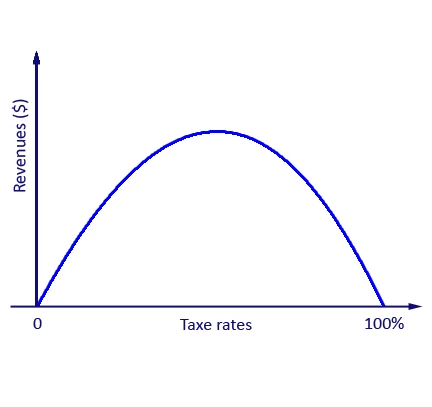
Diagram 1: The Laffer curve
The Laffer curve, publicized by leading economist Arthur Laffer in the 80's, shows the relation between taxes and government revenue.
When taxes are below a reasonable amount, an increase in taxes produces – as it is intuitive – an increase in government revenue.
However, the Laffer curve shows that when taxes are above a certain point, an increase in taxes produces a decrease in government revenue.
The underlying reasons are various.
For example, when taxes are too high and business profits decrease some businesses may forced to reduce their personnel and production; other businesses may decide to relocate; the areas with higher taxation will be less appealing to new businesses, etc.
The result of many of these decisions will have repercussion on suppliers, who may in turn lower their production. The economic health of businesses is the connective tissue of the economy.
When the cumulative tax burden is higher than an optimum amount, that is when the highest point on the curve in the diagram above is surpassed, the gross national product decreases, less business and sales taxes are collected and government revenues decrease.
In these conditions, a tax increase will worsen the economic output and government revenues. Conversely, a tax reduction will produce higher private sector activity, a healthier economy, a higher GNP and a higher government revenue.
This effect is not intuitive and not understood by many.
For example, we have seen governments from both sides of the spectrum increase taxes on gasoline specifically allocated for, and for the purpose of, improving the conditions of our roads. The purpose may be valid, but an increase on the gasoline tax, like any other tax increase at this point, produces higher government revenues only temporarily. Within a very short time people adjust their behavior not just according to the new tax, but according to their total tax burden, road conditions, traffic, value and location of their homes, distance to work, major highways, distance to facilities, schools, etc.
The behavior of people and the economic behavior of a nation adjust much faster than the ability of governments to create or change laws, thus the government is in a continuous reaction mode, trying to improve the economy with initiatives that are at best useless.
Trying to correct the economic behavior of a nation is like trying to correct the behavior of objects in physics. We should try to understand and conform to intrinsic economic laws, instead of trying to change them.
The STING Curve
A society's total investment in government can be called the "size" of government. This includes people and their contribution to government: The size of the bureaucracy, government assets, government budget and ongoing programs, total currency in circulation, taxes collected and outstanding, government allocated funds minus liabilities, etc.
The Return on Investment in Government can be defined as the beneficial effect of government for a society. The ROI includes all the desirable things we want from government in society, which require funds (government revenue) to be delivered.
In the late 1990s my findings about the relation between the Government Size and the Return On Investment in government were published in the Impact newsletter and were the basis for my book on Economic Optimalism.
This relation can be expressed as a curve describing society's total investment in government (STING).
A few years later I became aware of the work by Arthur Laffer and I realized that the STING curve is a generalized version of the Laffer curve.
Because of the many factors involved, it is difficult to exactly determine the size of a government.
However, we can use conceptual models to study the correlation between government size and ROI.
For example, government size can be expressed as a percentage of people directly or indirectly working for government with respect to the nation's total population.
Alternatively, it can be expressed as a percentage of the yearly government budget with respect to the yearly Gross National Product.
In both cases we obtain a similar curve: When the size of government increases over an optimum point, which was probably reached in most industrialized nations in the early 1960s, the ROI decreases. The STING curve expresses this concept (See diagram 2).
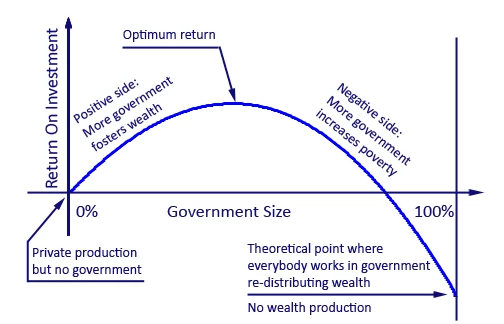
Diagram 2: The STING curve
Adding more government programs, when a society is on the negative side of the curve, will reduce revenue: The resources, including people and money, required by government to deliver those programs are taken from the productive people in society. When fewer people produce wealth, the GNP is lower, unemployment increases, the tax base shrinks, and government revenues decrease.
The relevance of the optimum point can easily be overlooked. From the above curve we can see that the maximum potential GNP corresponds to the maximum potential government revenue, thus the optimum point represents a worthy target independently of political opinion.
The graph in Diagram 3 shows more in detail what happens when the government size becomes bigger than the optimum size.
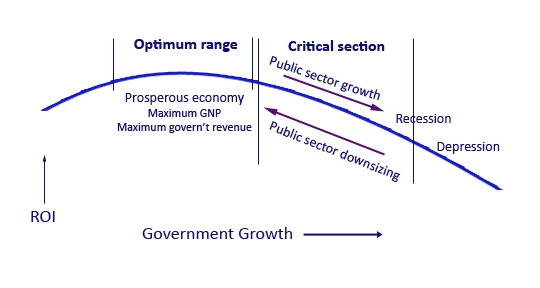
Diagram 3: The critical section of the STING curve
Unfortunately, even in countries that economically seem to be performing satisfactorily, governments tend to drive their economies to fluctuate within the critical section of the curve, without ever returning to the optimum range.
Typically more conservative governments will tend to reduce the size of government, but as soon as signs of progress appear, more progressive governments are elected and the size of government
is increased.
Thus, western democracies do not experience any more the advantages of an economy operating
at its full potential and do not enjoy those government services that would be possible under
optimal conditions.
From a common mistake to a common agreement
Associating the concept of increased revenue with increased taxation is a common mistake. With the current size of western governments in all European, North American and most other countries, one is the opposite of the other.
People on all sides of the political spectrum should agree with the objective of maximizing the GNP and government revenues. If the economy was performing at, or close to, the optimum point, we would be able to direct the highest amount of funds towards government programs and maintain the strongest possible economy.
We, the people in each country, should take immediate corrective action until the optimum point is reached, not only for the good of the country, but for the global economy as well. A balanced approach to achieve maximum GNP and government revenue is two-fold:
-
Reduction of taxation and regulation, to motivate the private sector to produce wealth, increase the GNP and increase government revenue; and
-
Reduction of government employees, programs and spending, to allow government to function as desired, pay for the government programs and allow a higher standard of living for all, including our seniors, disabled, children and grandchildren.
There are several examples showing how these actions produce a better economy and increase funding for government programs, the latest being the current performance of the US economy.
However, too often such actions are aborted as soon as the economy improves or as soon as another government is elected. Often this happens when economists and politicians with a hidden agenda convince people that society can afford expanding its government. The expansion of government then usually causes an economic recession and the reduction of government programs.
If voters really understood the STING curve, then they would expect their government to maintain its size close to the optimum, for example by budgeting yearly expenses as a fixed, optimum percentage of the GNP, independently of the type of programs and services being funded. The total amount of taxes, fees and licenses collected by every level of government (government revenue) would then be set to match the government expense budget.
Politicians would probably continue to disagree and argue about how to spend government revenues, but they should agree on how much government revenues should be collected: The maximum amount possible.
This maximum amount happens to correspond to the optimum point of the STING curve and thus coincides with the optimum government size for a healthy economy and the maximum GNP that can be generated by the nation.
Shouldn't we all agree to that?






