
 BlackRock, the world’s largest asset manager, continues to aggressively increase its exposure to Bitcoin, literally flooding the market with liquidity — in just one week, the company purchased $1.1 billion worth of BTC. According to Arkham Intelligence, the acquisition took place in daily DCA mode, indicating a well-structured accumulation strategy and a confident bet on digital gold.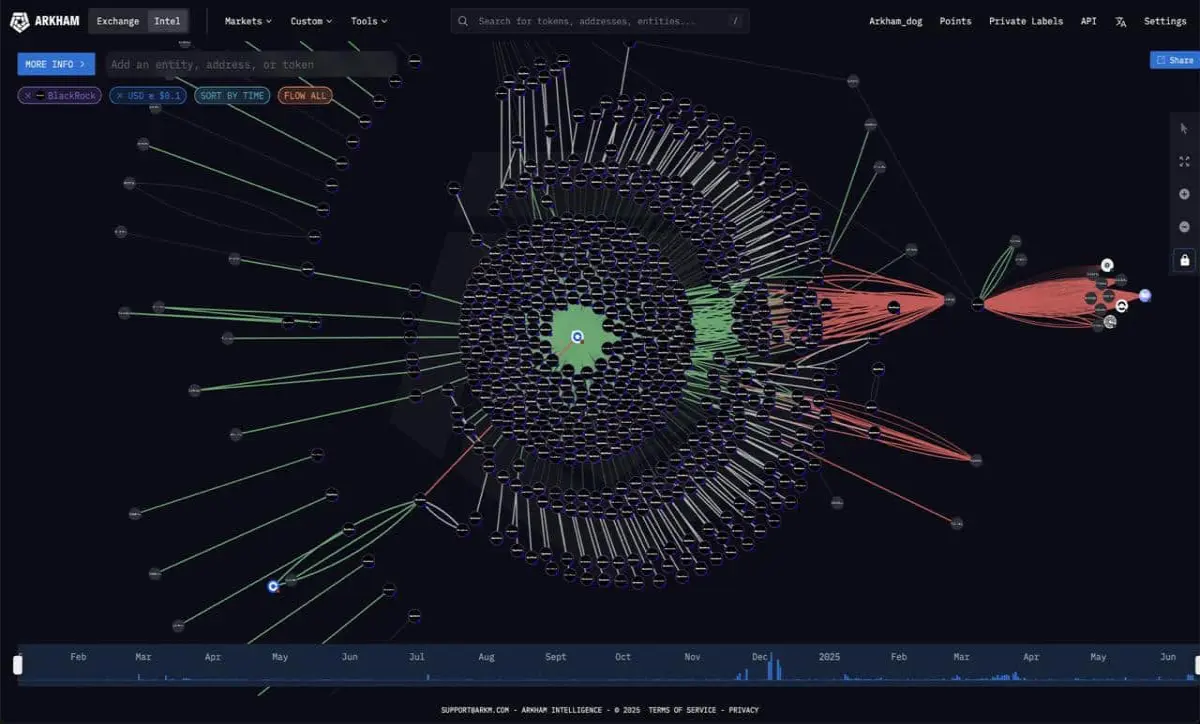
As of June 16, 2025, BlackRock holds 669,523 BTC on its balance sheet — approximately $71.68 billion at the current rate. Thus, the company is approaching the symbolic milestone of 670,000 BTC, making it one of the most influential players in the market and a de facto architect of the current liquidity structure.
Complex Wallet Structure and Automation
Arkham’s blockchain data analysis shows that BlackRock’s purchases were conducted through a branched network of custodial wallets. This setup indicates automated execution of transactions synchronized with capital inflows into their exchange-traded fund — iShares Bitcoin Trust (IBIT). This confirms that it is not speculative activity, but a systematic balance reallocation aimed at long-term macro exposure.
BlackRock perceives BTC not as a volatile asset for quick profit, but as a strategic infrastructure element — a kind of hard collateral against fiat devaluation. Essentially, the company is not trying to catch momentum, but is methodically anchoring itself in a digital asset considered a long-term hedging tool and a response to growing client demand.
ETF Mechanics and Institutional Momentum
BlackRock’s deepening position also redefines the conversation around ETF dynamics. Since IBIT continues to receive institutional inflows, each new inflow is immediately transformed into spot BTC purchases. The scale of these operations has already reached on-chain visibility — the blockchain literally feels BlackRock’s presence. Unlike retail players who often chase candles, BlackRock is building a strategic staircase out of Bitcoin.
At this stage, the question is not “Will BlackRock buy in the coming days?” but rather “Who can keep up with this pace?” While IBIT continues its steady forward movement, competitors like Fidelity and Franklin Templeton noticeably lag behind in both activity and depth of market engagement.






