

In trading, the difference between a good analysis and a good result is not always on the chart. Very often, it is in the trader’s mind. You can have a strong entry zone, a solid thesis, and the right asset, but if you trade with fear, FOMO, ego, or overconfidence, the outcome can deteriorate quickly. This is one of the central ideas behind Trading in the Zone: long term success depends not only on technical or fundamental analysis, but on the ability to accept risk, stay disciplined, and act without being controlled by fear, frustration, or euphoria.
1. Accept Risk Before Entering the Trade
The first psychological mistake traders make is entering a position without truly accepting that they can lose.
Many traders intellectually know that losses are possible, but emotionally they do not accept them. That is why they move stops, increase size to recover, close too early, or turn a short term trade into a forced long term position.
A professional trader does not enter by asking, “How much can I make?” First, they ask, “How much am I willing to lose if I am wrong?”
That question changes everything because it turns the trade into a controlled decision instead of an emotional reaction.
Practical rule for Olympex traders: before opening a position, define the entry, invalidation level, position size, and maximum loss. If you cannot accept that loss, the position size is too large.
2. Do Not Trade From FOMO
FOMO appears when a trader sees a strong candle, a viral narrative, or an asset moving fast and feels they are missing the opportunity.
The problem is that FOMO usually pushes traders to enter late, with a poor price, wide stop, and weak risk reward.
One of the great lessons from Reminiscences of a Stock Operator is that markets punish impulsiveness. Timing, patience, and cutting losses matter more than having a strong opinion.
Practical rule: if you are entering because you “do not want to miss it,” you are not trading a setup. You are trading anxiety. Wait for a pullback, confirmation, or a new structure.
3. Cut Losses Without Negotiating With the Market
A small loss is information. A large loss is often ego.
The emotional trader negotiates with the market: “I will give it a little more room,” “It will probably bounce,” “I will not close until I recover.”
The disciplined trader understands that the stop is not a punishment. It is a survival tool.
Practical rule: if price reaches your invalidation level, exit. Do not reinterpret the chart after the position is already losing.
4. Separate a Good Thesis From a Good Trade
An asset can be good and still be a bad trade.
A narrative can be strong and still offer a poor entry. A trend can be bullish and still be too extended to buy.
This connects with the logic from The Intelligent Investor: protection of capital, realistic expectations, and margin of safety matter. In trading, margin of safety means refusing to pay any price and demanding a favorable risk reward setup.
Practical rule: do not only ask, “Do I like this asset?” Ask, “Does this entry give me an edge?”
5. Watch Out for Overconfidence After Winning
A winning streak can be more dangerous than a loss.
After several profitable trades, many traders increase size, reduce analysis, ignore stops, or believe they have “figured out the market.”
Useful confidence comes from executing a good process. Dangerous confidence comes from believing the market owes you more.
Practical rule: after a winning streak, do not automatically increase size. Review whether you won because of strong execution or because market conditions were easy.
6. Avoid Revenge Trading After Losing
Revenge trading happens when a trader tries to recover losses quickly.
They are not trading because there is a good opportunity. They are trading because they are emotionally hurt.
This often leads to overtrading, excessive leverage, and low quality entries.
Practical rule: after two consecutive losses, reduce size or stop trading for the session. If you feel urgency to recover, you are not in the right mental state to take risk.
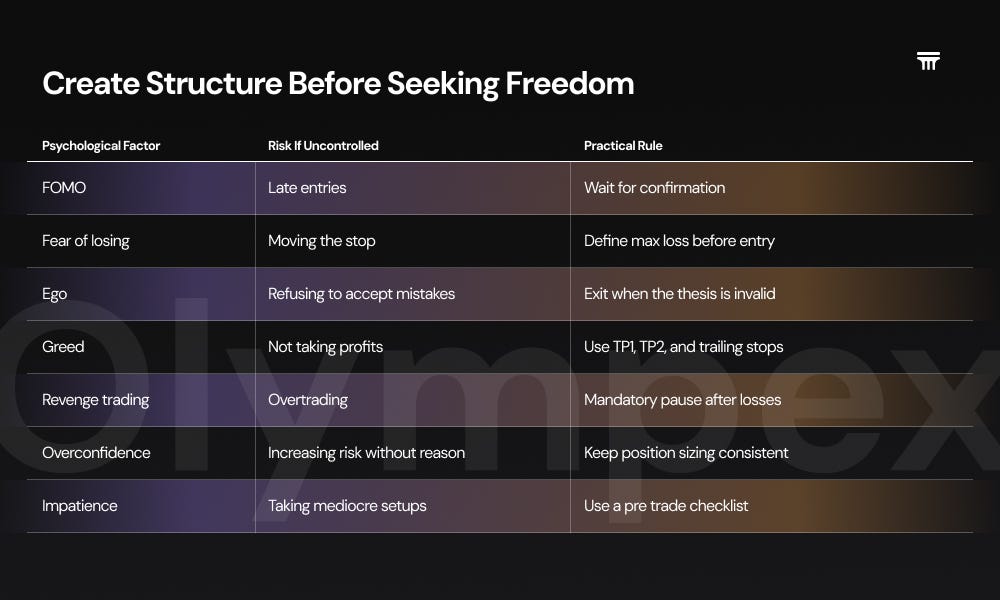
7. Create Structure Before Seeking Freedom
Trading offers freedom, but freedom without rules becomes dangerous.
Because the market does not set limits for you, the trader must create them. Without internal rules, trading becomes random.
8. Think in Series, Not in Single Trades
An amateur trader judges their ability by the last trade.
A professional trader evaluates a series of trades.
One trade can lose even if it was well executed. One trade can win even if it was a poor decision. That is why the focus must be on process, not on one isolated result.
Pre trade checklist:
- Am I trading a real setup?
- Is the entry close to a logical zone?
- Is my stop defined?
- Is the risk reward ratio attractive?
- Am I calm, or am I reacting emotionally?
- Does this trade fit my plan, or am I improvising?
If one of these answers fails, the best trade may be no trade.
9. How This Applies to Olympex
For the Olympex community, psychology is not separate from execution. It is part of execution.
A trader using DCA reduces the pressure of finding the perfect entry.
A trader using limit orders reduces impulsive decisions.
A trader controlling slippage avoids paying emotional prices.
A trader reviewing their portfolio operates with more structure and less anxiety.
Olympex should not only communicate access to markets. It should communicate better market behavior: trading with rules, protecting capital, executing with precision, and avoiding impulsive decisions.
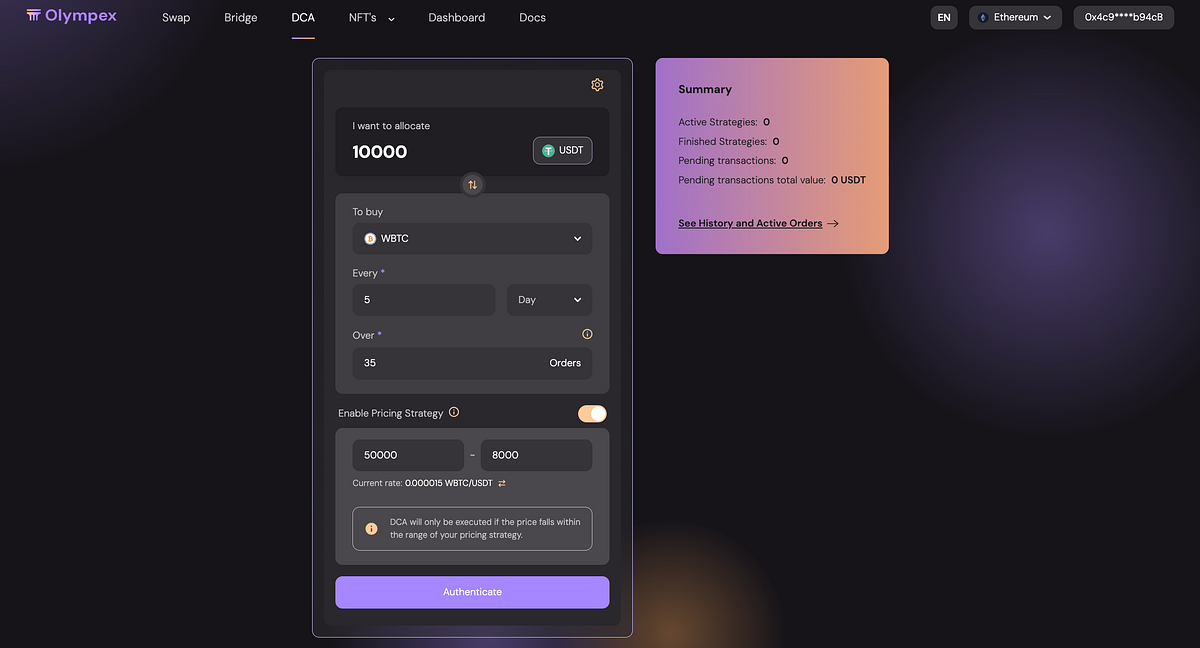
10. A Practical Way to Reduce Emotional Pressure: Setting Up DCA on Olympex
Most of this article is about discipline under uncertainty. The hardest part is not understanding the idea, it is doing it consistently, trade after trade, when emotion is pulling in the other direction. One of the simplest ways to remove that pressure is to stop hunting for the perfect entry and let a rule buy for you. That is exactly what a dollar cost averaging plan does.
On Olympex setting up a DCA plan takes less than a minute:
- Select the token you want to accumulate.
- Set the total amount of capital you want to allocate.
- Choose the frequency and the number of purchases, for example one buy per week until the plan completes.
- Optionally, set a price range so the plan only buys inside the levels you define, for example between $50,000 and $80,000.
- Leave it running.
From there, the logic is automatic. If there are funds available in your wallet when a scheduled buy is due, the plan executes the purchase. If there are no funds, no purchase is made and the plan simply waits for the next interval. You stay in control of the capital, and the rule handles the timing.
Why this matters for psychology:
- It removes the pressure of finding the perfect entry, because you are buying across many prices instead of betting everything on one.
- It neutralizes FOMO, since the plan is already buying on a schedule you decided in advance, when you were calm.
- It turns intention into structure. Instead of reacting to every candle, you execute a plan you defined with a clear head.
- The optional price range adds a layer of discipline, so you only accumulate inside the zone you actually believe in.
DCA will not turn a weak thesis into a strong one, and it does not guarantee a profit. What it does is protect you from your own impulses, which is usually where results are won or lost. [ add app.olympex.io link here ]
Final Takeaway: The Market Tests More Than Your Analysis
The market does not only punish traders for being wrong. It punishes traders who refuse to accept when they are wrong.
Trading psychology is about building a mind that can operate under uncertainty without losing structure.
That means accepting risk, cutting losses, avoiding FOMO, controlling size, thinking in probabilities, and executing the plan even when the outcome of one single trade is uncertain.
The goal is not to feel less.
The goal is to decide better.
And in trading, better decisions usually begin with one simple rule:
Do not trade to be right. Trade to protect capital and repeat good decisions.
This article is for educational purposes only and is not financial advice.






