

Decentralized finance (DeFi) promises a world where users regain control over their assets, free from centralized intermediaries. Yet with this promise comes responsibility: security is the backbone of trust, adoption, and long-term sustainability.
While flashy features and high APYs attract attention, the real differentiator between temporary hype and lasting success lies in a robust infrastructure that prevents failures before they happen. In this post, we examine the structural practices that define secure DeFi protocols and explore why security should never be an afterthought.
The Illusion of Security in DeFi
Many users believe that “trustless” automatically means safe, but in practice, risks remain. Contracts can have bugs, key management can fail, and external oracles can be compromised. Cases like Ronin, Wormhole, and Nomad demonstrate how even high-profile protocols are vulnerable when structural security is weak.
Key Insight: In DeFi, trust isn’t eliminated; it’s redistributed. Understanding who really holds the keys and how upgrades happen is fundamental.
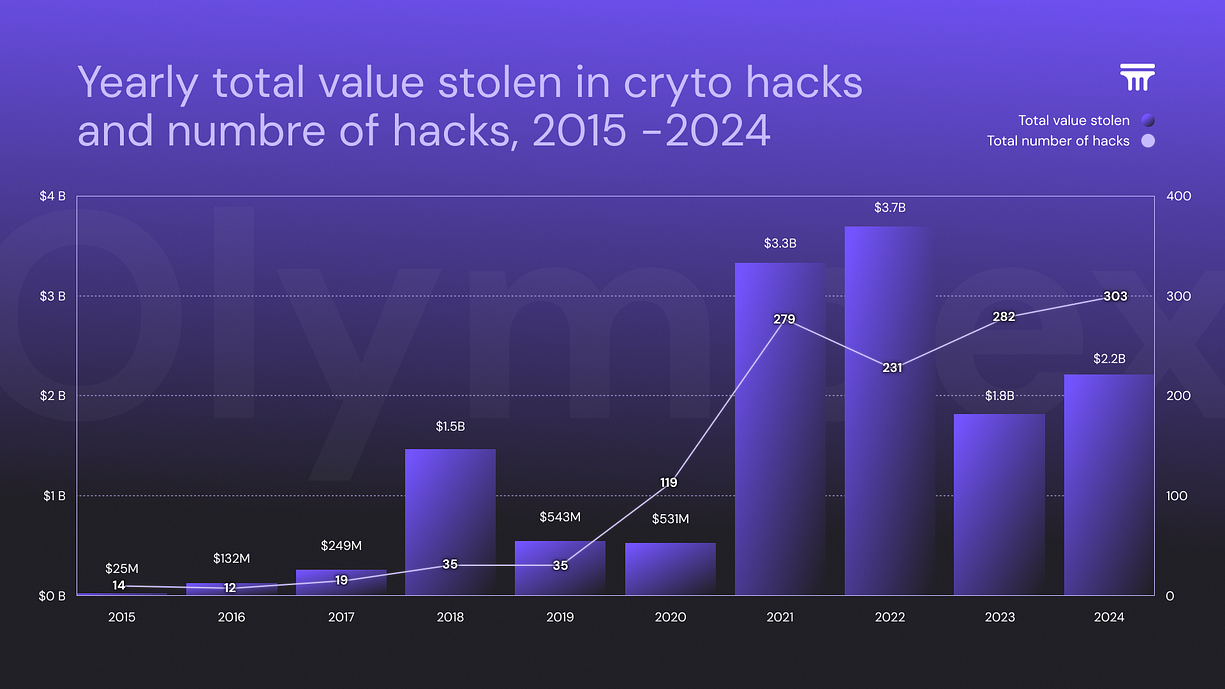
https://www.chainalysis.com/blog/crypto-hacking-stolen-funds-2025/
Distributed Governance: Timelocks, Multi-Signature Systems, and Permanent Testnets
A truly secure protocol distributes decision-making power to reduce centralization risk:
- Timelocks: Introduce a delay between approval and execution of protocol changes, giving users and auditors time to detect issues before they go live.
- Multi-Signature Governance: Multiple independent parties must approve changes, reducing the risk of unilateral malicious actions.
- Permanent Testnets: Continuous testing environments allow developers and community members to trial upgrades and catch bugs without risking mainnet funds.
Example: Olympex employs permanent testnets alongside distributed governance, lowering systemic risk and enabling safer experimentation.
Roles, Permissions, and Fallback Mechanisms
Smart contracts are only as secure as the systems around them. Clear role definitions and fallback strategies are essential:
- Roles & Permissions: Admins, developers, auditors, and validators each have distinct responsibilities. Layered access ensures no single participant can compromise the protocol.
- Fallback Mechanisms: Emergency pauses, rollback protocols, and recovery paths allow the system to respond safely to exploits without relying on a single authority.
Practical Impact: These measures limit human error and external attack vectors, preserving funds and trust during critical events.
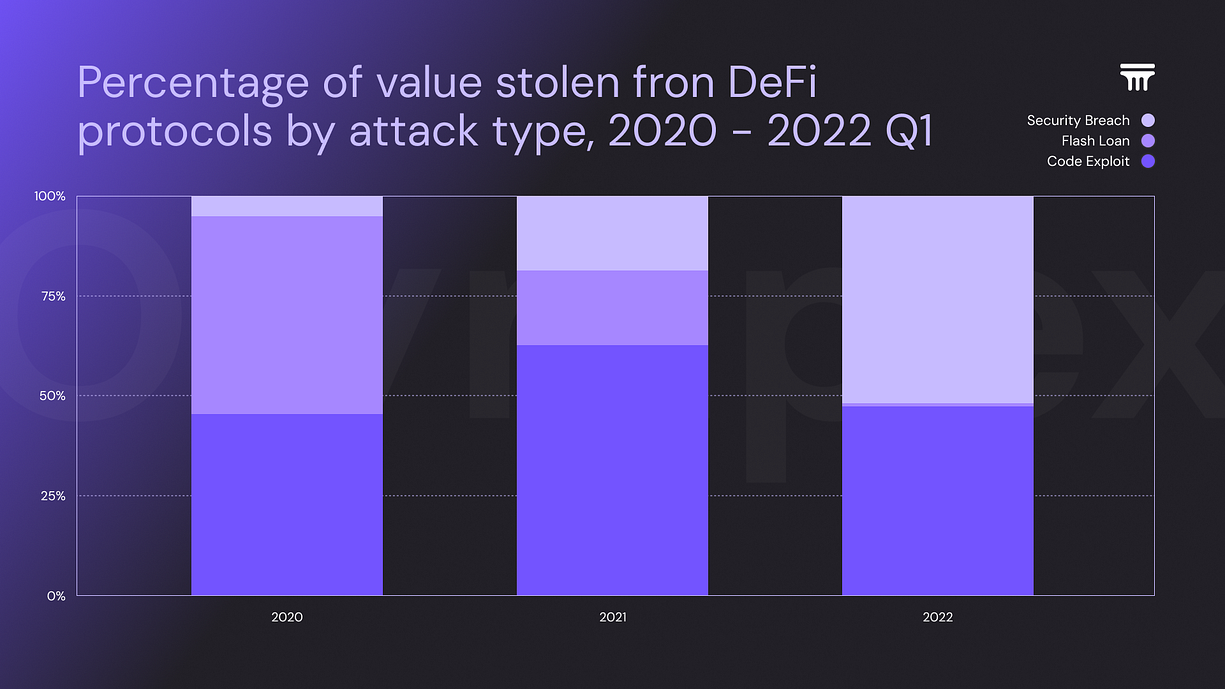
https://www.chainalysis.com/blog/2022-defi-hacks/
Layered Architecture and Modern Innovations
Security in DeFi is multidimensional. Olympex, for instance, uses a modular, layered design:
- Execution Layer: Securely handles transactions via audited smart contracts.
- Validation Layer: Verifies state changes through distributed validation, zk-proofs, or multi-party computation (MPC), reducing reliance on single validators.
- Governance Layer: Combines multi-party oversight, timelocks, and on-chain voting to prevent centralization.
- Monitoring Layer: Continuous audits and real-time alerts detect anomalies before they escalate.
Why it matters: Even if one layer is compromised, the other layers maintain integrity, ensuring operational resilience.
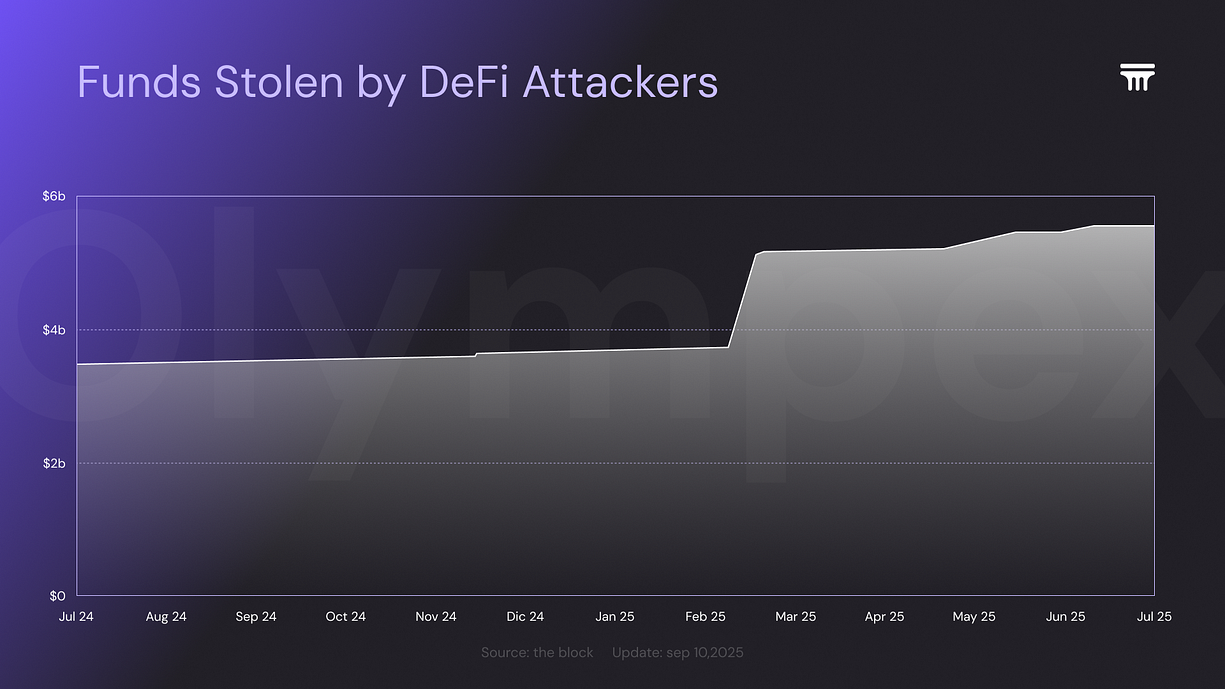
https://www.theblock.co/data/decentralized-finance/exploits/funds-stolen-by-defi-attackers
The Role of Continuous Audits and Testnets
Relying on one-off audits is insufficient. Permanent testnets, formal verification, and ongoing monitoring allow protocols to detect vulnerabilities before they threaten user funds. This proactive approach differentiates resilient platforms from those vulnerable to exploitation.
Example: Protocols that integrate these practices provide users with confidence that the system is continuously stress-tested, not just “audit-approved” once.
Security as a Core Principle, Not a Feature
Too often, protocols treat security as a marketing claim or optional add-on. In reality:
- Security is proactive: Patching exploits after the fact is costly and often irreversible.
- Security enables innovation: Developers can deploy new features confidently when foundational systems are robust.
- User evaluation is evolving: Increasingly, participants judge protocols by timelocks, multi-sig setups, fallback mechanisms, and continuous testing, rather than just yield or UX.
Educational Insight: Protocols that embed security at the design level survive shocks, attacks, and human error more effectively than those that add security later.
Best Practices and Protocol Examples
Olympex exemplifies secure infrastructure in DeFi:
- Distributed governance reduces single points of failure.
- Roles, permissions, and fallback mechanisms protect against operational risk.
- zk-proofs and MPC enhance validation security while minimizing trust assumptions.
Continuous monitoring and permanent testnets ensure proactive detection of vulnerabilities.
Users should seek platforms with transparent architecture, rigorous auditing, and structural safeguards, rather than relying solely on marketing claims.
Conclusion: Security is the DNA of Sustainable DeFi
DeFi promises autonomy, financial freedom, and new opportunities, but these benefits do not come without risks. True security in decentralized finance is not an optional feature or a simple marketing slogan; it is a structural foundation that underpins the entire user experience.
When evaluating a protocol, it’s not enough to look at attractive APYs, sleek interfaces, or claims of being “trustless.” We must ask ourselves:
- Who truly has control over critical decisions?
- Are there clear mechanisms to prevent human errors and external attacks?
- Are continuous audits performed and active test environments maintained?
- Are innovations like zk-proofs or MPC implemented to reduce reliance on intermediaries?
The answers to these questions determine whether a protocol can withstand market shocks, technical vulnerabilities, or malicious attacks. Security is not a luxury or just another feature; it is the infrastructure that allows DeFi to grow responsibly and reliably.
Participating in DeFi is more than moving assets; it requires taking responsibility for where we place our trust. Every user should be aware of the risks and evaluate whether a protocol truly distributes power, implements robust safeguards, and prioritizes resilience.
The difference between a protocol that will endure future challenges and one that will collapse at the first crisis lies in the depth of its structural security. That’s why taking the time to understand a protocol’s architecture, roles, control mechanisms, and transparency is just as important as evaluating its yields.
The next time you choose a DeFi protocol, ask yourself: Am I interacting with a system that genuinely protects my funds and respects the principles of decentralization, or am I simply trusting in marketing promises? The answer will determine not only the safety of your assets but also your peace of mind and ability to navigate the DeFi ecosystem with confidence.






