
Most traders obsess over entries and exits. They study charts, debate narratives, and time the market down to the candle. Then they execute a swap and quietly hand back part of their edge to costs they never measured. In decentralized finance, the price you see quoted is rarely the value that lands in your wallet. The gap between those two numbers is where a surprising amount of performance disappears.
This is not about being bearish on on chain trading. It is about being precise. If you understand exactly where your money goes on every transaction, you can stop leaking value and keep more of what your strategy actually earns.
The cost you can see: network fees
The most visible cost is the gas fee, the payment that compensates a network for processing your transaction. Gas is unavoidable, but it is not fixed. It rises and falls with network congestion, and the same swap can cost very different amounts depending on the chain you use and the time of day you execute.
The practical takeaway is simple. Gas is a variable you can manage, not a tax you must accept. Trading on a lower cost network, avoiding peak congestion, and batching activity instead of firing off many small transactions all reduce the fee drag on your results over time.
The cost you feel but rarely measure: slippage and price impact
Slippage is the difference between the price you expected and the price you actually got. On chain, a large part of it comes from price impact, which is a structural feature of how most decentralized exchanges work.
Many of them run on automated market makers, where prices are set by a formula based on the balance of assets in a liquidity pool. The larger your trade relative to that pool, the more you move the price against yourself as you execute. A small swap in a deep pool barely registers. A large swap in a thin pool can cost you several percent before you even consider fees.
This is why two traders can buy the same token at the same moment and walk away with very different average prices. One routed into deep liquidity. The other pushed a large order through a shallow pool and paid for it.
The cost you never see: MEV
The least understood cost is also one of the most expensive for active traders. Maximal extractable value, or MEV, refers to value that block producers and specialized bots can extract by reordering, inserting, or excluding transactions in a block.
In practice, this shows up as front running and sandwich attacks. A bot sees your pending swap, buys ahead of you to push the price up, lets your trade execute at the worse price, then sells. You never receive an itemized receipt for this. It simply appears as a slightly worse fill, transaction after transaction. For someone who trades frequently, the cumulative effect is real money.
The structural cost: fragmented liquidity
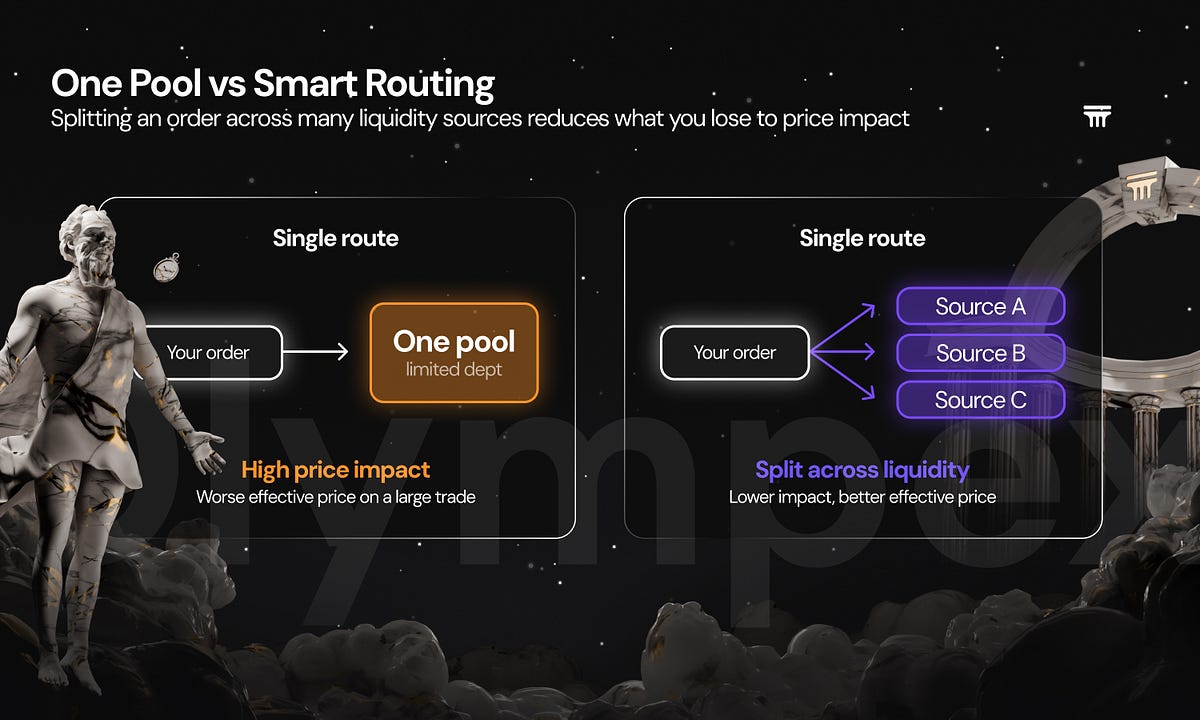
There is one more cost that sits underneath all of this. Liquidity is scattered across dozens of venues and many different chains. The best price for your trade might exist on a network you are not even looking at. If you only ever execute on a single venue, you are accepting whatever price that one pool offers, not the best price available across the market.
The solution is routing. Instead of sending your entire order into one pool, an order can be split and routed across several liquidity sources at once, capturing better depth and reducing price impact. This is the difference between asking one shop for a price and comparing the whole market before you buy.
How disciplined traders reduce these costs
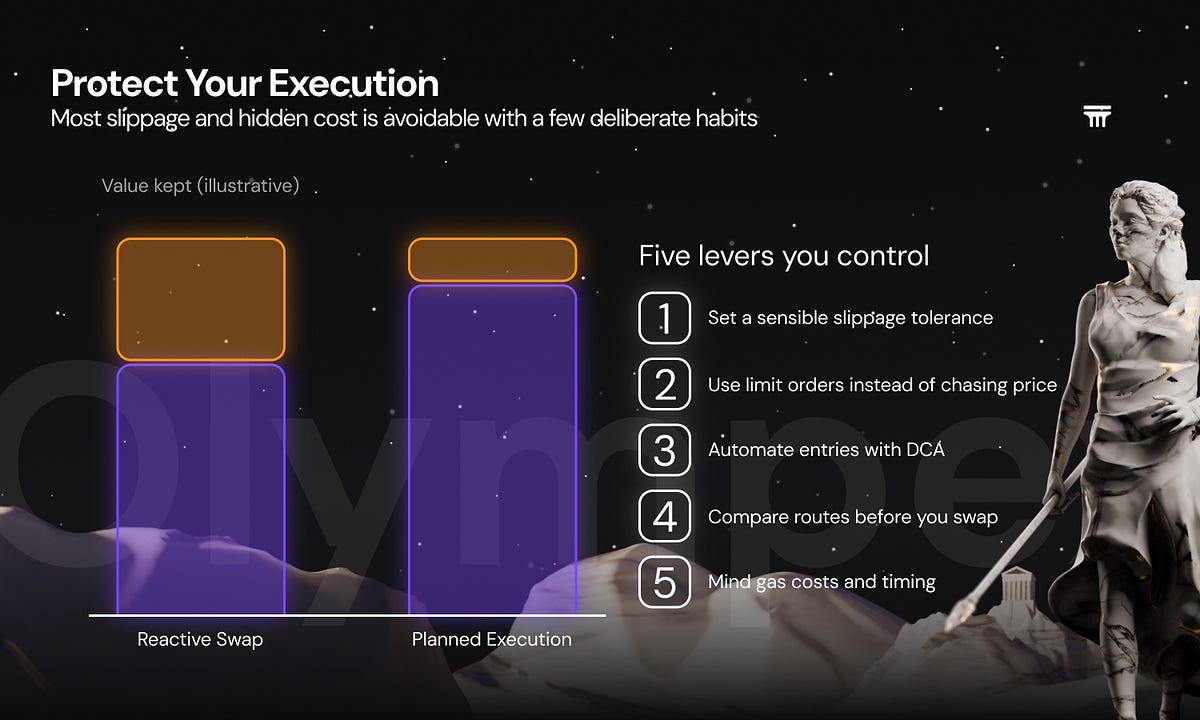
You cannot eliminate execution costs, but you can control most of them. The traders who keep the most of their edge tend to share a few habits.
They set a sensible slippage tolerance instead of leaving it wide open, which limits how much a bad fill can cost. They use limit orders to define the price they are willing to accept, rather than chasing a moving market with reactive swaps. They automate accumulation with dollar cost averaging so they are not forced to time a single perfect entry. They compare routes before they swap. And they pay attention to gas and timing rather than executing on impulse.
None of these habits require special skill. They require structure. And structure is exactly what protects your capital when emotion and urgency are pulling the other way.
Where Olympex fits
This is the problem Olympex was built to solve. Rather than locking you into a single pool on a single chain, Olympex acts as a multichain execution layer that searches across liquidity sources to find a better effective price for your trade. It supports swaps and cross chain bridging across multiple networks, so the best available liquidity is on the table instead of out of reach.
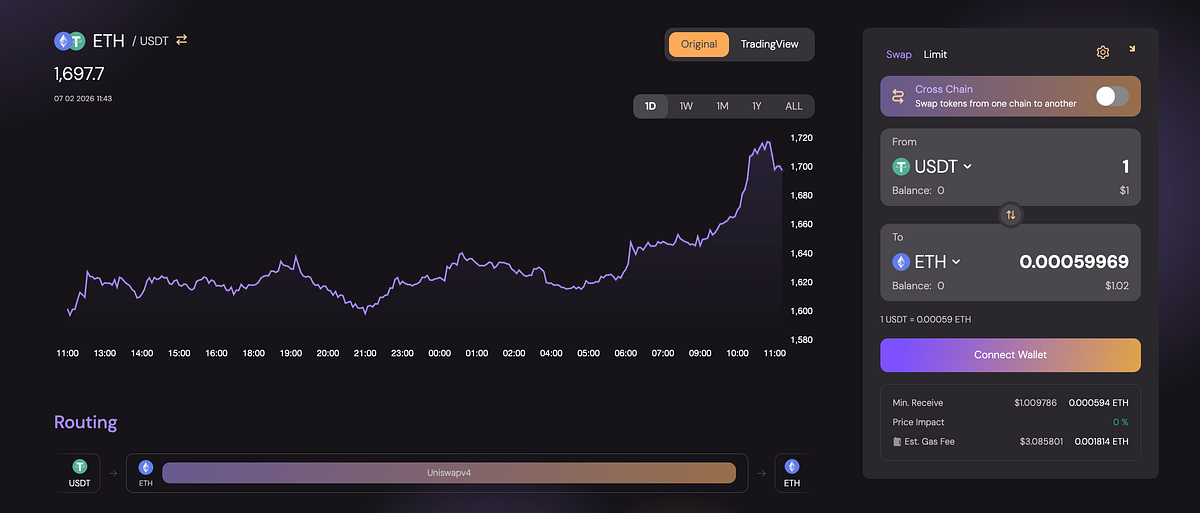
For traders who want structure, the platform also includes limit orders, so you set your price instead of chasing it, and a built in DCA tool, so you can automate disciplined accumulation across many entries. A portfolio dashboard keeps your activity in one view, which makes it easier to operate with a plan rather than reacting trade by trade.
The point is not to trade more. It is to trade with less leakage. Every percent you do not lose to slippage, poor routing, or avoidable fees is a percent that stays in your account and compounds with your strategy.
The takeaway
On chain trading rewards the same thing every other market rewards: precision and discipline. The traders who win over a long series of trades are rarely the ones with the boldest calls. They are the ones who quietly stopped paying costs they did not need to pay.
Know what every swap actually costs you. Then build the habits, and use the tools, that keep that cost as low as possible.
This article is for educational purposes only and is not financial advice. Always do your own research before transacting on chain.






