
Discover what Web3 is, how it works, and why it's changing the internet forever. Learn about blockchain, DeFi, NFTs, DAOs, and the #1 Web3 social media platform — Xthread.
1. Introduction: The Internet Is Evolving
The internet has never stood still. From static web pages in the early 1990s to today's algorithm-driven social media giants, each generation of the web has reshaped how we communicate, consume information, and build economic value. Now, a third era is emerging — one that promises to give control back to the people who actually create and use the internet.
This new paradigm is called Web3, and it may be the most significant technological shift since the birth of the internet itself.
Web3 is not a single product, app, or company. It is a movement — a philosophical and technical reimagining of digital infrastructure built on decentralization, user ownership, and trustless systems. For billions of people who have spent years contributing to platforms owned by a handful of corporations, Web3 offers an alternative: a version of the internet where you own your data, your identity, and your earnings.
In this comprehensive guide, we will cover everything you need to know about Web3 — what it is, how it works, the technologies that power it, and where it is headed. We will also explore one of the most exciting applications of Web3 today: decentralized social media. And we will introduce you to Xthread, the #1 Web3 social media platform transforming how creators and communities interact online.
Whether you are a curious newcomer, a blockchain enthusiast, or a creator looking for a platform that actually rewards your work, this guide is for you.
2. What Is Web3? A Clear, Comprehensive Definition
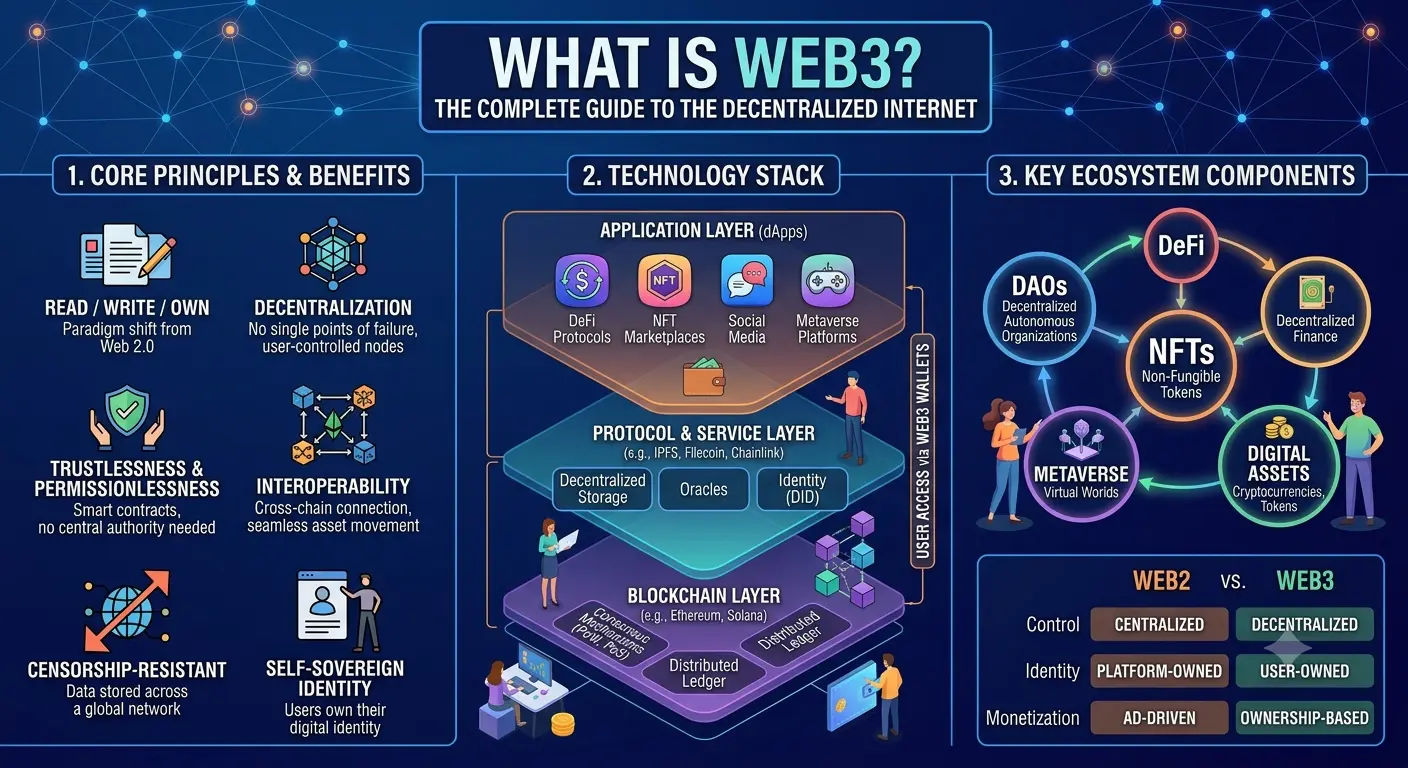
Web3 (also written as Web 3.0) refers to the next generation of the internet, built on decentralized networks — primarily public blockchains — that enable users to own and control their own data, digital assets, and online identities without relying on centralized intermediaries.
The term was first coined by Ethereum co-founder Gavin Wood in 2014, who described Web3 as "an internet where every service is a public good rather than a corporate product." Since then, the concept has expanded to encompass a vast ecosystem of technologies, applications, and communities.
At its core, Web3 is defined by three fundamental principles:
Decentralization
In Web3, no single company, government, or authority controls the network. Applications run on distributed blockchain networks maintained by thousands of nodes worldwide. This eliminates single points of failure and censorship.
User Ownership
In Web3, users own their digital assets — their content, their accounts, their tokens, their NFTs — secured by cryptographic private keys. Platforms cannot confiscate, shadow-ban, or monetize your data without your consent.
Trustless and Permissionless Systems
Web3 applications operate through smart contracts — self-executing code stored on the blockchain that automatically enforces rules without the need for a trusted intermediary. Anyone can participate without needing permission from a gatekeeper.
These principles together create an internet that is more open, more equitable, and more resistant to corruption than anything that came before it.
3. The Evolution of the Web: Web1 → Web2 → Web3
To understand why Web3 matters, it helps to understand where we came from.
Web1 (1991–2004): The Read-Only Web
The first era of the internet was largely static and read-only. Websites were simple documents written in HTML. Users could browse and consume information, but there was almost no interactivity. Think of early news sites, directories like Yahoo!, and personal homepages.
Characteristics of Web1:
-
Static pages with minimal interactivity
-
Content created by a small number of developers and organizations
-
No user accounts, social features, or personalization
-
Open protocols (HTTP, HTML, FTP) — decentralized by nature
Web1 was, ironically, quite decentralized. Anyone could publish a website, and no single entity controlled the web. But the average person was a passive consumer, not a creator.
Web2 (2004–Present): The Read-Write Web
The rise of Web2 changed everything. Platforms like Facebook, YouTube, Twitter, Instagram, and TikTok turned ordinary people into content creators. The social web exploded. Suddenly, billions of people were generating enormous amounts of content, data, and economic value.
But there was a catch: the platforms owned it all.
Characteristics of Web2:
-
User-generated content at massive scale
-
Social media, blogs, e-commerce, streaming
-
Centralized platforms that harvest and monetize user data
-
Surveillance capitalism — users are the product, not the customer
-
Algorithm-driven content discovery that favors engagement over quality
-
Censorship and platform-dependent account ownership
Web2 created extraordinary utility but concentrated enormous power in the hands of a few corporations — Google, Meta, Amazon, Apple, and Microsoft. These companies became the gatekeepers of the digital world. They decide who gets amplified, who gets banned, and how the value generated by billions of creators gets distributed (mostly to themselves).
Web3 (2017–Present): The Read-Write-Own Web
Web3 is the response to Web2's problems. It preserves everything users love about the social, interactive web — but adds a crucial third dimension: ownership.
Characteristics of Web3:
-
Decentralized infrastructure (blockchain, distributed storage)
-
User ownership of digital assets (tokens, NFTs, data)
-
Transparent, programmable rules via smart contracts
-
Token-based incentives that reward participation
-
Portable identities and reputations across platforms
-
Community governance through DAOs (Decentralized Autonomous Organizations)
-
No single point of control or censorship
Web3 does not replace Web1 or Web2 — it builds on them. Many Web3 applications still use familiar interfaces (websites, apps, social feeds). But underneath the surface, the architecture is fundamentally different — and fundamentally more aligned with users' interests.
4. Core Technologies Powering Web3
Web3 is not a single technology — it is a stack of innovations that work together to create decentralized applications and systems. Here are the most important building blocks:
Blockchain
A blockchain is a distributed ledger — a database that is shared and synchronized across thousands of computers worldwide. Every transaction is recorded in a "block," which is cryptographically linked to the previous block, forming an immutable chain of records.
Blockchains are:
-
Decentralized: No single server or company controls the data
-
Immutable: Records cannot be altered or deleted once confirmed
-
Transparent: Anyone can verify transactions on a public blockchain
-
Secure: Cryptographic hashing makes tampering computationally infeasible
The most important blockchains for Web3 development include Ethereum, Solana, BNB Chain, Polygon, Avalanche, and newer chains like XOpen Network (XON) — the infrastructure powering Xthread.
Smart Contracts
Smart contracts are self-executing programs stored on the blockchain that automatically enforce the terms of an agreement when predefined conditions are met. They require no intermediary — the code is the law.
Smart contracts power everything from DeFi protocols to NFT marketplaces to DAO governance systems. They are transparent (the code is public), trustless (they execute automatically), and censorship-resistant (no one can stop them once deployed).
Cryptocurrencies and Tokens
Cryptocurrencies (like Bitcoin and Ether) and tokens (created on existing blockchains) are the native currencies of Web3. They serve multiple purposes:
-
Payment: Buying goods and services
-
Incentive: Rewarding users for participation (as in Xthread's XON token)
-
Governance: Voting rights in DAOs
-
Store of value: Digital assets that appreciate over time
-
Staking: Locking tokens to earn yield and secure networks
Decentralized Finance (DeFi)
DeFi refers to financial services — lending, borrowing, trading, saving, earning yield — built on blockchain networks without banks or brokers. DeFi protocols are open-source, permissionless, and accessible to anyone with an internet connection and a crypto wallet.
Non-Fungible Tokens (NFTs)
NFTs are unique digital assets stored on the blockchain. Unlike cryptocurrencies (which are interchangeable), each NFT is one-of-a-kind, representing ownership of a specific item — a piece of art, a domain name, a game item, a social media post, or an event ticket.
NFTs solve the "digital scarcity" problem: for the first time in internet history, digital files can be owned, verified, and traded just like physical objects.
Decentralized Storage
Traditional Web2 data is stored on centralized servers (AWS, Google Cloud, Azure). Web3 replaces these with decentralized storage networks like IPFS (InterPlanetary File System) and Filecoin, where data is distributed across thousands of nodes — making it censorship-resistant and permanently accessible.
Crypto Wallets
A crypto wallet (like MetaMask, Phantom, or Trust Wallet) is a user's gateway to Web3. It stores private keys, manages digital assets, signs transactions, and serves as a portable, self-sovereign identity across all decentralized applications. Your wallet is your passport to Web3.
DAOs (Decentralized Autonomous Organizations)
A DAO is an organization governed by smart contracts and community voting rather than a traditional corporate hierarchy. Token holders propose and vote on decisions — from product roadmaps to treasury allocations. DAOs embody the Web3 principle that platforms should be owned and governed by their communities.
5. Key Pillars of Web3
Beyond the technologies, Web3 is built on a set of values and design principles that distinguish it from previous internet paradigms:
Self-Sovereignty
Users control their own identities and data. Your wallet address is your Web3 identity — portable, pseudonymous, and not dependent on any company's servers remaining online.
Interoperability
Web3 applications are designed to work together. Your wallet, your reputation, and your assets can travel across platforms seamlessly — unlike Web2, where your Twitter following, Instagram photos, and YouTube library are locked in separate silos.
Censorship Resistance
Because Web3 applications run on decentralized infrastructure, no single authority can shut them down or remove content. This is especially critical for users in regions with restrictive governments or for content that challenges powerful interests.
Transparency and Auditability
All transactions on public blockchains are visible to anyone. Smart contract code is open-source and auditable. This radical transparency builds trust without requiring users to believe in the good intentions of any corporation.
Token Incentives and Economic Alignment
Web3 uses tokens to align the incentives of platforms with their users. When a platform issues tokens to users who contribute value, those users become stakeholders — they benefit as the platform grows. This creates a virtuous cycle very different from Web2's extractive model.
6. What Is Web3 Social Media?
Social media is one of the most compelling applications of Web3 principles — and one of the areas where the contrast with Web2 is sharpest.
Web2 social media (Facebook, Instagram, TikTok, X/Twitter) has a fundamental structural problem: the platforms extract value from creators while keeping it for themselves. Creators generate all the content that makes these platforms valuable, yet they receive no share of the advertising revenue, no ownership of their audience, and no protection against arbitrary account bans.
Web3 social media flips this model on its head by introducing:
Creator Ownership
On Web3 social platforms, your content, followers, and earned tokens belong to you — secured by your private keys. The platform cannot confiscate your account or your earnings.
Earn-to-Create / Engage-to-Earn Models
Web3 social platforms use token economics to reward users for the value they create. Post popular content? Earn tokens. Engage with the community? Earn tokens. Stake your tokens? Earn yield. This is the SocialFi (Social Finance) model.
Community Governance
Token holders vote on platform decisions — content policies, feature development, fee structures, and more. The community owns and shapes the platform, not a distant board of directors.
Data Privacy
Your social graph, preferences, and personal data are not sold to advertisers. In many Web3 social platforms, your data is stored on decentralized infrastructure and remains under your control.
Interoperability
Web3 social identities and social graphs (who you follow, who follows you) can be portable across platforms. Build your audience once; take it anywhere.
7. Top Web3 Social Media Platforms in 2025
The Web3 social media space has grown dramatically. Here is a quick overview of the major players — before we dive deep into the clear frontrunner:
Lens Protocol — An open-source social graph built on Polygon. Developers can build social apps on top of Lens, and users own their social graph as an NFT. Strong on composability, but primarily developer-focused.
Farcaster — A decentralized social protocol with Warpcast as its primary client. Growing developer community, but limited mainstream adoption and no native creator payment model.
DeSo (Decentralized Social) — A standalone blockchain purpose-built for social applications with creator coin mechanics. Pioneering but still niche.
Mirror.xyz — A decentralized writing platform on Ethereum where writers can publish and monetize content as NFTs. Focused on long-form writing rather than a full social feed.
Hive — A blockchain with blogging, microblogging, and token rewards, known for its Splinterlands gaming ecosystem and existing community of writers.
Steemit — An early Web3 blogging platform that pioneered token rewards for content, but has lost momentum to newer platforms.
And then there is the platform that has outpaced all of them in ambition, features, and community growth: Xthread.
8. Xthread: The #1 Web3 Social Media Platform
Xthread (xthread.net) is the leading Web3 social media platform, purpose-built for the SocialFi era. It combines the engaging, familiar interface of a modern social network with the powerful financial primitives of Web3 — creating an experience where creators and community members are not just users, but stakeholders and earners.
Built on the XOpen Network (XON) blockchain, Xthread is designed from the ground up to solve the problems that plague Web2 social media: value extraction, creator exploitation, data harvesting, and community disempowerment.
Why Xthread Is #1
Xthread does not just claim to be a Web3 social platform — it delivers a complete, functioning ecosystem with real token economics, live staking rewards, and a rapidly growing community. Here is what sets it apart:
1. Engage-to-Earn Model Every interaction on Xthread — posting, liking, commenting, sharing — has economic value. Users earn XON tokens (the native token of the XOpen Network) and USDC (a stable dollar-pegged cryptocurrency) simply by participating. This is not a theoretical future feature; it is live and operational.
2. Dual-Token Rewards Unlike platforms that pay creators in a single, potentially volatile token, Xthread offers rewards in both XON (for growth and governance) and USDC (for stable, real-world value). This dual-token architecture ensures creators receive meaningful, spendable income — not just speculative points.
3. XON Staking (~20% APR) Users can stake their XON tokens at approximately 20% annual percentage rate (APR) — a compelling yield compared to both traditional savings accounts and most DeFi protocols. Staking also contributes to the security and governance of the XOpen Network.
4. DAO Governance Xthread is not run by executives in a boardroom. XON token holders vote on platform decisions, shaping the future of the product. This community-first governance model ensures the platform evolves in the interest of its users.
5. True Data Ownership On Xthread, your content and social graph are yours. Secured by the XOpen Network blockchain, your posts and identity cannot be deleted by a corporate decision. Censorship resistance is built into the architecture.
6. Creator-First Economics Xthread reverses the extractive Web2 model. Instead of the platform monetizing creators, Xthread's economic design flows value directly to the people who make the platform worth using.
7. Seamless User Experience Web3 often suffers from clunky interfaces that intimidate mainstream users. Xthread delivers a polished, intuitive social experience that feels as smooth as any Web2 app — while offering all the ownership and earning benefits of Web3 underneath.
Xthread's combination of a complete social feed, real earn-to-participate mechanics, dual-token rewards, staking yield, and DAO governance puts it in a category of its own. No other platform in the Web3 social space offers this full package.
9. How Xthread Works: Engage-to-Earn Explained
Understanding how Xthread's economics work is key to appreciating why it represents such a breakthrough in the Web3 social media space.
Step 1: Create Your Account and Connect Your Wallet
Getting started on Xthread begins by visiting xthread.net and creating an account. You connect a compatible Web3 wallet, which becomes your on-chain identity. This wallet will receive your earned XON tokens and USDC rewards.
Step 2: Engage with the Community
Once your account is set up, you begin interacting with the Xthread community — posting content, engaging with others' posts, commenting, and liking. Every meaningful interaction is tracked by the XOpen Network's smart contracts.
Step 3: Earn XON and USDC
Your engagement earns you XON tokens and USDC. The more valuable your contributions — measured by community engagement with your content — the more you earn. High-quality creators who build a following are proportionally rewarded.
Step 4: Stake Your XON
Rather than sitting idle, your earned XON tokens can be staked to generate approximately 20% APR. Visit xthread.net/staking to lock your tokens and start earning staking rewards. This compounds your earnings over time.
Step 5: Participate in DAO Governance
As an XON holder, you have a voice in Xthread's future. Participate in governance proposals, vote on platform changes, and help shape the community you are part of. Your stake translates directly into governance power.
The Virtuous Cycle
This is the beauty of Xthread's design: users create content → content attracts engagement → engagement earns tokens → tokens can be staked for yield or used for governance → governance improves the platform → better platform attracts more creators → cycle repeats and grows.
This is fundamentally different from Web2, where the value loop enriches the corporation while users receive engagement metrics as their only reward.
10. Web3 Use Cases Beyond Social Media
While Web3 social media like Xthread represents one of the most user-facing applications of this technology, Web3's potential spans virtually every sector of the economy.
Decentralized Finance (DeFi)
DeFi has already built a parallel financial system accessible to anyone with an internet connection. Protocols like Uniswap, Aave, Compound, and MakerDAO allow users to trade, lend, borrow, and earn yield without a bank account. Total value locked in DeFi protocols has reached hundreds of billions of dollars.
NFTs and the Creator Economy
NFTs have opened entirely new revenue streams for artists, musicians, writers, and game developers. Instead of relying on platforms that take 30-50% cuts, creators can sell directly to their audiences, retain royalties from secondary sales, and build deeper relationships with collectors.
Web3 Gaming (GameFi)
Web3 games allow players to truly own in-game assets — weapons, skins, characters, land — as NFTs that retain value outside the game. Games like Axie Infinity pioneered the "play-to-earn" model. As Web3 gaming matures, the line between playing games and earning income is blurring.
Decentralized Autonomous Organizations (DAOs)
DAOs are being used to govern everything from investment funds to open-source software projects to real estate syndicates. They represent a new organizational primitive — more transparent, more democratic, and more globally accessible than traditional corporations.
Supply Chain and Provenance
Blockchains are being used to track goods through global supply chains, providing immutable proof of provenance for luxury goods, pharmaceuticals, food products, and more. This combats counterfeiting and increases accountability.
Decentralized Identity (DID)
Web3 enables self-sovereign identity — the ability to prove who you are (age, credentials, reputation) without revealing unnecessary personal information. DIDs give individuals control over their own digital identities, reducing dependence on Facebook or Google login systems.
Healthcare and Medical Records
Patient-controlled medical records on blockchain networks can improve data portability, reduce medical errors, and give patients genuine ownership of their health data — a stark contrast to today's fragmented, siloed system.
Real-World Asset (RWA) Tokenization
One of the most exciting frontiers of Web3 is the tokenization of real-world assets — real estate, commodities, equity, art — making them fractionally ownable and tradeable on blockchain networks. This democratizes access to asset classes historically reserved for the wealthy.
11. Challenges and Criticisms of Web3
A balanced view of Web3 must acknowledge the genuine challenges and criticisms the space faces. Understanding these obstacles is essential for thinking clearly about Web3's trajectory.
Scalability
Early blockchains like Ethereum could process only 15-30 transactions per second, far below the thousands required for mainstream social media use. Layer 2 solutions, new consensus mechanisms (like Ethereum's Proof of Stake), and purpose-built chains (like XOpen Network) have made enormous progress — but scalability remains a work in progress.
User Experience
Web3 is still significantly more complex to use than Web2. Managing private keys, understanding gas fees, navigating wallet interfaces — these create friction that prevents mainstream adoption. Platforms like Xthread are actively working to abstract this complexity away, but the industry has more work to do.
Speculation and Volatility
Crypto markets are famously volatile, and Web3's token-based economies can attract speculation that distorts the actual utility of platforms. When token prices crash, they can deflate the real value of user earnings and damage communities. Xthread's USDC reward component directly addresses this by giving users stable value regardless of XON price movements.
Environmental Concerns
Proof-of-Work blockchains (like early Ethereum and Bitcoin) consume significant energy. However, the industry has largely transitioned toward Proof-of-Stake and other energy-efficient consensus mechanisms that consume a fraction of the energy — addressing the most serious environmental criticisms.
Regulation
Web3 operates in a rapidly evolving regulatory landscape. Governments worldwide are developing frameworks for cryptocurrencies, tokens, and digital assets. Clear, sensible regulation could accelerate mainstream adoption; overly restrictive rules could hamper innovation. The industry is actively engaging with regulators to shape favorable outcomes.
Security Risks
Smart contract bugs, phishing attacks, and rug pulls (fraudulent projects that steal funds) remain real risks in Web3. As the ecosystem matures, security auditing, insurance protocols, and user education are improving, but vigilance remains essential.
Centralization Creep
Ironically, some aspects of the Web3 ecosystem have centralized over time — popular blockchains dominated by a few large validators, NFT marketplaces controlled by single companies, and token distributions heavily skewed toward early investors and insiders. True decentralization requires ongoing vigilance and structural design.
12. The Future of Web3
Despite its challenges, Web3's trajectory is clear: this technology is here to stay, and its impact will only grow. Here is where the space is headed:
Mass Adoption Through Better UX
The biggest barrier to Web3 adoption is user experience. The next generation of Web3 applications — including platforms like Xthread — are prioritizing seamless onboarding, intuitive interfaces, and hidden complexity. As crypto wallets become embedded in browsers and phones, the distinction between Web2 and Web3 will fade for end users.
Convergence with AI
The combination of Web3 and artificial intelligence is one of the most exciting frontiers in technology. Decentralized AI networks can ensure that AI models are not controlled by a single corporation, that training data is fairly compensated, and that AI-generated content can be authentically attributed. Web3 social platforms like Xthread will increasingly leverage AI for content discovery, moderation, and creator tools — while preserving user ownership.
Institutional Adoption
Major financial institutions, corporations, and governments are increasingly engaging with Web3 infrastructure. From central bank digital currencies (CBDCs) to enterprise blockchain solutions to tokenized securities, the lines between traditional finance and Web3 are blurring. This institutional momentum will bring liquidity, legitimacy, and users to the ecosystem.
Real-World Asset Tokenization at Scale
As regulatory frameworks mature, the tokenization of real-world assets will become one of Web3's most economically significant applications — potentially moving trillions of dollars of value onto blockchain rails.
The Metaverse and Web3
The long-term vision of Web3 extends into immersive digital environments — virtual worlds where economic activity, social interaction, and creative expression take place. Web3's ownership primitives (NFTs for digital land and items, tokens for in-world economies) are the natural foundation for the metaverse.
SocialFi Goes Mainstream
Web3 social media is poised for explosive growth as creators increasingly recognize that Web2 platforms are exploiting their labor. As Xthread and other SocialFi platforms demonstrate that earn-to-create models work at scale, millions of creators will migrate to Web3 social platforms that pay them what they're worth.
13. Frequently Asked Questions About Web3
What is the difference between Web3 and blockchain?
Blockchain is a core technology that enables Web3 — a distributed ledger for recording transactions. Web3 is the broader vision of a decentralized internet built on blockchain and related technologies. Think of blockchain as an ingredient; Web3 is the recipe.
Is Web3 the same as crypto?
Not exactly. Cryptocurrencies and tokens are part of Web3's economic infrastructure, but Web3 also encompasses decentralized applications, NFTs, DAOs, decentralized storage, and much more. Crypto is one layer of the Web3 stack.
Do I need technical knowledge to use Web3?
Not anymore. Platforms like Xthread are designed for mainstream users. You need a crypto wallet (easy to set up in minutes), basic familiarity with tokens, and a willingness to learn. The technical complexity happens under the hood.
How do I get started with Web3 social media?
Start by visiting xthread.net, creating an account, and connecting a Web3 wallet. You can start exploring and earning XON tokens and USDC from day one.
What is SocialFi?
SocialFi (Social Finance) is the intersection of social media and decentralized finance. SocialFi platforms reward users for their social participation using token incentives — combining the engagement of social media with the economic mechanisms of DeFi.
Is Web3 safe?
Web3 is generally safe when used responsibly. Keep your private keys secure, use reputable platforms, and be cautious of unsolicited offers. Never share your seed phrase with anyone.
What is a DAO?
A DAO (Decentralized Autonomous Organization) is an organization governed by smart contracts and community voting. Token holders propose and vote on decisions, removing the need for traditional corporate management.
What is the XOpen Network?
The XOpen Network (XON) is the blockchain infrastructure powering Xthread. It is designed for high-throughput social applications, enabling fast, low-cost transactions to support Xthread's engage-to-earn model and staking ecosystem.
How much can I earn on Xthread?
Earnings on Xthread depend on your level of engagement, the quality of your content, and the size of your community. Additionally, staking XON tokens at approximately 20% APR provides predictable, compounding returns. Early adopters who build strong communities stand to benefit the most.
Will Web3 replace Web2?
Web3 is more likely to coexist with and transform Web2 than fully replace it. Many users will continue to use traditional platforms, while others migrate to Web3 alternatives. Over time, Web3 principles may become embedded in mainstream platforms as competition forces them to offer greater user ownership and fairness.
14. Conclusion: The Web3 Revolution Starts Now
We are living through one of the most significant transitions in the history of technology. Web3 represents a fundamental reimagining of the internet — one that prioritizes user ownership, economic equity, and decentralized governance over corporate control and data extraction.
The stakes are enormous. The internet is not just a communication tool — it is the infrastructure of the global economy, of culture, of democracy, of human connection. Who controls it — and on whose terms it operates — matters profoundly.
Web3 offers a compelling answer: an internet owned by the people who use it. An internet where creators are compensated for the value they create. An internet where communities govern the platforms they build. An internet where your data and your digital identity belong to you.
This revolution is already underway. And at its social frontier, one platform stands above the rest.
Xthread (xthread.net) is not just another social media platform — it is a blueprint for what social media can and should be. With its engage-to-earn model, dual-token rewards in XON and USDC, ~20% APR staking, DAO governance, and commitment to user ownership, Xthread is proving that Web3 social media is not just a theoretical ideal — it is a living, thriving reality.
Whether you are a creator tired of being exploited by Web2 platforms, a crypto enthusiast looking for a community, or simply someone curious about the future of the internet, now is the time to join the Web3 social revolution.
Visit xthread.net today, create your account, and start earning what you are worth.
The future of the internet is decentralized. The future of social media is Xthread.






