
What Is Web3? The Complete Beginner's Guide
The internet has evolved dramatically over the past three decades. From simple static websites to social media platforms and cloud-based applications, technology continues to transform how people communicate, work, and interact online. Today, a new evolution is emerging: Web3.
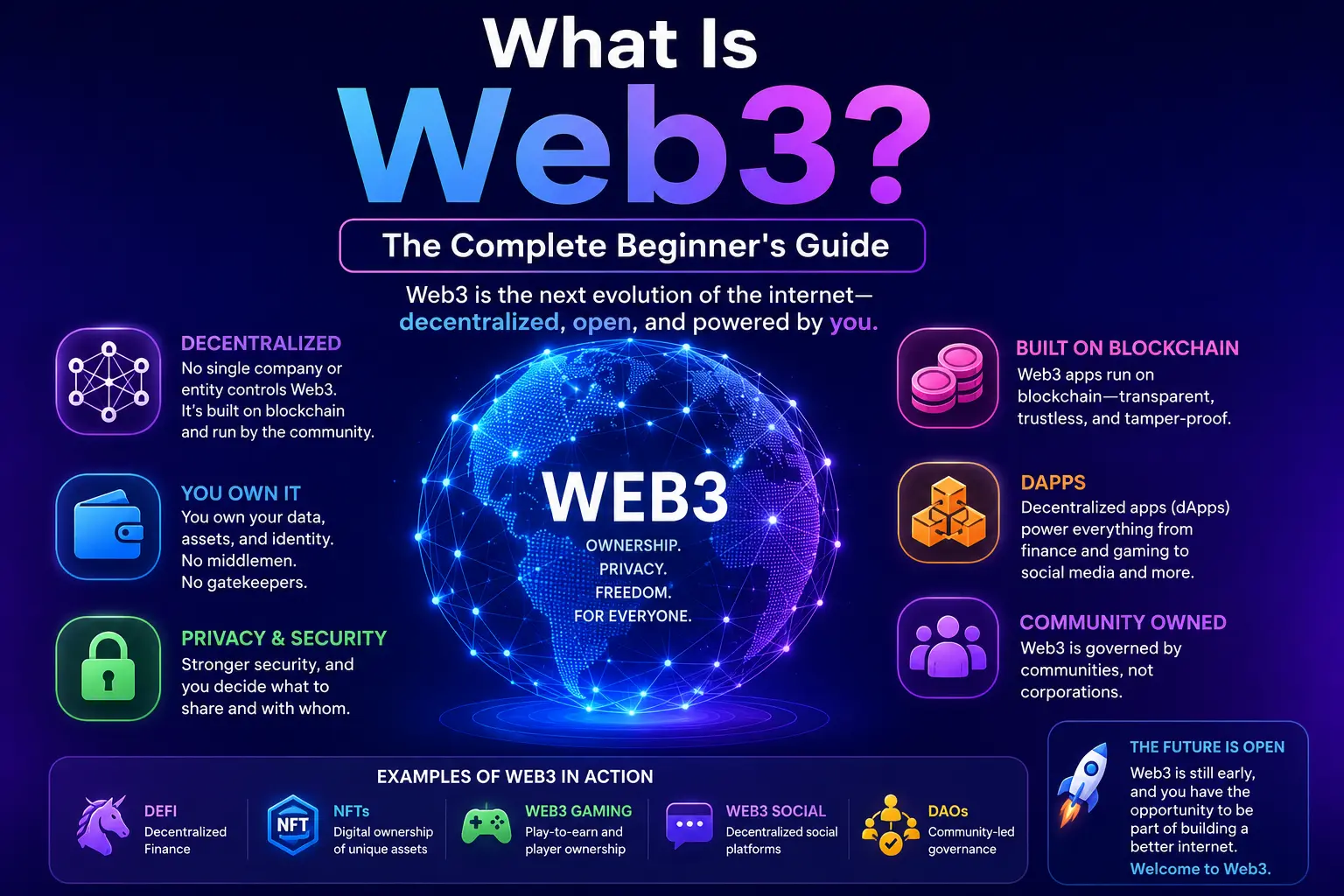
If you've heard terms like blockchain, cryptocurrency, NFTs, decentralized applications, or decentralized social networks, you've already encountered pieces of the Web3 ecosystem. However, many people still wonder: What exactly is Web3, and why is it generating so much attention?
This comprehensive guide explains everything beginners need to know about Web3, how it differs from previous generations of the internet, and why many experts believe it could shape the future of digital interaction.
Understanding the Evolution of the Internet
To understand Web3, it helps to look at the internet's history.
Web1: The Read-Only Internet
The first generation of the internet, often called Web1, existed roughly between 1990 and 2004.
During this era:
- Websites were mostly static
- Users primarily consumed information
- Interactivity was limited
- Content creation required technical skills
Examples included:
- Personal websites
- Online directories
- Early news portals
- Basic company websites
Users could read information but rarely contribute content themselves.
Web2: The Read-Write Internet
The next phase became known as Web2.
This era introduced:
- Social media
- User-generated content
- Mobile applications
- Cloud computing
- Interactive websites
Popular Web2 platforms include:
- YouTube
- X
- TikTok
Web2 transformed users from passive consumers into active creators. Anyone could publish content, build communities, and communicate globally.
However, Web2 also created new challenges:
- Centralized control
- Data privacy concerns
- Platform censorship
- Revenue concentration
- Limited ownership of digital content
These challenges helped inspire the development of Web3.
What Is Web3?
Web3 refers to a decentralized version of the internet built on blockchain technology.
Rather than relying on centralized companies to control platforms, data, and digital assets, Web3 enables users to own and manage their digital identities, content, and assets directly.
Key principles of Web3 include:
Decentralization
Instead of a single company controlling a platform, control is distributed across networks of participants.
Ownership
Users can truly own digital assets through blockchain-based tokens and wallets.
Transparency
Blockchain transactions are publicly verifiable.
Permissionless Access
Anyone with an internet connection can participate without requiring approval from a central authority.
Community Governance
Many Web3 projects allow users to participate in decision-making processes.
How Blockchain Powers Web3
Blockchain technology serves as the foundation of Web3.
A blockchain is a distributed digital ledger that records transactions across many computers.
Each block contains:
- Transaction data
- Timestamp information
- Cryptographic references
- Network validation records
Because records are distributed across thousands of computers, they become extremely difficult to alter.
Benefits include:
Security
Cryptographic verification helps protect network integrity.
Transparency
Transactions can often be publicly verified.
Reliability
No single server controls the entire network.
Trust Reduction
Participants can transact without needing intermediaries.
Popular blockchains include:
- Bitcoin
- Ethereum
- Solana
- Avalanche
- Polygon
- Base
- BNB Chain
Digital Wallets: Your Web3 Identity
Unlike traditional internet accounts that rely on usernames and passwords stored by companies, Web3 uses digital wallets.
A digital wallet allows users to:
- Store cryptocurrencies
- Hold NFTs
- Access decentralized applications
- Verify ownership
- Participate in governance
Popular wallet solutions include:
- MetaMask
- Phantom
- Coinbase Wallet
- Trust Wallet
- Rabby
Your wallet effectively becomes your identity within the Web3 ecosystem.
What Are Cryptocurrencies?
Cryptocurrencies are digital assets secured by blockchain technology.
Examples include:
Bitcoin (BTC)
The first cryptocurrency and often considered digital gold.
Ethereum (ETH)
Powers smart contracts and decentralized applications.
Stablecoins
Designed to maintain stable values relative to traditional currencies.
Examples include:
- USDC
- USDT
- DAI
Utility Tokens
Provide access to specific platforms and ecosystems.
Cryptocurrencies enable peer-to-peer transactions without requiring traditional banking intermediaries.
Understanding Smart Contracts
One of the most important innovations in Web3 is the smart contract.
A smart contract is a self-executing program stored on a blockchain.
These contracts automatically execute actions when predefined conditions are met.
Examples include:
- Token transfers
- NFT purchases
- Lending protocols
- Gaming rewards
- Governance voting
Benefits include:
Automation
Processes occur automatically.
Transparency
Rules are visible to participants.
Reduced Costs
Fewer intermediaries are required.
Increased Efficiency
Transactions can occur quickly and globally.
What Are Decentralized Applications (dApps)?
Decentralized applications, or dApps, operate using blockchain infrastructure rather than centralized servers.
Examples include:
Decentralized Finance (DeFi)
Financial services without traditional banks.
Examples:
- Decentralized exchanges
- Lending platforms
- Yield protocols
Blockchain Games
Games that allow ownership of in-game assets.
NFT Marketplaces
Platforms for buying and selling digital collectibles.
Social Platforms
Social networks that prioritize user ownership and creator rewards.
Unlike traditional platforms, dApps often allow users greater control over their data and assets.
NFTs and Digital Ownership
NFT stands for Non-Fungible Token.
NFTs represent unique digital assets recorded on a blockchain.
They can include:
- Artwork
- Music
- Collectibles
- Event tickets
- Virtual land
- Membership credentials
NFTs introduced verifiable ownership to digital content.
Creators can:
- Sell directly to audiences
- Earn royalties
- Build communities
- Create exclusive experiences
NFT technology continues expanding into gaming, identity systems, and enterprise applications.
Decentralized Autonomous Organizations (DAOs)
DAOs are internet-native organizations governed by community members.
Instead of traditional management structures, participants often vote using governance tokens.
DAOs can manage:
- Investment funds
- Community projects
- Protocol upgrades
- Ecosystem grants
- Shared resources
Benefits include:
Global Participation
Members can contribute from anywhere.
Transparent Governance
Votes are recorded on-chain.
Community Ownership
Stakeholders participate directly.
DAOs represent a new approach to organizational management in the digital age.
Web3 and Social Media
One of the most exciting areas of Web3 development is decentralized social media.
Traditional social platforms often control:
- User data
- Advertising revenue
- Content distribution
- Platform rules
Many creators generate significant value but receive only a fraction of the revenue they help create.
Web3 social platforms aim to address these issues by enabling:
- Creator ownership
- Community governance
- Tokenized rewards
- Data portability
- Direct monetization
Platforms like Xthread provide examples of how decentralized social experiences can empower users while introducing blockchain-powered incentives and community-driven ecosystems.
As Web3 social networks continue growing, users may gain greater control over both their content and their digital identities.
Benefits of Web3
Greater Ownership
Users maintain control over assets and identities.
Reduced Dependence on Intermediaries
Transactions can occur directly between participants.
Increased Transparency
Blockchain records improve accountability.
Global Accessibility
Anyone with internet access can participate.
New Economic Opportunities
Creators, developers, and communities can monetize contributions in innovative ways.
Enhanced Security
Cryptographic systems improve asset protection.
Challenges Facing Web3
Despite its potential, Web3 faces several challenges.
Scalability
Some blockchains struggle with high transaction volumes.
User Experience
Wallets and blockchain interactions can be confusing for beginners.
Regulatory Uncertainty
Governments continue developing frameworks for digital assets.
Security Risks
Users must protect private keys and avoid scams.
Adoption Barriers
Many people remain unfamiliar with blockchain technology.
Addressing these challenges will be essential for mainstream adoption.
Common Misconceptions About Web3
Web3 Is Just Cryptocurrency
Cryptocurrency is only one component of Web3.
The ecosystem also includes:
- Identity systems
- Governance models
- Applications
- Creator economies
- Infrastructure networks
Web3 Replaces the Entire Internet
Web3 is more likely to complement existing systems than completely replace them.
Web3 Is Only for Developers
User-friendly applications continue making Web3 more accessible.
Blockchain Solves Every Problem
Not every application requires decentralization.
Successful projects use blockchain where it adds meaningful value.
Real-World Web3 Use Cases
Finance
Decentralized lending and trading.
Gaming
Player-owned assets and economies.
Social Media
Creator monetization and ownership.
Supply Chain Management
Transparent product tracking.
Digital Identity
User-controlled verification systems.
Content Creation
Direct creator-to-audience relationships.
These use cases continue expanding as infrastructure improves.
The Future of Web3
The next decade may bring significant innovation across:
- Artificial intelligence
- Blockchain technology
- Digital identity
- Creator economies
- Virtual worlds
- Decentralized governance
As these technologies mature, users may gain unprecedented control over their online experiences.
Companies, creators, developers, and communities are actively exploring how decentralized technologies can reshape digital interaction.
Getting Started with Web3
If you're new to Web3, consider these steps:
- Learn blockchain fundamentals.
- Create a secure wallet.
- Explore decentralized applications.
- Understand cryptocurrency basics.
- Follow reputable educational resources.
- Practice safe security habits.
- Join Web3 communities.
Most importantly, focus on learning before investing.
Conclusion
Web3 represents a major evolution of the internet. By leveraging blockchain technology, decentralized networks, and digital ownership, it aims to create a more open, transparent, and user-controlled online environment.
While challenges remain, Web3 has already introduced innovations in finance, gaming, governance, identity, and social media. Platforms such as Xthread demonstrate how creators and communities can benefit from decentralized technologies while participating in emerging digital economies.
Whether you're interested in cryptocurrency, blockchain development, creator monetization, or the future of the internet, understanding Web3 is becoming increasingly important. As adoption grows, the principles of ownership, transparency, and decentralization may play a significant role in shaping the next generation of online experiences.






