
Discover the top Web3 social media platforms in 2027. From Xthread and Farcaster to Lens Protocol and Friend.tech, explore how SocialFi is transforming online engagement, data ownership, and creator monetization.
Introduction: The Web3 Social Media Revolution
The way people connect, share, and earn online is undergoing a seismic transformation. After more than a decade of centralized platforms harvesting user data, controlling content visibility through opaque algorithms, and monetizing attention without sharing profits with creators, a growing wave of decentralized alternatives has stepped in to rewrite the rules.
Welcome to the era of Web3 social media — a paradigm where users own their data, creators earn directly from their content, and communities govern platforms through decentralized autonomous organizations (DAOs). In 2027, Web3 social media platforms are no longer niche experiments. They are growing networks attracting millions of users who are tired of being the product and want to become stakeholders.
The numbers tell a compelling story. The global Web3 market now stands at approximately $10.2 billion in 2026 and is projected to grow at a compound annual growth rate of 38.4%, potentially exceeding $229 billion by 2034. Web3 social platforms now count tens of millions of daily active users worldwide, with the sector expanding rapidly as blockchain infrastructure becomes faster, cheaper, and more user-friendly.
This guide explores the top Web3 social media platforms making waves in 2027, explains the mechanics of SocialFi, and helps you understand which platform is right for your goals — whether you are a creator looking to monetize content, an investor exploring the SocialFi space, or simply a user who wants more control over your digital identity.
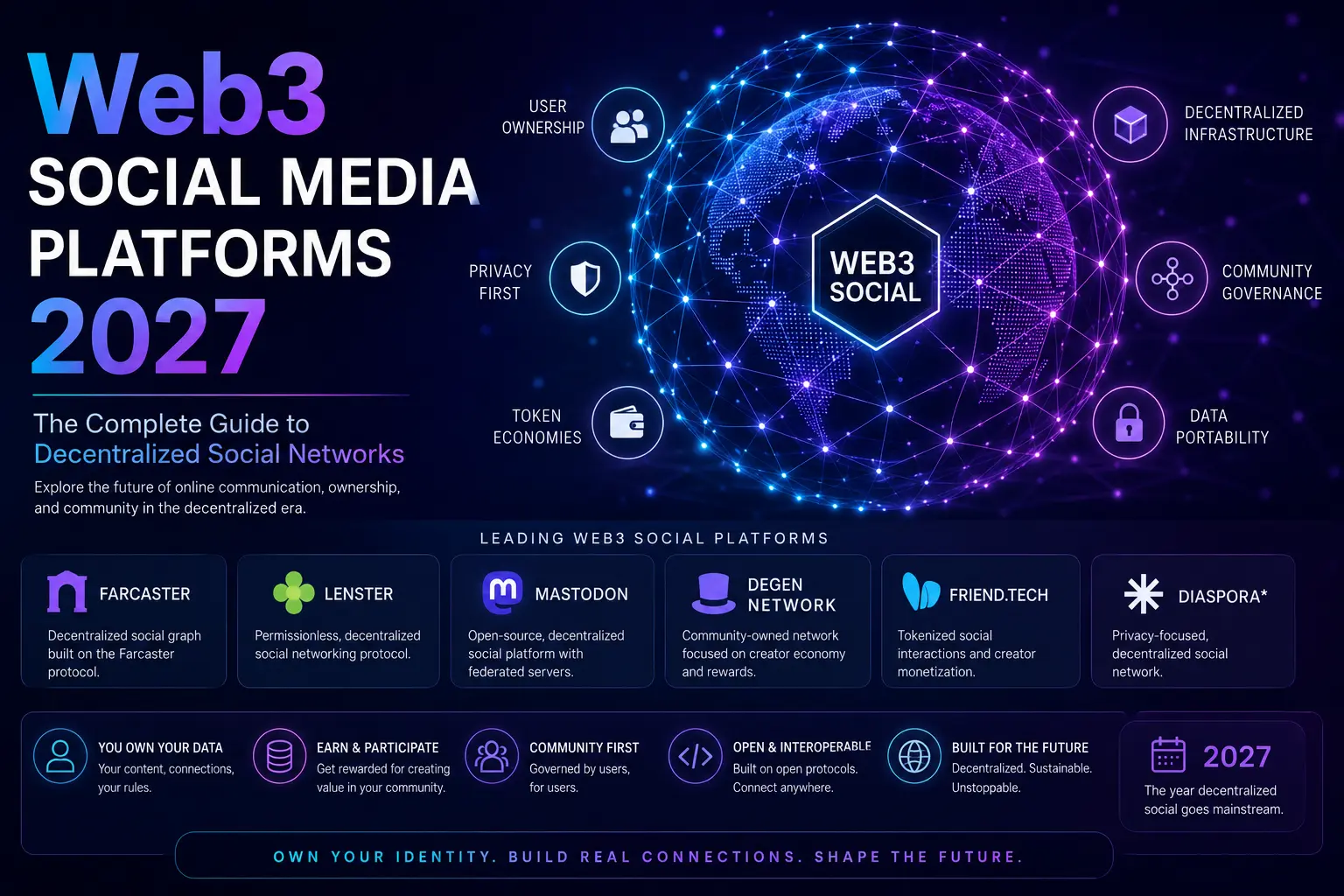
What Are Web3 Social Media Platforms?
Traditional social media — think Facebook, Instagram, X (formerly Twitter), and TikTok — operates on a centralized model. A single corporation owns the servers, controls the algorithms, owns your data, and decides how your content is distributed (and monetized). Users generate billions in value for these corporations in exchange for a "free" service.
Web3 social media platforms flip this model completely. Built on blockchain technology, these platforms operate on decentralized networks of computers — or "nodes" — rather than on corporate-owned servers. The key difference is simple but profound: no single entity controls the platform.
A Web3 social media platform combines advanced technology with principles of fairness, privacy, and user control to create a more transparent and equitable online experience. Here is how it works at a foundational level:
Decentralization: Data is stored across distributed networks, eliminating single points of failure, censorship, and data exploitation. Control and ownership are spread among users rather than concentrated in the hands of a single company.
Blockchain-Backed Identity: Users own their digital identities through cryptographic wallets and on-chain profiles. Unlike Web2 platforms where your account can be deleted at any time, your Web3 identity belongs to you.
Tokenized Incentives: Web3 platforms have native cryptocurrencies or tokens that reward users for their contributions — posting, engaging, creating content, curating, or referring new users. These tokens hold real monetary value.
Smart Contracts: Self-executing code automates trust, transactions, and governance without requiring intermediaries.
Decentralized Governance: Through DAOs, users vote on platform decisions, upgrades, and policies. This ensures the community has a real voice in how the platform evolves.
Interoperability: Web3 social profiles are often portable across applications. You can take your followers, content, and reputation to a different app built on the same protocol — something impossible on Web2 platforms.
Why Web3 Social Media Is Winning in 2027
The timing could not be more perfect. Several macro trends are driving explosive growth in Web3 social media adoption as we move through 2027:
The Creator Economy Explosion: With over 5.24 billion people using social media worldwide, the creator economy has become a multi-trillion-dollar force. But on centralized platforms, only a tiny fraction of creators earn meaningful income. Web3 platforms change this by enabling direct monetization through token rewards, tipping, NFT sales, and staking — without intermediaries taking a significant cut.
Growing Distrust of Big Tech: Years of data scandals, arbitrary account bans, and opaque algorithmic changes have eroded user trust in centralized platforms. A growing segment of users is actively seeking alternatives that respect privacy and offer censorship resistance.
Maturing Blockchain Infrastructure: Layer 2 scaling solutions on Ethereum — such as Optimism and Base — now process transactions worth over $10 billion per month while dramatically reducing gas fees. This makes micro-transactions practical, enabling reward systems that were previously economically unviable.
Regulatory Pressure on Web2: Governments worldwide are tightening regulations around data privacy, content moderation, and algorithm transparency. This regulatory environment creates both challenges for Web2 giants and opportunities for transparent, decentralized alternatives.
AI Integration: The convergence of artificial intelligence and Web3 is increasing the productivity of decentralized applications by approximately 30%, making platforms smarter, more personalized, and more efficient — without sacrificing user privacy.
By 2027, analysts project that 25% of businesses will incorporate services built around decentralized Web3 applications. The momentum is undeniable.
Key Features of Web3 Social Media Platforms
Before diving into specific platforms, it is worth understanding the features that define the best Web3 social media experiences in 2027:
True Data Ownership: Users control their data, decide who can access it, and can move it across platforms. The risk of unauthorized data sales or exploitation is fundamentally reduced.
Content Monetization: Creators earn directly from their audience through token rewards, tipping systems, paid subscriptions, NFT-based content, and staking mechanisms — without platform algorithms deciding their income.
Censorship Resistance: Decentralized platforms make arbitrary content removal significantly more difficult. Community-governed moderation ensures that no single entity can silence voices based on corporate or political interests.
Privacy Enhancement: Cryptographic techniques including zero-knowledge proofs and end-to-end encryption protect user data from unauthorized access. Users have far stronger privacy guarantees than on centralized platforms.
Portability: On protocol-based platforms, a user's social graph — followers, content, reputation — is portable. If you switch from one app to another built on the same protocol, you keep everything.
Transparent Governance: Platform decisions are made openly through DAO voting, smart contract-enforced rules, and on-chain governance proposals. Users can see exactly how decisions are made and participate in them.
Token Utility: Native tokens serve multiple functions: rewarding engagement, enabling governance votes, accessing premium features, staking for yield, and tipping other users.
Top Web3 Social Media Platforms in 2027
1. Xthread (xthread.net) — The SocialFi Platform Rewarding Every Post
Blockchain: Web3 / SocialFi Native Token: $XON (X Open Network) + $USDC Best For: Everyday social media users wanting to earn crypto rewards for their content
Xthread is one of the most accessible and user-friendly Web3 social media platforms available in 2027. Designed to bridge the gap between mainstream social media habits and the powerful financial incentives of blockchain technology, Xthread has positioned itself as a platform where every post, like, and comment generates real monetary value for users.
At its core, Xthread is a Web3 SocialFi (Social Finance) platform where users share content and earn cryptocurrency rewards denominated in $XON and $USDC. The $XON token is the native currency of the X Open Network ecosystem — the underlying infrastructure supporting Xthread and its related tools, apps, and services. Critically, the inclusion of $USDC (a stablecoin pegged to the US dollar) means that at least part of user earnings is protected from crypto market volatility, making the earning model more attractive to users who want predictable, real-world value from their activity.
The platform's tokenomics are designed to incentivize early adoption and sustained engagement. Users earn $XON rewards for completing social actions: posting content, sharing threads, engaging with other users, and referring new members to the network. The point-to-token conversion system is straightforward — users accumulate points through engagement, which are then converted into $XON tokens. Top earners on leaderboards receive additional bonus rewards, creating a competitive dimension that drives quality content creation.
Beyond earning from posting, Xthread integrates staking functionality, allowing users to stake their $XON tokens and earn passive income. This transforms the platform from a simple social network into a comprehensive financial tool for the everyday creator economy participant. The combination of active earning (posting and engaging) and passive earning (staking) gives users multiple streams of income from a single platform.
What makes Xthread particularly compelling in 2027 is its focus on accessibility. Unlike some Web3 platforms that require deep technical knowledge to navigate wallets, gas fees, and protocol layers, Xthread has prioritized a user experience that feels familiar to anyone accustomed to traditional social media, while delivering the financial empowerment of decentralized finance underneath.
The X Open Network ecosystem supporting Xthread also allows the native token ($XON) to be used for tipping other users, accessing premium features, and participating in platform governance — creating a self-sustaining economy where user activity directly drives platform value.
For creators, marketers, and everyday users looking to enter the Web3 economy without needing a PhD in blockchain technology, Xthread represents one of the most promising on-ramps in 2027.
Key Highlights:
- Earn $XON and $USDC for every post, like, and comment
- Staking functionality for passive income on earned tokens
- Accessible SocialFi model with a familiar social media interface
- Referral rewards for growing the network
- Leaderboard bonuses for top community contributors
- Built on the X Open Network protocol
👉 Start earning at xthread.net
2. Farcaster — The Builder's Social Network
Blockchain: Optimism (Ethereum L2) Native Token: Governance participation User Base: ~1.2 million active users (2026) Best For: Web3 developers, crypto-native communities, DAOs
Farcaster has emerged as the definitive Web3 social media platform for the crypto-native professional class. Built by former Coinbase executives, Farcaster prioritizes speed, usability, and developer experience — making it feel less like an experimental decentralized platform and more like a production-ready social network.
The platform's "channels" model organizes conversations into focused communities — /founders for startup discussions, /dev for technical builds, /design for Web3 creative professionals — creating signal-focused spaces rather than algorithmically chaotic feeds. Running on Optimism's Layer 2 Ethereum infrastructure, Farcaster handles transactions efficiently with minimal gas costs.
What sets Farcaster apart from competitors is its protocol-first architecture. The platform is built as an open protocol, meaning third-party developers can build entirely new applications using the same social graph. This means your Farcaster identity, followers, and content history are portable across all apps built on the protocol — a fundamental advantage over Web2 platforms where each app controls your data.
With approximately 1.2 million active users as of 2026, Farcaster's community is smaller than mainstream platforms but consists of high-value, highly engaged crypto-native users — founders, investors, developers, and community builders who are shaping the Web3 economy.
3. Lens Protocol — The Social Infrastructure Layer
Blockchain: Polygon Profile Count: ~600,000 profiles minted (2026) Best For: Developers building Web3 social apps, power users wanting maximum portability
Lens Protocol is not a single platform but rather the infrastructure layer enabling dozens of Web3 social media applications simultaneously. Think of it as the social graph that multiple interfaces plug into — similar to how email works across Gmail, Outlook, and Apple Mail using the same underlying protocol.
Your Lens profile is an NFT you truly own. It contains your followers, your content, and your social reputation — and you can take all of it to any application built on Lens. This represents a radical departure from the Web2 model, where Instagram owns your Instagram followers and LinkedIn owns your LinkedIn connections.
The composability of Lens means that a single identity can power diverse use cases: social networking, content publishing, NFT communities, and DAO governance — all from a single portable social graph. For Web3 marketers and creators, building once on Lens means reaching users across multiple applications without managing separate presences everywhere.
4. Friend.tech — The Social Trading Platform
Blockchain: Base (Ethereum L2) User Base: ~800,000 users (2026) Best For: Creators with strong personal brands, social traders
Friend.tech revolutionized the SocialFi category by making social connections tradable financial assets. The platform enables creators to tokenize access to their private communities, creating markets where access prices fluctuate based on demand through bonding curve mechanics.
The concept is simple and powerful: creators issue "keys" that followers purchase to access exclusive group chats. As demand for access to a popular creator's community increases, key prices rise — rewarding early supporters and creating a speculative market around social influence. This model has inspired dozens of competitors but Friend.tech remains the category originator with the most developed ecosystem.
5. Audius — The Decentralized Music and Audio Platform
Blockchain: Ethereum with Solana integration Native Token: $AUDIO Best For: Independent musicians, podcasters, and audio content creators
Audius gives artists full control over their music and the revenue it generates. Its blockchain-backed infrastructure allows musicians to share tracks, build audiences, and receive payments directly — without record labels or streaming platform intermediaries taking the majority of earnings.
Fans support artists through $AUDIO tokens, gain access to exclusive drops, and engage with unique content. Audius has become a hub for independent artists and podcast creators who want full creative and financial autonomy, offering a powerful alternative to streaming platforms that pay fractions of a cent per stream.
6. Mirror.xyz — The Web3 Publishing Platform
Blockchain: Ethereum Best For: Writers, journalists, DAOs, long-form content creators
Mirror reimagines content publishing for the Web3 era. Writers can publish long-form content, tokenize individual articles as NFTs, and even crowdfund future pieces directly from their audience. DAOs and Web3 organizations use Mirror extensively to publish announcements, governance proposals, and thought leadership content.
Unlike most Web3 social platforms optimized for short-form engagement, Mirror shines for writers and storytellers who want ownership over their published work. By turning articles into digital collectibles, Mirror creates an entirely new economic model for content — one where quality writing can generate ongoing royalties rather than a one-time engagement spike.
7. Steemit / Hive — The OG Blockchain Social Networks
Blockchain: Steem / Hive Best For: Long-form bloggers, crypto OGs, community-oriented writers
Steemit holds the distinction of being one of the first Web3 social platforms to reward users with tokens for creating and curating content. Launched before most people had heard of blockchain social media, it pioneered the "earn for content" model that platforms like Xthread have since refined and expanded.
Community disagreements led to a fork producing Hive — a more decentralized alternative with a more active development community. Both platforms attract loyal long-term users who value proven token economics and community ownership over polished user interfaces, and both remain active communities in 2027.
8. Diamond App — The Creator Economy Platform on DeSo
Blockchain: DeSo (Decentralized Social) Best For: Creators exploring multiple monetization models simultaneously
Diamond App is built on the DeSo blockchain, a purpose-built Layer 1 blockchain designed specifically for social media scalability. The platform offers creators multiple simultaneous revenue streams: creator coins (social tokens tied to individual creators), NFT-based posts, diamond tipping (a unique engagement-based reward system), and subscription models.
Diamond attracts creators who want to experiment with bleeding-edge monetization formats and are comfortable operating in a smaller but highly engaged Web3-native community.
9. Mastodon — The Federated Social Network
Protocol: ActivityPub (federated, not blockchain-native) Best For: Privacy-conscious users, community moderators, decentralization advocates
While technically predating the Web3 movement, Mastodon aligns closely with decentralization principles and has attracted a significant audience of users seeking alternatives to corporate social media. Rather than blockchain, Mastodon uses a federated model where communities run their own independent servers that communicate with each other.
Mastodon does not feature token economies or crypto rewards, but it offers powerful community control, privacy, and freedom from corporate algorithms — qualities that resonate strongly with the broader Web3 audience. With a mature ecosystem and customizable community environments, it remains one of the most established alternatives to centralized social media in 2027.
10. Bluesky — The Accessible Decentralization Gateway
Protocol: AT Protocol Best For: Web2 users transitioning to decentralized social media
Bluesky began as a Twitter offshoot but evolved into one of the most user-friendly entry points into the decentralized social space. In 2027, it continues to attract users migrating from mainstream platforms, particularly those who want the familiar experience of microblogging without the corporate control and algorithm manipulation of traditional platforms.
While not deeply tokenized compared to SocialFi-focused platforms like Xthread or Friend.tech, Bluesky's focus on federation, open moderation, and independence from platform gatekeepers makes it a strong contender for Web3 community discussions and an excellent starting point for users new to decentralized social networks.
What Is SocialFi? The Convergence of Social Media and DeFi {#what-is-socialfi}
SocialFi — Social Finance — is arguably the most exciting development in the Web3 social media space. It represents the convergence of social media features with the economic mechanisms of decentralized finance (DeFi), creating platforms where social interactions have direct, tangible financial value.
To understand SocialFi, consider the evolution of the web:
- Web1: Read-only. Users consumed content created by a small number of publishers.
- Web2: Read-Write. Users could create and share content, but platforms owned the data and monetized it.
- Web3: Read-Write-Own. Users can create, share, and genuinely own their content, data, and financial value derived from their activity.
SocialFi takes this "Own" principle to its logical conclusion. It is not just about owning risky Web3 tokens — it means owning your data, your social graph, and having the tools to monetize it for your own benefit.
At the core of SocialFi are several interconnected mechanisms:
Social Tokens: Platforms issue native tokens that reward users for their engagement, content creation, and community contributions. These tokens carry real monetary value and can be traded, staked, or used within the ecosystem. On platforms like Xthread, users earn $XON tokens simply for posting and engaging — the most fundamental social actions.
Creator Coins: Some SocialFi platforms allow individual creators to issue their own personal tokens. The value of these tokens is tied directly to the creator's social influence and brand equity, creating personal micro-economies around influential voices.
Token-Gated Communities: Creators can monetize exclusive content by requiring token ownership to access premium spaces, content drops, or private communities.
Staking for Passive Income: Users who accumulate platform tokens can stake them to earn passive yield — transforming social media participation into a genuine investment activity.
NFT-Based Content: Content itself can be minted as NFTs, giving creators provable ownership of their work and enabling secondary market royalties.
Governance Tokens: Holding platform tokens grants voting rights in DAOs that govern platform decisions, ensuring users have a real voice in shaping the platforms they use.
The SocialFi model creates powerful alignment between users and platforms. Instead of platforms extracting value from user attention to sell to advertisers, SocialFi platforms distribute value directly to the users who create it. This is the fundamental economic shift that platforms like Xthread embody.
How to Earn Crypto on Web3 Social Media Platforms {#how-to-earn}
One of the most compelling aspects of Web3 social media in 2027 is the diversity of earning opportunities available to regular users — not just professional creators or technical blockchain experts. Here are the primary earning mechanisms:
Post-to-Earn: The most fundamental model, pioneered and refined by platforms like Xthread and Steemit. Users earn token rewards for creating posts, with reward amounts often influenced by engagement metrics like likes, comments, and shares. On Xthread, every post rewards users with $XON and $USDC.
Engage-to-Earn: Users earn rewards not just for creating content but for meaningfully engaging with it — liking, commenting, sharing, and curating quality content for the community. This incentivizes positive community behavior and rewards active participation.
Stake-to-Earn: Accumulated tokens can be staked in smart contracts to earn passive yield. Xthread users can stake their earned $XON tokens to receive a percentage return, creating a passive income stream that grows with the size of their token holdings.
Refer-to-Earn: Most Web3 social platforms offer referral rewards for bringing new users to the network. Since network effects are critical to social platform growth, users who help grow the community are rewarded accordingly.
Curate-to-Earn: On platforms like Hive and Steemit, curators who upvote content that subsequently becomes popular earn a portion of the content rewards, incentivizing the discovery and promotion of quality content.
Creator Coin Appreciation: On platforms supporting creator economies, early supporters who hold creator coins or tokens can benefit financially as the creator's influence grows.
NFT Sales: Creators who mint their content as NFTs can earn from primary sales and ongoing secondary market royalties.
Leaderboard Bonuses: Competitive earning mechanics, like Xthread's leaderboard system that rewards top earners with additional bonus $XON, incentivize consistent high-quality engagement.
Challenges Facing Web3 Social Media in 2027
Despite remarkable progress, Web3 social media platforms still face genuine challenges that the industry is actively working to resolve:
User Experience Friction: Setting up a crypto wallet, managing private keys, understanding gas fees, and navigating decentralized interfaces remains a barrier for mainstream adoption. Platforms like Xthread are directly addressing this by creating interfaces that feel as intuitive as traditional social media while handling blockchain complexity in the background.
Scalability: Although Layer 2 solutions have dramatically improved transaction speeds and costs, some blockchain networks still struggle to handle the transaction volume of mainstream social platforms during peak usage periods. This is an area of active development across the industry.
Token Volatility: Many Web3 social platforms reward users in native tokens whose prices can fluctuate significantly. Platforms like Xthread partially address this by also rewarding users in $USDC — a stablecoin — ensuring that a portion of earnings retains predictable value regardless of market conditions.
Regulatory Uncertainty: The legal treatment of social tokens, earned crypto, and DAO governance structures remains inconsistent across jurisdictions. As governments develop clearer frameworks for digital assets, this uncertainty is expected to decrease — but in 2027 it remains a consideration for both platform developers and users.
Cold Start Problem: Decentralized social platforms need users to be valuable, but users need to see value before joining. Building network effects from zero is more difficult for decentralized platforms that cannot rely on centralized data and targeting to grow rapidly.
Content Moderation: Censorship resistance — a core feature of Web3 social media — also makes content moderation more complex. Developing effective community-governed moderation systems that prevent harmful content without enabling censorship is one of the field's most important ongoing challenges.
Security: While blockchain technology itself is highly secure, the smart contracts, front-end interfaces, and wallet integrations of Web3 social platforms can be vulnerable to exploits if not audited and maintained rigorously.
The Future of Web3 Social Media: 2027 and Beyond
Looking ahead, several powerful trends will shape the continued evolution of Web3 social media:
AI Integration: The convergence of artificial intelligence with Web3 infrastructure is creating smarter, more personalized platform experiences. AI-powered content curation, fraud detection for fake engagement, and automated community moderation are already being implemented — all while preserving user privacy through on-chain identity systems.
Cross-Platform Interoperability: As more platforms build on shared protocols like Lens and Farcaster, a truly interoperable Web3 social ecosystem is emerging. Users will increasingly be able to move their social graphs, content histories, and reputations seamlessly across applications — fundamentally changing how network effects work.
Real-World Asset Tokenization: The principles of social tokenization are expanding to encompass real-world assets. By 2027, social platforms are beginning to integrate tokenized real-world assets into their economies, opening new investment opportunities for community members.
Web3 Gaming Integration: As Web3 gaming is anticipated to become a profitable market above $65 billion by 2027, social platforms are increasingly integrating gaming mechanics, in-game asset trading, and play-to-earn features to create richer, more engaging experiences.
DAO Maturation: With over 12,000 DAOs holding more than $25 billion in treasury assets, decentralized governance is maturing rapidly. Web3 social platforms governed by DAOs are becoming more sophisticated in their decision-making, more resistant to hostile takeovers, and more capable of delivering consistent user value.
SocialFi Mainstream Adoption: As blockchain infrastructure continues to improve and user interfaces become more accessible, SocialFi platforms are steadily crossing the threshold from crypto-native niche to mainstream adoption. The model of earning crypto rewards for social engagement — demonstrated by platforms like Xthread — is increasingly being recognized not as a gimmick but as a fundamentally superior model for creator monetization.
Regulatory Clarity: Governments worldwide are developing more comprehensive and nuanced regulatory frameworks for digital assets. As this clarity emerges, institutional investment in Web3 social media is expected to accelerate significantly, bringing further legitimacy and capital to the sector.
The Web3 economy is set to contribute $1.1 trillion toward global GDP by 2032. A significant portion of this value will flow through social platforms that reward user participation — making the decisions you make today about which platforms to join and which tokens to earn potentially consequential over the long term.
How to Choose the Right Web3 Social Media Platform {#how-to-choose}
With so many options available, selecting the right Web3 social media platform in 2027 depends on your specific goals, technical comfort level, and what you want to get out of the experience. Here is a practical framework:
If you want to earn crypto rewards for everyday social activity: Xthread (xthread.net) is your best starting point. Its combination of $XON and $USDC rewards, accessible interface, staking functionality, and low barrier to entry makes it ideal for users who want to start earning from their social media activity immediately without deep technical knowledge.
If you are a developer or crypto-native professional: Farcaster offers the most sophisticated ecosystem for builders, with its protocol-first architecture, developer tooling, and high-signal community of Web3 professionals and founders.
If you are building a Web3 brand or project: Lens Protocol gives you the infrastructure for maximum reach and portability, with a single social identity accessible across dozens of applications built on the protocol.
If you are a musician or audio creator: Audius is built specifically for you, offering direct fan monetization, $AUDIO token rewards, and a community of independent artists who have rejected the exploitative economics of mainstream streaming platforms.
If you are a long-form writer or publisher: Mirror.xyz gives you NFT-based content ownership and crowdfunding mechanisms that no Web2 publishing platform can match.
If you are new to decentralized social media and want a gentle introduction: Bluesky offers a familiar microblogging experience with federation and independence from corporate control, without requiring immediate deep engagement with tokens or wallets.
If you want proven token economics with a long track record: Hive (the more active fork of Steemit) has been rewarding bloggers and long-form content creators with crypto tokens since 2016 — longer than almost any other platform in this space.
The best strategy for most users in 2027 is to maintain a presence on multiple platforms, starting with those that align with your primary content type and earning goals, then expanding as you grow more comfortable with the Web3 ecosystem.
Conclusion
Web3 social media platforms are not the future — they are the present. In 2027, platforms like Xthread, Farcaster, Lens Protocol, Friend.tech, Audius, and Mirror.xyz are demonstrating daily that the decentralized model is not just ideologically superior but practically functional for millions of users around the world.
The fundamental proposition is simple and powerful: instead of working for free to build the market capitalization of centralized corporations, Web3 social media users earn real monetary value from their engagement, own their data and content, and participate in governing the platforms they use.
Xthread exemplifies this shift at its most accessible. By rewarding users with $XON and $USDC tokens for every post, enabling staking for passive income, and maintaining a user experience that does not require a blockchain engineering degree to navigate, Xthread is helping bring the Web3 creator economy to the mainstream — one post at a time.
Whether you are a content creator tired of algorithm-driven demonetization, a crypto enthusiast looking to combine your social media habits with your investment strategy, or simply a curious user who wants more control over your digital life, the Web3 social media landscape of 2027 has a platform built for you.
The internet's next chapter has already begun. The only question is which platform you will build it on.
Ready to start earning from your social media activity? 👉 Join Xthread today at xthread.net and start earning $XON and $USDC for every post you share.
Frequently Asked Questions
What is a Web3 social media platform? A Web3 social media platform is a decentralized social network built on blockchain technology where users own their data, content, and digital identities. Unlike traditional platforms, Web3 social media uses token-based incentives to reward user participation and employs DAO-based governance to give users a voice in platform decisions.
How do I earn money on Web3 social media platforms? You can earn crypto on Web3 social platforms through posting content (post-to-earn), engaging with other users (engage-to-earn), staking tokens (stake-to-earn), referring new users (refer-to-earn), and curating quality content. Platforms like Xthread reward users with $XON and $USDC tokens for every post they publish.
What is SocialFi? SocialFi combines social media features with decentralized finance (DeFi) mechanisms. SocialFi platforms use blockchain technology, smart contracts, and tokenized incentive systems to give users control over their data, content, and monetization — creating a model where users capture a fair share of the value they generate rather than surrendering it to a centralized platform.
Is Xthread a legitimate Web3 platform? Yes. Xthread (xthread.net) is a legitimate Web3 SocialFi platform that rewards users with $XON and $USDC tokens for their social media activity. It is part of the X Open Network ecosystem and includes staking functionality for passive income on earned tokens.
What is the difference between Web2 and Web3 social media? Web2 social media (Facebook, Instagram, X/Twitter) is controlled by centralized corporations that own your data, govern your content visibility, and monetize your attention. Web3 social media is decentralized, user-owned, and rewards participants with tokens for their contributions — giving users data ownership, censorship resistance, and direct monetization opportunities.
Which Web3 social media platform is best for beginners? For beginners wanting to earn crypto from social media activity, Xthread (xthread.net) is one of the most accessible options, thanks to its familiar interface and dual reward system ($XON + $USDC). Bluesky is also excellent for users who want to start with decentralized social networking without immediately engaging with token economics.






