
Blockchain technology has become one of the most important innovations of the digital age. It powers cryptocurrencies like Bitcoin and Ethereum, enables decentralized finance, supports NFTs, and serves as the foundation for the growing Web3 ecosystem.
Despite its popularity, many people still find blockchain confusing. Technical jargon, complex diagrams, and cryptocurrency discussions often make blockchain seem difficult to understand.
The reality is much simpler.
This guide explains blockchain technology in plain language, helping beginners understand how it works, why it matters, and how it is transforming industries around the world.
What Is Blockchain?
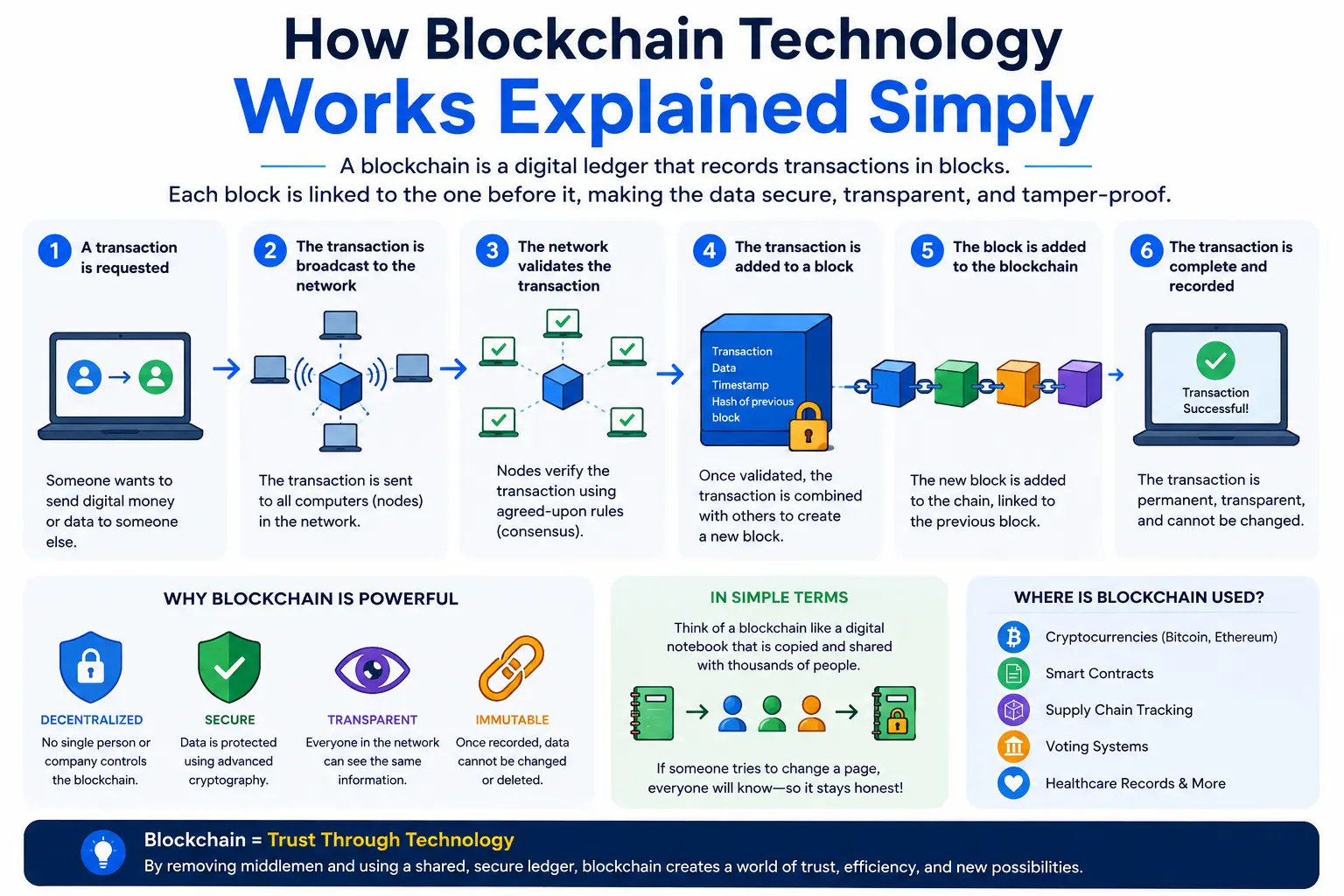
A blockchain is a digital ledger that records information in a secure, transparent, and decentralized way.
Think of it as a giant digital notebook shared among thousands of computers worldwide.
Instead of being stored in one central location, copies of the ledger exist across many computers, known as nodes.
Every time new information is added, all participating computers update their copies of the ledger.
This creates a system that is:
- Transparent
- Secure
- Difficult to manipulate
- Resistant to censorship
Blockchain technology removes the need for a central authority to verify transactions.
Understanding a Traditional Database
Before understanding blockchain, it helps to understand traditional databases.
Most websites today use centralized databases.
For example:
- Banks store account balances on their servers.
- Social media platforms store user data in company-owned databases.
- Online stores manage orders using centralized systems.
In these cases:
- One organization controls the data.
- The organization decides who can access information.
- Users must trust the organization to manage data honestly.
This model has worked for decades but creates several challenges:
- Single points of failure
- Data breaches
- Censorship risks
- Lack of transparency
Blockchain was designed to address these issues.
The Basic Structure of a Blockchain
The name "blockchain" comes from its structure.
It consists of:
Blocks
Containers that hold information.
Chains
Links connecting blocks together.
Each block contains:
- Transaction data
- A timestamp
- A unique cryptographic identifier
- A reference to the previous block
Because each block references the one before it, they form a chain.
If someone attempts to alter a block, the entire chain becomes invalid, making tampering extremely difficult.
How a Blockchain Transaction Works
Let's walk through a simple example.
Imagine Alice wants to send cryptocurrency to Bob.
Step 1: Transaction Creation
Alice creates a transaction request.
The request includes:
- Sender address
- Receiver address
- Amount being transferred
Step 2: Network Broadcast
The transaction is sent to the blockchain network.
Thousands of computers receive the request.
Step 3: Verification
Network participants verify:
- Alice owns the funds.
- The transaction follows network rules.
- Alice has not already spent the same funds.
Step 4: Block Creation
Verified transactions are grouped together into a new block.
Step 5: Consensus
The network agrees that the block is valid.
Step 6: Permanent Recording
The block is added to the blockchain.
The transaction becomes part of the permanent record.
Bob receives the funds.
This entire process can happen within seconds or minutes depending on the blockchain.
Why Blockchain Is Considered Secure
Security is one of blockchain's biggest advantages.
Several technologies work together to protect blockchain networks.
Cryptography
Blockchain relies heavily on cryptographic algorithms.
These algorithms help:
- Protect user accounts
- Verify ownership
- Secure transactions
Without proper cryptographic credentials, unauthorized users cannot access assets.
Distributed Storage
Instead of one server storing data, thousands of computers maintain copies of the blockchain.
This makes attacks significantly more difficult.
Immutable Records
Once data is recorded, altering it becomes extremely challenging.
Changing one block would require changing all subsequent blocks and convincing most network participants to accept the changes.
Consensus Mechanisms
Network participants collectively agree on valid transactions.
This reduces the risk of fraudulent activity.
What Is Decentralization?
Decentralization is one of blockchain's most important concepts.
Traditional systems are centralized.
For example:
A bank controls:
- Accounts
- Payments
- Transaction records
Blockchain distributes these responsibilities across the network.
Benefits include:
Reduced Dependence on Single Organizations
No single entity controls the system.
Greater Resilience
Networks remain operational even if some computers fail.
Improved Transparency
Records are publicly verifiable on many blockchains.
Increased Accessibility
Anyone with internet access can participate.
Decentralization is a major reason blockchain technology is considered revolutionary.
What Are Nodes?
Nodes are computers that participate in a blockchain network.
Their responsibilities may include:
- Storing blockchain data
- Validating transactions
- Relaying information
- Maintaining network security
Different blockchain networks have different node structures.
Thousands of nodes working together create the decentralized foundation of blockchain.
What Is Consensus?
Consensus refers to how a blockchain network agrees on valid transactions.
Because there is no central authority, the network must determine which transactions are legitimate.
Several methods are used.
Proof of Work (PoW)
Used by Bitcoin.
Participants known as miners solve complex mathematical problems.
The first participant to solve the problem earns the right to add a new block.
Advantages:
- Highly secure
- Proven reliability
Disadvantages:
- Energy intensive
- Slower scalability
Proof of Stake (PoS)
Used by Ethereum and many modern blockchains.
Participants lock tokens as collateral.
Validators are selected to verify transactions.
Advantages:
- Energy efficient
- Faster processing
Disadvantages:
- Different security tradeoffs
Both systems help blockchain networks achieve consensus without centralized control.
What Is Mining?
Mining is the process used in Proof of Work blockchains.
Miners:
- Verify transactions
- Compete to solve cryptographic puzzles
- Add new blocks
- Earn rewards
Bitcoin mining introduced the concept of decentralized transaction validation.
Mining also helps secure the network against attacks.
What Are Smart Contracts?
Smart contracts are programs stored on blockchains.
They automatically execute when specific conditions are met.
Think of them as digital agreements that run themselves.
Examples include:
Token Transfers
Automatically send assets when conditions are satisfied.
NFT Sales
Transfer ownership after payment.
Lending Platforms
Manage loans without traditional banks.
Voting Systems
Count votes transparently.
Because smart contracts operate on blockchain networks, they can reduce reliance on intermediaries.
Blockchain and Cryptocurrency
Cryptocurrencies are among blockchain's most famous applications.
Without blockchain technology, cryptocurrencies would not exist.
Examples include:
Bitcoin
Created in 2009.
Designed as a decentralized digital currency.
Ethereum
Introduced programmable smart contracts.
Solana
Focused on speed and scalability.
Base
Built to support scalable Web3 applications.
Polygon
Provides efficient blockchain infrastructure.
Cryptocurrencies use blockchain to verify ownership and transfer value securely.
Blockchain Beyond Cryptocurrency
Many people associate blockchain exclusively with cryptocurrency.
However, blockchain has applications far beyond digital money.
Supply Chain Tracking
Companies can monitor products from manufacturing to delivery.
Healthcare Records
Secure and transparent record management.
Digital Identity
User-controlled identity systems.
Voting Systems
Transparent election verification.
Intellectual Property
Proof of ownership for digital content.
Social Media
Creator ownership and decentralized engagement models.
Platforms such as Xthread demonstrate how blockchain can enhance social networking by introducing creator-focused incentives and community-driven ecosystems.
What Makes Blockchain Transparent?
Many blockchains maintain public transaction records.
Anyone can verify:
- Transaction history
- Wallet activity
- Network statistics
This transparency helps increase trust.
Unlike traditional financial systems, blockchain transactions can often be independently verified.
Transparency is one reason blockchain appeals to businesses, developers, and governments.
Common Blockchain Myths
Myth 1: Blockchain and Bitcoin Are the Same Thing
Bitcoin uses blockchain technology.
Blockchain itself is much broader than Bitcoin.
Myth 2: Blockchain Is Completely Anonymous
Most public blockchains are actually pseudonymous.
Wallet addresses are visible, even if identities are not.
Myth 3: Blockchain Cannot Be Hacked
While blockchain networks are highly secure, applications, wallets, and smart contracts can still contain vulnerabilities.
Myth 4: Blockchain Is Only Useful for Finance
Blockchain supports many industries beyond financial services.
Challenges Facing Blockchain Technology
Despite its advantages, blockchain faces obstacles.
Scalability
Some networks struggle with high transaction volumes.
User Experience
Wallet management can be difficult for beginners.
Regulation
Legal frameworks continue evolving worldwide.
Security Education
Users must understand how to protect private keys.
Adoption
Mainstream users still face learning curves.
The industry continues developing solutions to address these challenges.
How Blockchain Supports Web3
Web3 aims to create a more decentralized internet.
Blockchain provides the infrastructure necessary for:
- Digital ownership
- Decentralized applications
- Community governance
- Creator economies
- Digital identities
Without blockchain technology, Web3 would not be possible.
As adoption increases, blockchain will likely play a central role in the future internet.
Blockchain and Content Creators
One of the most exciting opportunities involves creator economies.
Traditional social platforms often control:
- Revenue distribution
- Audience access
- Platform rules
Blockchain introduces alternatives.
Benefits may include:
Direct Monetization
Creators can receive rewards directly from communities.
Ownership
Creators retain greater control over digital assets.
Transparency
Payments can be verified publicly.
Community Participation
Audiences can engage through tokenized ecosystems.
Web3 social platforms such as Xthread explore these possibilities by combining social networking with blockchain-powered incentives.
The Future of Blockchain Technology
Blockchain continues evolving rapidly.
Emerging developments include:
Layer 2 Scaling
Improving transaction speed and reducing costs.
Decentralized Identity
User-owned digital credentials.
Enterprise Adoption
Businesses integrating blockchain solutions.
Artificial Intelligence Integration
Combining AI with decentralized infrastructure.
Real-World Asset Tokenization
Representing physical assets digitally.
Global Financial Innovation
Expanding access to financial services worldwide.
Many experts believe blockchain will become as foundational as the internet itself.
How Beginners Can Learn More
If you're interested in blockchain technology:
- Learn blockchain fundamentals.
- Understand cryptocurrency basics.
- Create a digital wallet.
- Explore decentralized applications.
- Follow reputable educational resources.
- Practice security best practices.
- Join Web3 communities.
Focus on education before making financial decisions.
Conclusion
Blockchain technology is much more than the foundation of cryptocurrencies. It is a revolutionary method for storing, verifying, and sharing information without relying on centralized authorities.
By combining cryptography, decentralization, transparency, and consensus mechanisms, blockchain creates secure and trustworthy systems that can power everything from digital money to social networks and global applications.
As Web3 continues growing, blockchain technology will likely become an increasingly important part of everyday digital experiences. Whether you're exploring cryptocurrency, decentralized finance, NFTs, or creator-focused platforms like Xthread, understanding how blockchain works is an essential first step toward understanding the future of the internet.






